

Grow Zone 9 Planting Guide: What to Plant and When
Published On: Sep 9, 2026
Share:
| In this Article | |||
|---|---|---|---|
Gardening in USDA Grow Zone 9 gives you something gardeners in much of the country would love to have: a remarkably long growing season. Winters are mild, spring arrives early, and fall often stretches well past the point where gardeners farther north have put the shovel away. That means more time for planting, more opportunities for flowers, and an enormous selection of trees, shrubs, perennials, and ornamental grasses.
But there is another side to gardening in Zone 9, and it is the side that catches people out.
Summer is the hard season here, not winter. Long stretches of heat, intense afternoon sun, drought in some regions and drenching humidity in others, and warm nights that never let a plant recover — all of it puts real stress on trees, shrubs, and perennials, especially the ones that went into the ground too close to the arrival of summer.
That is why the single most important thing to understand about Zone 9 is that your planting calendar does not look like the spring planting calendar used farther north. Fall is one of your very best planting seasons. Get that part right, choose plants suited to your particular corner of Zone 9, and this is one of the most rewarding places in the country to garden.

What Is USDA Grow Zone 9?
The USDA Plant Hardiness Zone Map is built on one number: a location's average annual extreme minimum winter temperature. Zone 9 covers places where that average low falls between 20°F and 30°F.
If you are not sure which zone you are in, our grow zone lookup tool will tell you from your zip code, and our USDA Plant Hardiness Zone Map page lets you see where you sit relative to your neighbors.
Zone 9a and Zone 9b
Zone 9 splits into two halves:
- Zone 9a: 20°F to 25°F
- Zone 9b: 25°F to 30°F
Those five degrees matter more than they look like they should. A plant that comfortably handles 20°F will perform throughout Zone 9. A more tender plant might be entirely dependable in 9b and take winter damage every few years in 9a. That is why I check the hardiness range on each individual plant rather than assuming that anything labeled "warm climate" will work everywhere in the zone.
Hardiness Is Only Half the Story
Here is the part the map does not tell you. The average annual extreme minimum is an average. Half of your winters will not reach that low, and half of them will go colder. It is a planning number, not a guarantee.
More importantly, hardiness zones describe winter cold and nothing else. They say nothing about summer heat, humidity, rainfall, drought, or the intensity of your sunlight — and in Zone 9, those are the factors that decide whether a plant thrives or merely survives.
Lavender is the cleanest example I know. Phenomenal Lavender is rated well into Zone 9 on cold hardiness, and it will sail through your winter without blinking. Then it sits through a humid Gulf Coast August with wet feet and rots. The zone number was never wrong. It was just answering a different question than the one you were asking.
Where Is Grow Zone 9?
Zone 9 runs across a surprising amount of the country. On the 2023 map it covers most of central and northern Florida, the southern half of Louisiana, a broad band of coastal and south-central Texas, the southern edges of Georgia, Alabama, Mississippi, and South Carolina, plus large parts of coastal and interior California, southern Arizona, and pockets of the Pacific Northwest that surprise people — the Seattle area moved into 9a on the 2023 revision.
That geographic spread is the whole problem with the number.
A Zone 9 landscape outside Orlando deals with tremendous summer humidity, sandy soil, and a rainy season. A Zone 9 garden in Baton Rouge gets the humidity plus heavy clay and the occasional tropical system dumping a foot of water in a day. A Zone 9 garden in Arizona faces extreme heat and almost no rain. A Zone 9 garden in California gets dry summers and mild, wet winters.
They are all Zone 9. They are not remotely the same gardening environment.
That is why your USDA zone should be the start of your plant selection process, not the end of it. Everything in this guide is written from the Gulf South end of Zone 9 — Florida, Louisiana, and the humid Southeast — because that is where the heat-and-humidity combination is hardest on plants and where the standard national advice goes wrong most often.
Where We Ship
Worth saying plainly, because it saves people a wasted afternoon: we do not ship everywhere Zone 9 exists. Our plant shipping policy covers the eastern and central states, which includes Florida, Louisiana, Georgia, Alabama, Mississippi, South Carolina, and Texas — but not California, Arizona, or Oregon, and several states have their own agricultural restrictions on particular plants. Check the policy page before you plan a whole landscape around a plant list. If you garden in the western half of Zone 9, the growing advice here still applies to you; the plant links will not.
The Zone 9 Planting Calendar
One of the real advantages of Zone 9 is flexibility. You do not have to compress a year of gardening into a few frantic months. For trees, shrubs, and hardy perennials, planting can continue through most of the calendar.
But "possible" and "ideal" are not the same word. Here is how I would rank the Zone 9 year:
- Fall: The best time to plant trees, shrubs, and most perennials. Not a consolation prize for missing spring — the actual first choice.
- Winter: An excellent second window for hardy trees and shrubs whenever the ground is workable, which in Zone 9 is most of it.
- Early spring: Still very good, and the last comfortable window before the heat.
- Late spring: Workable, but watering discipline starts to matter a great deal.
- Summer: Possible with container-grown plants, but you are signing up for daily attention.
The logic behind that ranking is simple. Give the plant as much time as possible to build roots before summer arrives.
Why Fall Is Zone 9's Best Planting Season
If you grew up thinking of spring as planting season, Zone 9 is an invitation to rethink the calendar entirely.
As air temperatures moderate in fall, the soil stays warm enough for active root development well into winter. The plant is losing far less moisture through its foliage, and it is no longer trying to do two hard things at once — recover from transplanting and survive extreme heat. It can put its energy into the one thing that matters most in the first year: growing roots.
Those roots keep developing through much of a mild Zone 9 winter. When spring arrives, your tree or shrub is not starting from zero. It already has a working root system and moves straight into growth. Most importantly, it faces its first Zone 9 summer with a foundation underneath it instead of a root ball.
This is not just my opinion. LSU AgCenter makes the same case for the Gulf South: a tree planted in November establishes its root system in native soil before the spring growing season begins. If you want the longer version of the argument, we wrote it up in can I order and plant trees and shrubs in fall and winter?

Early Spring Is the Second-Best Window
Spring is still an excellent planting season in Zone 9. The difference from the national advice is that you do not have to wait for it — and you should not wait long once it starts.
Trees, shrubs, and hardy perennials planted in February and March have real time to establish before temperatures climb. If you are planning a significant landscape project, I would far rather see the plants in the ground while conditions are moderate than watch you hold off until May because that is when the garden centers up north fill up.
Can You Plant in Summer?
Yes. But pay attention.
Container-grown plants let us plant through far more of the year than was traditionally possible. The question is not whether a tree or shrub can go in the ground in July. It is whether you can keep its root system properly hydrated while it establishes.
A newly planted tree may carry a full canopy while nearly all of its roots are still confined to the original root ball. In hot weather, that small root system is supporting the entire plant. So: water deeply, mulch properly, plant during the cooler parts of the day, and never let the root ball dry out completely. If that sounds like more supervision than you want to sign up for, that is exactly the argument for waiting until fall.
Choosing Trees for Zone 9
The tree selection in Zone 9 is genuinely exciting, and it is where you should spend the most thought — a tree is the longest-lived and least reversible decision in the landscape.
Before you look at flowers, decide what you need the tree to accomplish. Shade? Privacy? Evergreen screening? Spring flowers? A focal point? Wildlife habitat? The right tree solves a landscape problem and looks good doing it. And always, always check mature size. The four-foot tree in the pot today may end up the largest thing on your property.
Browse the full Zone 9 tree collection, or start with the categories below.
Evergreen Trees for Structure and Screening
Evergreens do the heaviest lifting in a Zone 9 landscape because they are working twelve months a year. Little Gem Magnolia is the one I recommend most often — a slow, narrow Southern Magnolia that flowers when it is only a few feet tall and fits properties where the full-size species would be overwhelming. For a full-size Southern Magnolia, Bracken's Brown Beauty, D.D. Blanchard, Claudia Wannamaker, and Teddy Bear Magnolia are all excellent. Browse the full magnolia tree collection.
For screening, Nellie Stevens Holly is hard to beat in Zone 9 — dense, fast, heat-tolerant, and berrying. Oakland® Holly and Foster Holly give you narrower options for tighter spaces, and American Holly is the native. Among the conifers, Italian Cypress supplies vertical punctuation, Murray Cypress, Leyland Cypress, and Carolina Sapphire Cypress build fast privacy screens, and Deodar Cedar makes a graceful large specimen.
Flowering and Shade Trees
If there is one tree that defines the Zone 9 summer, it is Crape Myrtle. It blooms for months in exactly the heat that shuts other plants down. Tuscarora, Sioux, and Dynamite are full-size trees; Red Rocket®, Double Dynamite®, and Purple Magic® extend the color range. The whole Crape Myrtle collection is worth a browse before you commit to a color.
For shade, Nuttall Oak and Willow Oak are both outstanding in the Gulf South — fast for oaks, well adapted to the soils, and eventually enormous. Chinese Pistache is a smaller, tougher option that handles heat and drought and delivers reliable fall color in a climate where fall color is not a given. For spring flowers, Eastern Redbud, Rising Sun Redbud, and Okame Cherry all bloom early here.
And if you want fruit, figs are the easy answer in Zone 9. Chicago Hardy Fig and Brown Turkey Fig both crop reliably in Gulf Coast heat with almost no fuss. Apples are the hard answer — more on that in the questions below.
Trees for Wet Ground
Zone 9 does not mean dry. Much of it gets substantial rainfall, and most properties have at least one low spot that stays soggy. Rather than fight it, plant it. Bald Cypress is the native answer — it grows in standing water and is equally happy in ordinary soil. Sweetbay Magnolia is a smaller native that also tolerates wet feet, with lemon-scented flowers in early summer.
Flowering Shrubs for Zone 9
Zone 9 has one of the best flowering shrub palettes in the country, and the reason is the length of the season. You are not building one enormous spring display and then coasting. You are building succession.
Camellias are the plant that makes this possible, because they bloom when nothing else does. Yuletide Camellia flowers scarlet in December. Shishi Gashira and Setsugekka carry fall into winter, and the spring-blooming japonicas — Kramer's Supreme, Pink Perfection, April Dawn, High Fragrance — take over from there. Start with the fall-blooming camellia collection if you want winter flowers.
Gardenias are the Zone 9 signature for fragrance. Frost Proof Gardenia is the most dependable of the group, August Beauty gives you the longest bloom period, and Dwarf Gardenia Radicans works as a low edging plant. The full gardenia collection is small but every plant in it earns its spot.
For spring color that comes back, Encore® Azaleas rebloom in summer and fall instead of giving you two weeks and quitting — Autumn Royalty®, Autumn Twist®, Autumn Lilac®, and Autumn Fire® are all strong performers here.
Roses do exceptionally well in Zone 9 heat when you pick the disease-resistant landscape types rather than fussy hybrid teas. The Knock Out® rose collection covers the shrub forms, and the Drift® series — Coral, Apricot, Sweet, Lemon, White — gives you the same toughness at groundcover scale.
Round it out with Purple Daydream® Loropetalum and Crimson Fire™ Loropetalum for burgundy foliage and fringe flowers, Fragrant Tea Olive for apricot-scented blooms you will smell before you see, Kaleidoscope Abelia and Rose Creek Abelia for long summer bloom, and Miss Molly Butterfly Bush or Pugster® Amethyst for butterflies.
Hydrangeas do work in Zone 9, but siting decides everything. Ruby Slippers, Snow Queen, and Munchkin are oakleaf hydrangeas, native to the Southeast and the most at home here — give them dappled shade and sharp drainage, because they will not tolerate standing wet. Bigleaf types like Endless Summer® perform well too, but they need genuine afternoon shade; UF/IFAS recommends them for north and central Florida specifically on that basis.
Evergreen Shrubs Provide the Framework
Flowers get the attention. Foliage holds the landscape together.
That is why I always start a design with evergreen structure and layer the flowering plants around it. Get the bones right and the garden looks intentional in February, when nothing is blooming and there is nowhere to hide.
In Zone 9, the most reliable framework plants are Distylium Blue Cascade and Coppertone™ Distylium for low evergreen mass, Gem Box® Inkberry Holly, Densa Inkberry, and Shamrock Inkberry for native evergreen structure, and Dwarf Burford Holly, Needlepoint Holly, and Steeds Holly for larger hedging. Sky Pencil Holly gives you a narrow vertical accent where there is no room for a tree. The full holly shrub collection is the deepest evergreen selection we carry.
For broadleaf texture, Eleanor Taber™ Indian Hawthorn is a genuine Gulf Coast workhorse, and Sunshine Ligustrum brings chartreuse foliage that holds its color all year. Color Guard Yucca, Yucca Excalibur, and Red Yucca handle the hottest, driest, most reflective spots on the property without complaint.
A Note on Boxwood in the Humid South
People ask for boxwood constantly, and I understand why — nothing else looks quite like it. But I want you to go in with clear expectations. UF/IFAS rates common boxwood for zones 6 through 8, which puts Zone 9 outside the range entirely, and the humid Southeast is where boxwood blight, boxwood dieback, Volutella, and Phytophthora root rot all do their best work. Add sandy soils, root-knot nematodes, and the drainage problems that come with heavy summer rain, and the odds are simply not in your favor.
If you want the boxwood look, the substitutes are genuinely good. Dwarf yaupon holly and inkberry holly are both natives with the right texture, and Distylium gives you a similar evergreen mass with better heat and drought tolerance. It is not immune to everything — Distylium is still susceptible to Phytophthora in poorly drained ground — but it is a far better bet here than boxwood.
One Caution on Nandina
Nandina is widely planted in Zone 9 and it performs beautifully. It is also a plant with a real ecological problem attached: birds spread the seed into natural areas, and the berries are toxic to some birds in quantity. If you want Nandina, choose a non-fruiting cultivar. Lemon-Lime Nandina sets no fruit at all, and Flirt™ is very nearly sterile. We go into the full argument in growing Nandinas in the garden responsibly. If you garden in Florida, skip the fruiting types.
Perennials for Zone 9
Zone 9 gardeners have an enormous perennial palette, but this is the category where the hardiness-versus-heat distinction bites hardest. Browse the full Zone 9 perennial collection, and read the second half of this section before you fill a cart.
The perennials that genuinely thrive here are the ones built for heat. Hardy Hibiscus is the standout — dinner-plate flowers through the worst of summer, and it is a native wetland plant, so wet ground is a feature rather than a problem. Airbrush Effect, Summerific® Perfect Storm, Berry Awesome, and Midnight Marvel are all excellent; the whole hardy hibiscus collection is worth a look.
For long-season color, daylilies are close to indestructible in Zone 9 — Happy Returns, Stella D'oro, and Primal Scream all rebloom. Coneflowers (Magnus, Cheyenne Spirit, PowWow Wild Berry) and Black Eyed Susans (Goldsturm, American Gold Rush) carry midsummer. Blue Boa Agastache, May Night Salvia, Zagreb Coreopsis, and Paprika Yarrow fill out the sunny border, and Arp Rosemary is the rare Mediterranean herb that actually holds up in Gulf humidity.
For evergreen groundcover under trees and along walks, nothing in Zone 9 beats Big Blue Liriope, Variegated Liriope, Mondo Grass, and Dwarf Mondo Grass. In shade, Japanese Holly Fern, Fortune's Holly Fern, and Autumn Brilliance Fern hold up far better through a Zone 9 summer than the more delicate ferns do — the full fern collection has the rest.
And for the low, wet spot that has defeated everything else: Blue Flag Iris, Soft Rush, and Juncus Blue Arrow will grow in ground that stays saturated.
Ornamental Grasses Are Made for This Climate
Ornamental grasses may be the single most underused category in Zone 9 landscapes. They bring movement, texture, height, and seasonal change, and once established they ask for almost nothing.
Muhly Grass is the one I would plant first. It is native across the Southeast including Florida, Louisiana, and Texas, it is highly drought and salt tolerant once established, and in fall it produces a cloud of bloom that nothing else matches. White Cloud Muhly Grass is the white-flowered form.
Beyond Muhly: Shenandoah Switchgrass and Northwind Switchgrass are tough natives with real structure, Morning Light Miscanthus and Adagio Miscanthus give you fine silver texture, Mexican Feather Grass supplies constant motion, Dwarf Pampas Grass makes a big statement without the size of the full species, and Northern Sea Oats is one of the few grasses that performs in part shade.
Grasses also combine beautifully with flowering perennials. A mass of grass planted behind coneflower, rudbeckia, or salvia gives you a landscape that reads as natural rather than neglected — which is a harder line to walk than it sounds.
Perennials That Are Hardy Here but Unhappy Here
This is the section I wish more zone guides included.
Plenty of perennials are rated to Zone 9 on cold hardiness and still perform badly in the Gulf South, because the rating is answering a question about January and your problem is August. Hostas, heucheras, hellebores, astilbe, bleeding heart, and most lavenders fall into this group. They will not freeze. They will decline through a hot, humid summer, and in wet years they will rot.
None of that means never plant them. It means plant them knowingly: deep shade, excellent drainage, and modest expectations, or in containers where you control the soil. What it definitely means is that "hardy to Zone 9" on a plant tag is not the same statement as "good in Zone 9," and you should not build a border around the assumption that it is.
Woodie's Picks for Zone 9
Six plants that earn their place in nearly any Gulf South Zone 9 landscape. Every one of these handles the heat, the humidity, and the rainfall without special treatment.
Little Gem Magnolia
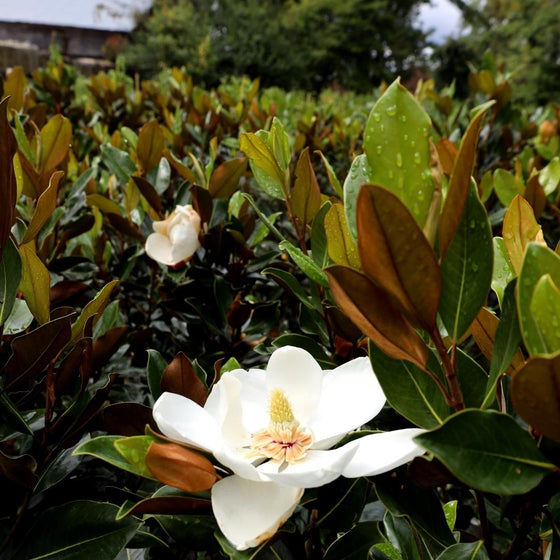
Little Gem is a Southern Magnolia scaled for a real yard. It is slow-growing and narrow, typically holding around 15 to 20 feet in landscape use with an 8 to 10 foot spread, and it flowers heavily from a young age — often when the plant is only three or four feet tall — then keeps going for months. The glossy leaves with bronze undersides look good in every season. Give it room to eventually exceed the numbers on the tag; in the Deep South it can go taller over decades.
Bald Cypress

If you have a low spot that stays wet, this is the tree. Bald Cypress is native across the Gulf South, it will grow in standing water, and it is just as happy in ordinary garden soil — which makes it far more versatile than its swamp reputation suggests. The soft, feathery foliage turns rusty orange before dropping, giving you genuine fall color in a climate that does not offer much. It gets large, so site it where 50 to 70 feet is welcome.
Frost Proof Gardenia

Gardenia fragrance is the smell of a Southern summer evening, and Frost Proof is the most dependable of the group — narrower leaves, better cold tolerance than the name even suggests, and heavy bloom in late spring. It stays a manageable 3 to 5 feet, which makes it a natural foundation plant near a door or window where you will actually walk past the flowers. It wants acid soil; if yours runs alkaline, grow it in a container.
Yuletide Camellia

Yuletide flowers scarlet with a boss of gold stamens in December, when the rest of the garden has nothing to offer. That is the entire argument. It is an evergreen sasanqua camellia, so it earns its space the other eleven months as glossy dark structure, and it takes part sun to part shade, which makes it useful on the east side of a house where full-sun shrubs sulk. Zone 9 is the sweet spot for this one.
Distylium Blue Cascade

This is the plant I hand people who ask for boxwood. Blue Cascade is a low, spreading evergreen with blue-green foliage that holds a tidy 3 to 4 feet without shearing, and it tolerates heat and drought far better than boxwood does in this climate. It is not invincible — it can get Phytophthora root rot in ground that stays waterlogged — so give it drainage and it will outlast almost anything else in the bed.
White Cloud Muhly Grass

Muhly Grass is native across the Southeast, drought tolerant, salt tolerant, and almost entirely maintenance-free once established — you cut it back once in late winter and that is the whole job. In fall it throws a haze of bloom that looks like smoke when the light is behind it. White Cloud is the white-flowered form, and it is at its best planted in a mass rather than as a single specimen. Full sun gives the heaviest flowering.
Heat, Sun, and Microclimates in Zone 9
In a hot climate, where you put a plant matters as much as which plant you chose.
Not All Full Sun Is Equal
Six hours of sunlight on a mild March morning is not the same input as eight hours of July afternoon sun bouncing off a driveway. A west-facing foundation bordered by brick, concrete, or stone can run considerably hotter than the air temperature suggests, and the plant tag has no way to know that.
So read both the duration and the intensity. Some plants labeled full sun will appreciate afternoon protection in the hottest parts of Zone 9. Others — yuccas, muhly grass, rosemary, crape myrtle — will thrive in exactly those brutal spots and sulk anywhere gentler. Learn your property before you plant it.
Use Your Microclimates
Every property contains small climate zones, and once you start noticing them your options expand considerably.
The north side of the house stays noticeably cooler. A south-facing brick wall holds enough warmth to carry a slightly tender plant through a cold snap. Large trees create afternoon shade. A low area collects cold air on still winter nights and water after storms. Walls, fences, patios, pools, driveways, and buildings all bend temperature, light, wind, and moisture.
Good gardeners do not just know their USDA zone. They know their yard.
Shade Is Landscape Infrastructure
In Zone 9, a tree does something a tree in Ohio does not: it changes the climate of the yard.
A well-placed shade tree cuts the intensity of afternoon sun and creates an entirely different growing environment underneath and around it. An area that was too hot for certain shrubs and perennials becomes usable. That is why I think of shade trees in warm climates as infrastructure rather than ornament — they make other planting possible.
Use them deliberately: around patios and outdoor living space, on the west side of the house, and over the areas where you eventually want shade-loving plants. Then plant those areas five years later, once the shade is real.

Watering, Mulch, and Drainage in Zone 9
Water management is the single biggest factor in whether new plants establish here. It also means two opposite things depending on where in Zone 9 you garden, which is why this section covers both.
Watering New Plants
Immediately after planting, water thoroughly enough that the entire root ball and the surrounding soil are moist. After that, stop watering on a schedule and start checking the soil.
I want deep, less frequent watering that pulls roots downward and outward into the native soil. Constant shallow watering does the opposite — it keeps roots clustered near the surface, which is the worst possible place for them when the heat arrives. Water early in the morning where you can, and direct water at the root zone rather than routinely soaking the foliage.
New plants need more attention than established ones, and the first summer is the one that decides the outcome. A soaker hose or watering wand makes this dramatically easier to be consistent about.
Mulch
Mulch does more work in a long, hot growing season than most people give it credit for. A 2- to 3-inch layer of shredded hardwood over the root zone moderates soil temperature, cuts moisture loss, suppresses weeds, and slowly improves the soil as it breaks down.
Just do not pile it against trunks and stems. Mulch should extend outward across the root zone and leave the base of the plant exposed. We are protecting roots, not building a volcano.
Drainage and Heavy Rain
Zone 9 does not automatically mean dry. Much of it gets substantial rainfall, and tropical systems can deliver an absurd amount of water in a few hours. That makes drainage every bit as important as irrigation — arguably more so, because you can add water and you cannot easily subtract it.
If water consistently stands in a bed after rain, resist the urge to solve it with more soil amendments. Sometimes the better answer is choosing plants that tolerate moisture: Bald Cypress, Sweetbay Magnolia, Hardy Hibiscus, Inkberry Holly, Blue Flag Iris, and the rushes will all grow where a gardenia would drown. Right plant, right place is still the most valuable rule in gardening.
Designing a Water-Wise Zone 9 Garden
In the drier parts of Zone 9, design should start from water conservation, and the smartest single move is grouping plants by their moisture needs.
Put the drought-tolerant trees, shrubs, perennials, and grasses together in one area. Put the plants that want regular irrigation in another. That lets you water where water is actually needed instead of irrigating an entire landscape to satisfy its thirstiest member. Combined with good plant selection, deep watering, and mulch, it can cut long-term irrigation dramatically.
Building a Zone 9 Pollinator Garden
A long growing season is a gift for pollinator gardening, because you can design for continuous bloom rather than a single pollinator season.
Aim for something in flower across as much of the year as possible. Camellias cover late fall through winter. Azaleas and redbud open spring. Coneflower, rudbeckia, salvia, agastache, and yarrow carry summer. Butterfly Weed, Blue False Indigo, Tall Verbena, Floristan White Blazing Star, and Iron Butterfly Vernonia add native value, and the pollinator perennial collection has more options.
Vary the flower shapes as well as the bloom times. Some pollinators want open, daisy-like flowers they can land on. Others are built for tubular flowers — that is what agastache and salvia are for, and it is why hummingbirds find them. Diversity of form matters as much as diversity of season.
Container Gardening in Zone 9
Zone 9 is excellent for containers. Patios, porches, pool decks, balconies, and entries can carry combinations of flowering perennials, ornamental grasses, compact shrubs, and even small trees.
Containers also solve a specific Zone 9 problem: they let you grow the plants that will not tolerate your soil. If your ground runs alkaline, or stays wet, or is pure sand, a pot is where gardenias, camellias, and Mediterranean herbs become possible.
But remember that a container behaves nothing like the landscape. The limited soil volume heats up faster and dries out far faster. In the hottest stretch of summer, containers may need checking every day and watering most days. Use a quality potting mix, make sure the container has real drainage, and size up rather than down — a bigger pot is more forgiving of a missed watering than a small one.

A Simple Zone 9 Landscape Design
One of the biggest mistakes homeowners make is believing a beautiful landscape requires dozens of different plants. It does not. It requires a few good plants used in repeated groups. Here is the sequence I would follow:
- Start with one or two trees that set the scale. Choose them for the job you need done — shade over a patio, screening along a property line, or a focal point near the entry — and site them for their mature size, not their nursery size.
- Add evergreen shrubs to build permanent structure. Place them around foundations, entries, property lines, and the major beds. This is the framework that makes the garden look intentional in winter.
- Layer flowering shrubs in front of and around the evergreens. Choose them so that bloom times overlap across the seasons rather than all landing in April.
- Use repeated groups of perennials and ornamental grasses for color, movement, and texture. Repetition of a few plants reads as design. One of everything reads as a collection.
- Finish with mulch and give everything room to reach mature size. The gaps will look wrong for two years and right for twenty.
Done this way, the landscape gets easier to maintain as it matures rather than harder.
The Biggest Zone 9 Planting Mistakes to Avoid
Gardening in Zone 9 becomes much easier once you work with the climate instead of against it. The recurring mistakes:
- Assuming spring is the only planting season. Fall is better here. Use it.
- Selecting plants on USDA hardiness alone. Check heat and humidity tolerance too. The zone number only describes winter.
- Ignoring afternoon sun and reflected heat. A west-facing bed against brick is a different climate from the rest of the yard.
- Watering shallowly and often. Deep and less frequent builds the root system that carries a plant through summer.
- Neglecting new plants in their first summer. Year one decides it. After that they largely look after themselves.
- Skipping mulch. In a long hot season it is not decorative, it is functional.
- Ignoring drainage. In high-rainfall regions, drowning kills more new plants than drought does.
- Planting for the size on the tag. Give plants room for what they will become.
- Treating Zone 9 as one climate. Choose for your particular combination of heat, rainfall, humidity, and soil — not simply the number on the map.
Shop the Zone 9 Shrub Collection
Zone 9 Questions, Answered
When is the best time to plant trees and shrubs in Zone 9?
Fall is the best planting season in Zone 9, followed by winter and early spring. Air temperatures moderate while the soil stays warm enough for active root growth, so the plant can concentrate on building roots instead of surviving heat. Those roots keep developing through a mild Zone 9 winter, so the plant enters spring already established and faces its first summer with a real root system underneath it.
What temperature range defines USDA Zone 9?
Zone 9 covers locations with an average annual extreme minimum winter temperature between 20°F and 30°F. It splits into Zone 9a, at 20°F to 25°F, and Zone 9b, at 25°F to 30°F. That figure is an average, not a floor — about half of winters will be colder than it.
Why did a plant rated for Zone 9 die in my Zone 9 garden?
USDA hardiness zones describe winter cold and nothing else. They say nothing about summer heat, humidity, rainfall, or sun intensity. A plant can be perfectly hardy to Zone 9 and still decline through a hot, humid Gulf South summer, or rot in a wet year. Hostas, heucheras, hellebores, astilbe, and most lavenders fall into this category. The hardiness rating was not wrong; it was answering a question about January.
Can I grow hydrangeas in Zone 9?
Yes, but siting decides everything. Oakleaf hydrangeas are native to the Southeast and the most at home here, given dappled shade and sharp drainage — they will not tolerate standing water. Bigleaf types perform well too but need genuine afternoon shade rather than full sun. Panicle hydrangeas sit at the warm edge of their rated range in Zone 9, so treat them as the least reliable of the three.
Can I grow apple trees in Zone 9?
Usually not the familiar supermarket varieties. Apples need a certain number of winter chill hours below 45°F to fruit properly, and coastal Zone 9 does not supply enough — roughly 200 to 400 hours in south Louisiana, about 210 around Orlando, and 350 to 450 on the Texas Gulf Coast, against requirements that run considerably higher for most named cultivars. Only low-chill varieties bred for the Deep South fruit reliably here. Figs are the far easier home fruit crop in Zone 9.
What are the toughest low-maintenance shrubs for Zone 9?
For evergreen structure that asks almost nothing: Distylium, Inkberry Holly, Dwarf Burford Holly, Indian Hawthorn, and Sunshine Ligustrum. For flowering shrubs that shrug off heat: Knock Out® and Drift® roses, Loropetalum, Encore® Azaleas, and Abelia. For the hottest, driest, most reflective spots on the property, yuccas are close to unkillable.
Woodie's Take
If I were starting a new landscape in Zone 9, the first thing I would do is stop thinking of gardening as something that begins in April and ends in October. Zone 9 gives you a far bigger window than that, and I would use every bit of it.
I would plant trees and shrubs in fall wherever possible so they could spend the cool months building roots. I would use early spring for the rest, and make sure everything was well established before the serious heat arrived.
I would also design around the heat rather than fight it. Shade trees where they will eventually cool the landscape. Evergreens for permanent structure. Flowering shrubs for the seasonal show. Tough perennials and ornamental grasses to carry color through a summer that would flatten anything more delicate. Plants grouped by water need, and mulch over all of it.
And I would remember that Zone 9 is not one climate. A gardener in California, Texas, Louisiana, or Florida may all technically live in Zone 9, but each is working with a completely different combination of heat, rainfall, humidity, soil, and sun. If you want to see how differently the same idea plays out one zone warmer, our Grow Zone 10 planting guide covers the frost-free end of the range, and everything you need to know about planting zones lays out the whole system.
Learn your particular piece of Zone 9. Then work with it. That is when gardening gets easier — and when you stop trying to make plants survive your landscape and start choosing plants that were always going to thrive there.