
Ninebark Shrubs for Colorful Foliage, Flowers & Wildlife Value
Tough native shrubs with bold foliage, spring bloom, and four-season texture.
Ninebark shrubs are one of the easiest ways to make a landscape look “designed” in every season, with fresh spring flowers, summer foliage color, fall texture, and that signature peeling bark that shows off when leaves drop. They’re native to eastern North America, widely described as adaptable, and they handle real-world conditions better than many ornamental shrubs: variable soils, occasional drought once established, and even heavier ground when drainage is reasonable. Give them full sun to partial shade (with the best density and color typically in stronger light), and you’ll get a shrub that looks intentional without becoming a high-maintenance chore.
The confidence trick is pruning timing. Ninebark sets flowers on older growth, so shaping is best done right after flowering (and no later than mid-August in several horticultural references) to protect next season’s bloom. If a shrub ever gets tired or overgrown, it can also be rejuvenated by cutting back hard in early spring, one of the reasons ninebark is so forgiving long-term. You’re backed by the We Grow Together Promise, so you can plant for impact now and fine-tune the shape later.


Fast privacy and four-season texture.
Ninebark is a go-to shrub for quick landscape “bones” without fuss. Its multi-stem habit and naturally arching framework make it excellent for soft screens, property edges, and back-of-border structure, especially when planted in repeating groups that read as one cohesive mass. Many selections are also praised for tolerating a wide range of soils, including clay, which makes ninebark a practical solution where pickier shrubs fail.
This is a strong collection for homeowners and landscapers because it scales: compact cultivars for foundation beds and tighter spaces, and larger growers for bigger borders and informal hedging. In most gardens, it’s steady rather than “wild”—fast enough to fill in and look established, but manageable with a simple prune window instead of constant shearing.
Ninebark also brings real landscape versatility: it can be used on slopes, in rain-garden-adjacent zones (where moisture is present but not stagnant), and in mixed shrub borders that need texture more than nonstop flowers. If your goal is low maintenance with high visual payoff, the combination of foliage, bark, and easy rejuvenation is hard to beat.
Peeling bark, bold foliage, spring bloom.
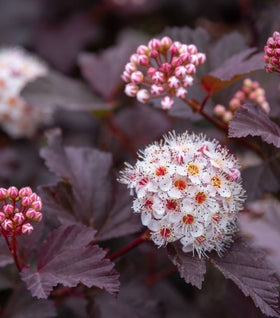
Ninebark’s spring bloom is a clean, classic moment: clusters of small flowers that typically appear in late spring and into early summer, depending on region and cultivar. After bloom, many forms develop ornamental seed capsules, and the exfoliating bark becomes increasingly noticeable with age, adding winter interest that doesn’t rely on evergreen foliage.
Mature size varies widely by selection, but many garden ninebarks are commonly grown in the roughly 5–8 foot range (with plenty of compact options staying smaller), which makes it easy to match the shrub to the bed instead of forcing the bed to fit the shrub. Growth is generally described as moderate to fast in good conditions, especially with sun and room to spread, so you get meaningful progress without waiting years for presence.
Color is a major selling point in modern ninebark varieties; deep burgundy, coppery orange shifts, and bright gold tones are often used specifically to create contrast with green shrubs and perennials. Just remember: stronger light usually equals better color and tighter habit, while lower light tends to soften color and loosen growth.
Sun-smart placement for best color.
Ninebark is happiest in full sun to partial shade, with many horticultural references emphasizing full sun for the densest habit and best foliage performance, while also noting that a bit of afternoon shade can help in hotter, humid climates. If you’re planting for the deepest leaf color or the strongest flowering, prioritize sun first.
Soil flexibility is part of the appeal: ninebark is widely described as tolerant of a broad range of soils, as long as drainage is decent and the site isn’t chronically waterlogged. For most landscapes, “moist, well-drained” is the sweet spot, especially during establishment, then many plants tolerate drier conditions once rooted in.
For spacing, plan around the mature width and the look you want. As a practical range, many medium ninebarks look best spaced about 4–6 feet apart for individual definition, while hedge-style massing often uses tighter spacing (commonly ~3–4 feet on center) to knit together sooner, always leaving enough room for airflow to reduce disease pressure.
Prune once, keep it thriving.
Pruning is straightforward, but timing matters: shape and thin immediately after flowering, and avoid late-season pruning that can interfere with next year’s blooms (mid-August is often cited as a latest “safe” window). If you want a cleaner, more open interior, remove up to about one-third of older stems selectively to improve airflow and reduce crossing branches.
For rejuvenation, ninebark is famously forgiving; many gardeners note it can be cut close to the ground in early spring to restart growth and refresh an older shrub. This is a great option when a plant gets leggy, crowded, or simply too large for its space, and it’s one reason ninebark stays “low-drama” long term.