
Topiary Plants for Sculpted Form & Year-Round Garden Structure
Evergreen living sculptures for instant curb appeal
Topiary trees are the “instant architecture” move: you get the polish of a formal garden design on day one, without waiting years for a plant to grow into its role. These are living sculptures—evergreens selected and shaped for dense foliage, tight branching, and a naturally tidy habit—so they hold crisp lines through every season. Whether you’re framing a front door, anchoring a patio container, or giving a foundation bed a finished edge, a topiary creates a strong focal point that makes everything around it look more intentional. And if you’re new to shaping plants, starting with a pre-trained form takes the pressure off; you’re maintaining a silhouette, not inventing one.
The confidence piece matters, too. A well-chosen topiary is designed to be steady—not fussy—when it’s planted in sun, given sharp drainage, and clipped at the right moments. Most evergreen topiary responds best to selective, thoughtful trimming rather than hard, frequent shearing, and a simple seasonal routine keeps the outline clean. If questions pop up along the way (watering, trimming, winter prep, or troubleshooting), the We Grow Together Promise is there as your safety net—so you can enjoy the look without second-guessing every snip.
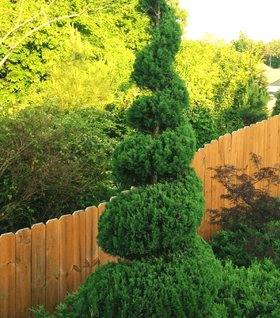
Blue Point Juniper Spiral Topiary
As Low As $87.95
Create an instant “estate garden” structure.
Topiary trees turn simple spaces into designed spaces. One sculpted evergreen at the front walk reads like an intentional finishing touch; a matched pair at a doorway adds symmetry and a sense of arrival; and a single spiral or globe can act as the “anchor” that makes mixed plantings look curated. Because topiary forms are trained to be dense and compact, they deliver visual impact without needing a huge footprint—perfect for tight foundation beds, courtyard gardens, and patio containers where every square foot counts.
They also solve a practical problem for busy gardeners: topiary offers year-round presence with a predictable outline. Evergreen topiary is typically chosen for small leaves or needles and a naturally thick habit, which makes it easier to keep the shape looking sharp through the growing season. That’s why topiary is such a go-to for formal landscapes, modern minimal designs, and “clean lines” entry plantings—it stays present in winter and doesn’t disappear when perennials go dormant.
And yes—topiary can be approachable. If you’re starting with a pre-shaped form (like a trained spiral evergreen), your job is simple maintenance: keep it healthy, then lightly refine the silhouette as new growth appears. Think of it like edging a lawn: small touch-ups look better than big overhauls, and you’ll quickly learn how much to trim by watching how the plant responds between haircuts.
Love the shape you’re getting.
Most outdoor topiary favorites are evergreen plants that naturally grow dense, so the form looks full rather than “see-through.” You’ll notice that the best topiary candidates tend to have compact branching and foliage that stays attractive all year, which helps the outline read clearly from the street and up close. In many landscapes, that means conifers or broadleaf evergreens that keep their color in winter and push fresh growth in spring.
In terms of size and speed, topiary isn’t about racing upward—it’s about controlled growth. A classic spiral juniper topiary, for example, is often described as a moderate grower with a mature footprint that still stays manageable in residential beds when spaced correctly. Expect a plant that gradually gains height and width over time (rather than exploding in a single season), which is exactly what you want for maintaining a crisp, repeatable shape.
Bloom is usually not the headline feature for outdoor topiary, but seasonal interest still shows up in subtle ways. Many evergreen topiary plants produce small, inconspicuous blooms or cones and may also develop ornamental berries or seed structures depending on species and plant sex—details that add texture without distracting from the silhouette. If you love the idea of “living sculpture,” this is the beauty: the form stays consistent, while the plant quietly shifts with the seasons.
Plant them where they get noticed.
For the strongest results, place topiary where its outline can be appreciated—near entries, along walkways, beside steps, at driveway turns, or as a punctuation mark in a foundation bed. Full sun is the sweet spot for many evergreen topiary choices (especially junipers), because strong light supports denser growth and better color; in hotter climates, a touch of afternoon shade can help reduce stress without sacrificing shape.
Spacing is where topiary either thrives—or struggles. Give enough room so light and air can reach the lower foliage; crowding can encourage thin growth at the base and increase disease pressure. For a Blue Point-type juniper form, spacing on the order of about 6–8 feet (and at least around 8 feet when you’re planning for mature width) is a smart planning range, especially if you want the outline to stay full all the way down.
Topiary also shines in containers, especially when you want symmetry on patios, pool decks, and front porches. Choose a heavy pot for stability, prioritize drainage, and leave breathing room around the base so foliage stays dry and airy. In-ground, topiary can work as a “green sculpture” among flowering perennials or grasses—just keep it slightly forward of taller plantings so the shape doesn’t get visually swallowed mid-summer.
Keep care simple and shapes crisp.
Start with the fundamentals: sun, sharp drainage, and steady moisture while roots establish. Junipers are widely described as drought-tolerant once established, but they do not like wet feet—so well-drained soil is non-negotiable, especially in heavier clay sites. Water deeply during establishment, then shift toward “infrequent but thorough” irrigation during dry spells to support root health without creating constantly soggy conditions.
For pruning and timing, think in two lanes: shaping trims vs. corrective cuts. Many topiary styles (including cloud-pruning approaches) are commonly maintained with clipping in early or late summer, while rejuvenation or more aggressive corrective pruning of evergreen topiary is often done in early to mid-spring, when plants can push new growth. For junipers specifically, avoid cutting back into old, bare wood; stay on green growth so the plant can refill and keep the form looking lush.