
Crape Myrtle Trees
Summer flowers for weeks, plus smooth bark and easy landscape style.
If you want the “summer statement tree” that keeps showing up—week after week—crape myrtles are hard to beat. They’re famous for bloom power in the heat: fresh flower clusters keep coming through summer, and many modern selections are bred for stronger disease resistance so foliage stays cleaner while the color performs. You also get bonus beauty when the flowers slow down: smooth, exfoliating bark and a clean branching habit that still looks intentional in winter. Best of all, there’s a size for nearly every landscape goal—compact forms for patios and tight beds, medium growers for foundation lines and courtyards, and taller tree-types for front lawns and street-side planting.
The confidence plan is straightforward. Give them full sun for the strongest bloom and the best overall health (shade can reduce flowering and increase disease pressure), then keep care simple: water deeply during establishment, mulch to cool roots, and prune with restraint—usually in late winter or early spring—because flowers form on new growth. If you want extra color, deadheading spent clusters on smaller plants can encourage additional flowering later in the season. And while these are generally easy trees, it’s smart to know the watch-outs: powdery mildew and leaf spot can show up (especially with poor airflow), and sap-feeding insects like aphids, scale, and crape myrtle bark scale can create sticky honeydew and sooty mold if ignored. The good news for pet households: crape myrtle is listed as non-toxic to dogs and cats, which makes it a comfortable choice around outdoor living spaces. You’re supported all the way by the We Grow Together Promise.
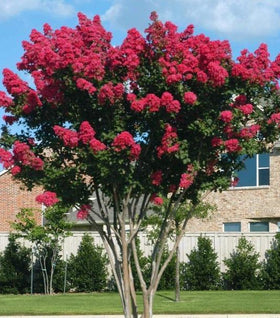

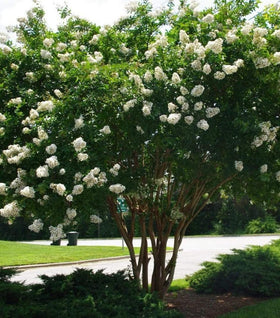

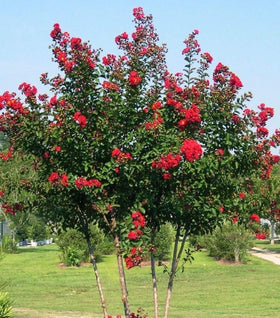
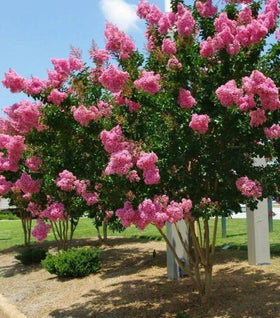

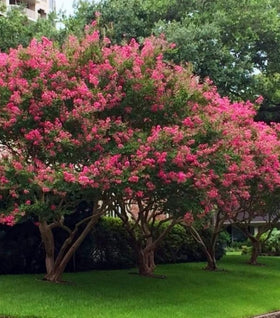
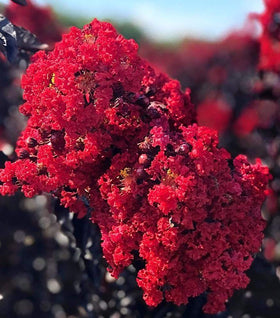

Turn summer heat into nonstop color.
Crape myrtles shine when other flowering trees are taking a break. Their bloom window is a true summer feature—often mid-summer through early fall, depending on variety, weather, and region—and the plant keeps producing new flower clusters in warm, bright conditions. That makes them ideal for homeowners who want a long season of color without constantly swapping annuals, and for landscape projects that need dependable summer interest after spring bloomers fade.
They’re also versatile in how you use them. Plant one as a specimen near an entry or at the corner of a lawn to create a focal point that reads from the street, or use a series to define a driveway edge or frame a view. Dwarf and compact selections can work in large containers or tight foundation beds, while multi-stem forms create a sculptural, “natural” look that softens hardscape. Because the flowers arrive during peak outdoor-living season, the impact feels immediate—more color when you’re actually outside using the space.
One practical perk many people don’t plan for (but end up loving): bark and structure. Even when blooms pause between flushes, the canopy stays attractive, and as trunks mature, the bark can peel and smooth into beautiful tones that keep the plant interesting through winter. In other words, you’re not just planting for flowers—you’re planting for a four-season ornamental tree that earns its spot year-round.
Choose your size, bloom color, and canopy shape.
Size is the first decision, because crape myrtles range from compact shrubs to true small trees. Many commonly planted landscape cultivars fall roughly in the 10–30 ft range with a 15–25 ft spread, while older specimens can grow larger over time—so it pays to match mature scale to the site instead of “planning to prune it smaller.” Choosing the right mature size up front is one of the best ways to keep the plant healthy and the branching graceful.
Growth rate is typically moderate to fast, especially in warm climates and full sun. That’s great for quick impact, but it also means spacing and airflow matter: crowded plants stay damp longer after rain or irrigation, which can increase the likelihood of leaf diseases. Many modern introductions focus on improved performance traits (including better mildew resistance), so if you’ve had a “mildew memory” with older types, it’s worth selecting cultivars that are bred to keep foliage cleaner.
Color and form are where the fun starts. Flower colors commonly range from white to pink, red, and purple, and the canopy can be trained as a single-trunk small tree or grown as a multi-stem clump. Pick multi-stem if you want a softer, more natural silhouette and bark display; pick a single-trunk form if you want a cleaner “street tree” look with canopy clearance. Either way, the best-looking crape myrtles are the ones allowed to keep their natural branching habit—no harsh topping needed.
Plant in full sun for bigger blooms.
The sun is the lever that drives performance. Full sun is widely recommended for strong growth and abundant flowering; heavy shade reduces blooms and can increase disease issues, so choose the brightest spot you have. If your site gets morning-to-midday sun with a little late-afternoon relief, that can still perform well in hotter regions—just avoid deep shade where flowering becomes sparse, and the plant loses its crisp structure.
Soil and drainage come next. Crape myrtles handle heat well and tolerate some drought once established, but they don’t like sitting in soggy conditions—good drainage helps roots stay healthy and reduces stress that can invite pests. A mulch ring over the root zone helps conserve moisture and keeps roots cooler in summer; just keep mulch pulled back from direct contact with the trunk to prevent rot issues.
Spacing should follow mature width and your goal (specimen vs. hedge effect). A practical rule: allow room for the mature spread rather than forcing the plant to stay narrow through hard pruning—many common cultivars mature in the 15–25 ft spread range, so spacing often lands around 12–20 ft on-center for tree forms, with tighter spacing reserved for smaller cultivars used in rows. More space also improves airflow, which helps reduce powdery mildew and leaf spot pressure.
Prune lightly, bloom harder, and avoid “overdoing it.”
Crape myrtles bloom on new growth, so they don’t require heavy pruning to flower well. If pruning is needed to stimulate new shoots or refine structure, late winter to early spring is a widely recommended window. For smaller plants, removing spent flowers after they fade can encourage additional bloom later in summer—an easy technique when you want extra color without changing anything else.
The biggest “simple-care” win is restraint. Severe topping can ruin the natural form, create weak regrowth, and lead to a patchy look that never quite recovers; instead, remove dead wood, crossing branches, and a few crowded stems to open the canopy. If the plant is too large for the space, the best long-term fix is choosing a smaller-maturing cultivar rather than relying on repeated hard cuts to force size control.