
Drift Roses for Compact, Colorful & Easy-Care Landscapes
Low, colorful roses that spread beautifully and bloom for months.
Drift roses are one of my favorite “problem solvers” when you want a bed to look finished fast—without signing up for high-maintenance rose drama. They were bred specifically as compact, spreading groundcover roses, so you get a tidy, mounded habit and a long bloom season that’s more like a flowering shrub than a once-and-done perennial. In real gardens, that means you can edge a walkway, soften a foundation line, fill an island bed, or cover a sunny slope with color that keeps coming from spring to frost.
The care story is refreshingly simple: give them sun (at least 6 hours is a strong baseline), plant in well-drained soil, and space them so air can move through the planting as they fill in. Then, do the one big annual reset—prune hard in late winter or early spring when you see new shoots starting—so the plant rebounds dense and bloom-ready for the season ahead. And because they’re still roses, it’s smart to keep a quick watch for the usual issues (like black spot and rose rosette disease) so you can act early and keep plants looking clean. That’s the We Grow Together Promise—clear timing, fewer surprises, and a groundcover rose planting that keeps paying you back.



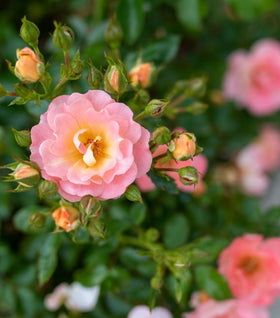


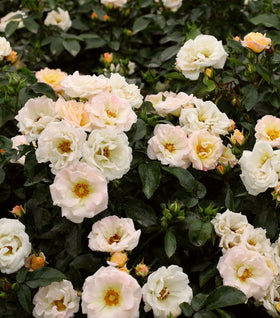


Color that carpets the landscape.
Drift roses are designed to behave like a flowering groundcover: low enough to stay neat, wide enough to knit together, and floriferous enough that the planting reads as “solid color” from across the yard. They’re commonly described as blooming from spring to frost, which is exactly why they’re so effective for borders, curb appeal beds, and sunny foundations where you don’t want gaps mid-season.
They’re also a strong “scale match” for modern landscapes. Instead of one tall shrub and a ring of mulch, Drift roses let you plant in drifts (pun intended) so beds look full and intentional—more like a designed garden and less like a few lonely plants in open soil. Use them to outline a walkway, wrap a mailbox planting, repeat them along a driveway edge, or create a low ribbon of color that ties multiple beds together.
If you like containers, these roses play nicely there too—especially in large pots where you want months of bloom without constant replanting. The habit stays compact and mounded, and the flower clusters keep the display looking fresh even when you’re not deadheading every single bloom. They’re a great way to get “rose garden” energy on a patio without committing to a full in-ground bed.
Compact growth, nonstop blooms.
A big reason Drift roses are so popular is their manageable mature size. One extension profile lists a mature size of about 1½ feet tall and 2–3 feet wide, with a spreading/mounded habit and a moderate growth rate—just enough vigor to fill space, not so much that you’re fighting it.
Bloom timing is the other headline feature. Drift roses are repeatedly described as repeat-blooming and long-flowering—spring into fall (and often right up to frost), which gives you the kind of season-long color most homeowners want from a “front-and-center” planting. That long bloom window is also why they’re a smart choice for commercial and landscape installations: they keep blooming for months.
You’ll also see them positioned as low-maintenance and fairly tough, bred from groundcover rose traits (durability, winter hardiness, disease resistance) combined with a more controlled, compact size and repeat flowering. Translation: they’re built to be easy color in the real world, not a fussy specialty plant that only looks good with constant babying.
Sun-first placement for best coverage.
For the densest growth and most flowers, plant Drift roses in full sun. A practical baseline is at least 6 hours of direct sun daily, and more sun typically means heavier bloom and faster drying foliage, which helps reduce common disease pressure. Morning sun is especially valuable because it dries leaves earlier in the day.
Spacing is where you can “tune” the look. If you want a quicker, more connected carpet, you’ll plant closer; if you want maximum long-term airflow and easier maintenance, you’ll plant wider. Extension sources commonly recommend at least about 3 feet between plants, and some suggest giving 4–5 feet for long-term spread in favorable climates, because these roses can broaden more than people expect once established.
Use that spacing intentionally: 3-foot spacing for a fuller border sooner, wider spacing where humidity is high, or you’ve had disease issues in the past. Either way, prioritize drainage (roses dislike wet feet) and avoid tight corners with stagnant air—good site choice is a big part of what makes these feel “low maintenance.”
One prune a year, then enjoy.
Drift roses are famous for one simple annual routine: prune once a year in late winter or early spring, right as you see buds breaking and new shoots starting. The commonly recommended approach is a hard cutback (often down to roughly 6–8 inches) to keep plants compact, dense, and loaded with fresh flowering growth for the season ahead.
Watering and feeding are straightforward too: focus irrigation at the base instead of overhead, and aim for deep soakings rather than frequent light sprinkles—especially during establishment and summer heat. This isn’t just about growth; base watering and good airflow are repeatedly recommended strategies for reducing black spot, one of the most common rose diseases.