

Camellia Shrubs
Glossy evergreen structure with blooms that carry from fall into spring
Camellias are the kind of shrub that makes a landscape feel established—deep green, glossy foliage all year, then a burst of rose-like flowers when so many beds are quiet. What makes this collection special is season coverage: depending on the type, camellias can bloom from early fall into winter (many sasanquas) and from late winter into spring (many japonicas), giving you a long runway of color instead of a single-week show. They’re also incredibly “designer-friendly”: tidy as specimens, strong as evergreen anchors in mixed borders, and elegant enough for entry beds where you want a polished first impression.
If you’ve ever felt intimidated by camellias, I’ll simplify it: put them in bright shade or morning sun with afternoon shade, keep soil organic-rich and well-drained (slightly acidic is ideal), and protect them from harsh wind and afternoon scorch—those basics unlock the best blooms and the best foliage. Pruning is also easier than people think: you’re mainly shaping right after flowering, so you don’t remove next season’s buds. And here’s a surprisingly comforting note for pet households—camellia (Camellia japonica) is listed as non-toxic to dogs and cats. The We Grow Together Promise means you’re not guessing at any of this; you’re planting with support.


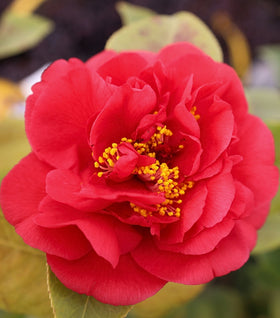


Evergreen shine with blooms when few shrubs do.
Camellias earn their spot because they deliver two high-value outcomes at once: year-round evergreen structure plus a standout bloom season that can land in fall, winter, or spring, depending on the type. That timing matters—sasanqua camellias are known for flowering from early fall into mid-winter, while many japonica camellias bloom later, bringing color from late winter into spring. Used together, they’re a smart way to extend flowering interest across multiple seasons without replanting annuals or rebuilding beds.
From a landscape-design standpoint, camellias are “clean architecture.” Their glossy foliage reads refined, and the flower form feels classic—like a rose and a peony had a winter-flowering cousin. They look incredible as a specimen near an entry or patio, but they also scale up beautifully in mixed borders where you need a dependable evergreen backbone behind hydrangeas, azaleas, and perennials. In milder regions and sheltered microclimates, they can be the anchor that makes the whole bed feel intentional year-round.
They’re also surprisingly practical. Many camellias can be trained as a small tree form, grown as a flowering screen, or kept as a dense shrub with minimal shaping—so homeowners get beauty without constant maintenance, and landscapers get a repeatable plant that performs when sited correctly. If you want flowers for cutting, camellia blooms and buds are a welcome treat in cool months, and the evergreen foliage keeps arrangements looking lush.
Choose bloom season, form, and mature size.
Camellias are not one-size-fits-all, and that’s the advantage. Sasanquas are often described as faster growers and can reach a larger shrub/small-tree scale over time (commonly cited up to the mid-teens in height with a narrower spread), while japonicas are often slower to establish and mature into long-lived, substantial shrubs when conditions are right. That difference lets you choose the “pace” and the final footprint that matches your site—quick fill for a screen, or slower, sculptural growth for a foundation anchor.
Bloom style and texture are part of what you’re really buying. Some camellias offer single blooms with visible stamens (a lighter, more natural look), while others lean into formal doubles that feel almost too perfect—great for classic landscapes and evergreen hedging where you want refined detail. And because bloom timing varies by group (fall-to-winter vs. winter-to-spring), you can intentionally plan for a “succession” of flowers instead of putting everything on one calendar month.
Seasonal interest isn’t limited to flowers. The foliage is the year-round payoff: glossy, dark green leaves that hold their look in shade gardens and mixed borders, creating contrast behind lighter greens and bright blooms. If you’re designing for a four-season structure, camellias function like evergreen “furniture” in the bed—steady visual weight, then an unforgettable bloom moment when the rest of the landscape is between peaks.
Place them in bright shade for best flowering.
Light is the first placement decision. Many camellias perform best in shade to part shade, or in morning sun with afternoon shade—enough light to set buds, but not so much that foliage and buds are stressed by intense afternoon exposure. Wind protection also matters, especially in colder parts of their growing range, where drying winter winds and temperature swings can damage buds and leaves. A sheltered spot near a structure or within a protected courtyard-style bed can make a noticeable difference.
Soil and drainage are the second decision—and they’re non-negotiable. Camellias prefer organically rich, well-drained soil that stays evenly moist but not wet; many authoritative references emphasize a slightly acidic range (commonly pH 5.5–6.5). If your soil tends to hold water, build up the planting area (a gentle berm or raised bed), widen the amended zone, and mulch to protect roots—this is the fastest path to a stronger, more reliable shrub.
Spacing depends on your goal and the mature size of the variety, but most landscape plans fall within a practical range of 5–8 feet apart for specimen shrubs, with tighter spacing (3–5 feet) for a fuller hedge or screen with naturally narrower forms. The simplest rule: space by mature width, then decide whether you want plants to touch at maturity (hedge look) or remain distinct (specimen look). That planning step reduces future pruning pressure and improves airflow.
Simple care that protects next year’s buds.
Watering is straightforward: keep moisture consistent during establishment, then maintain even moisture through dry spells—especially during bud set and flowering. Mulch helps stabilize moisture and temperature, and it also protects the shallow root zone that many camellias develop over time. Avoid soggy conditions, because “wet feet” is one of the most common reasons camellias decline.
Fertilizing is best approached as “support,” not “push.” A light, appropriate feeding in the growing season can help maintain vigor, but the real performance drivers are site, drainage, and organic matter. If leaves yellow or growth stalls, soil pH and nutrient availability can be the underlying issue—so a soil test is often more useful than simply adding more fertilizer.
Pruning is where confidence shows up. Most guidance points to pruning after flowering, so you don’t remove developing buds; for many gardens, that means spring pruning after bloom, with heavier cuts often timed so new growth can flush without sacrificing flower buds. Keep in mind that next year’s blossoms form on older growth, so late-season pruning can reduce the next bloom cycle. Think “shape and thin,” not repeated shearing—and always remove dead or damaged wood whenever you see it.