

Best Shrubs for Zone 10: Evergreen, Flowering & Fragrant
Published On: Sep 8, 2026
Share:
| In this Article | |||
|---|---|---|---|
One of the great advantages of gardening in USDA Grow Zone 10 is that shrubs can do much more than fill the space between your house and your lawn.
With mild winters and a long growing season, Zone 10 gardeners can build landscapes around broadleaf evergreens, reblooming azaleas, fragrant Gardenias, winter-flowering Camellias, colorful Roses, and architectural foliage plants. The result can be a landscape that changes throughout the year without ever really going dormant.
But as I discussed in The Ultimate Guide to Planting in Grow Zone 10, winter hardiness is only part of the equation.

In Zone 10, I pay just as much attention to summer heat, afternoon sun, humidity, rainfall, drainage, soil chemistry, and reflected heat from patios, driveways, walls, and pool decks. A shrub may be technically hardy in your zone and still be completely wrong for the location you have chosen.
That is why I always come back to the same rule.
Right plant. Right place.
For this list, I have focused on shrubs that give Zone 10 gardeners a useful combination of flowers, foliage, fragrance, structure, and long-season landscape value — and I have been honest about the handful of well-known shrubs that get recommended for Zone 10 constantly and should not be.
What Zone 10 Tells You About Shrubs, and What It Doesn't
Most "best shrubs for Zone 10" lists are really just lists of shrubs whose tags say 10. That is not the same thing as a list of shrubs that will do well for you.
Zone 10 is one number, and it answers exactly one question: how cold it gets in an average winter. Three other things decide whether a shrub thrives on your property, and none of them appear on the tag.
Hardiness Is a Floor, Not a Forecast
A USDA zone rating describes average annual minimum winter temperature. A shrub rated to Zone 10 will survive your winter. It says nothing about whether it will survive your August.
Plenty of shrubs sold with a Zone 10 rating on the tag are cool-summer plants that simply do not decline fast enough in a nursery pot for anyone to notice. Heaths and Heathers are the clearest example. Erica is a Pacific Northwest and Northern European plant; Oregon State University describes it as performing best in mild-winter, mild-summer regions, and most references cap it around Zone 8. The winter cold is not the problem in South Florida. The summer is.
When you are shopping for Zone 10, read the top of the range as a promise about January and treat July as a separate question.
Soil pH Is the Constraint Nobody Mentions
This is the single most useful thing on this page.
Much of South Florida — Miami-Dade and Broward especially — sits on oolitic limestone, and landscape soils there commonly run pH 7.4 to 8.4. Meanwhile UF/IFAS states that Gardenias need a soil pH between 5.0 and 6.5, and recommends that above pH 7.0 you either choose a different plant or grow them in containers. Azaleas want the same acid range.
Those two shrubs are on nearly every Zone 10 list published, including the top of this one. On limestone they will yellow between the leaf veins, stall out, and eventually die — not because of temperature, but because iron and manganese become chemically unavailable to the roots at high pH.
Zone 10 covers both kinds of ground. That is why this article treats acid-loving shrubs and alkaline-tolerant shrubs as two different lists rather than one.
In Florida, the Plant Rules Change the List
Two things Zone 10 gardeners outside Florida never have to think about, and Florida gardeners should.
The first is regulatory. Florida maintains a Noxious Weed List in Rule 5B-57.007, and Ligustrum sinense — Chinese Privet — is on it. That listing carries a specific and interesting exception, which I get to in the foliage section below.
The second is ecological rather than legal. UF/IFAS lists Nandina domestica as a FISC Category 1 invasive in Florida. Nandina is not on the Noxious Weed List, so it is perfectly legal to buy and plant, but the cultivar you choose genuinely matters. That gets its own section too.
Neither of these is a reason to avoid a whole genus. Both are reasons to buy a named cultivar instead of whatever the tag says.
Two Zone 10 Palettes: The Upper Edge and the True Tropics
Zone 10 is not one garden.
Upper Zone 10a and the warm edge of 9b, on sandy or neutral soil, will grow the classic Southern shrub palette: Gardenias, Camellias, Encore Azaleas, Indian Hawthorn, Loropetalum. This is most of the Zone 10 that is not sitting on limestone.
True 10b on South Florida limestone is a different garden. The acid-loving broadleaf evergreens above will fight you there. The shrubs that do well are the alkaline-tolerant and heat-adapted ones — Tea Olive, Yuccas, Ligustrum, roses on their own roots — along with the tropicals that belong to that climate.
Every section below tells you which palette it belongs to. If you are not sure which one you are in, check your address against our grow zone lookup tool, then have a soil test done. The zone takes thirty seconds. The pH is the part that will actually change your plant list.
Fragrant Evergreen Shrubs for Zone 10
If I am designing a Zone 10 landscape and there is an entrance, patio, porch, or walkway that people use every day, fragrance is the first thing I plan for.
Fragrance is the one quality in a landscape that cannot be appreciated in a photograph, which is exactly why it gets left out of most planting plans. Put it where people walk. There is very little point putting a Gardenia fifty feet away in the back corner of the property.
August Beauty Gardenia
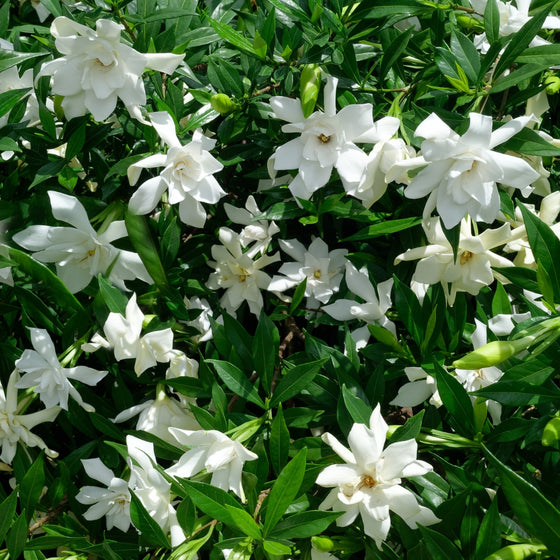
Gardenia jasminoides 'August Beauty' combines wonderfully fragrant double white flowers with glossy, dark-green evergreen foliage, growing to roughly 4 to 6 feet tall and 3 to 4 feet wide. It is hardy in Zones 8 to 11, which makes it comfortable across all of Zone 10. Use it around foundations, as an informal evergreen hedge, near patios, or as part of a fragrance garden. It is the Gardenia I reach for when I want a substantial but manageable plant rather than a groundcover.
Frost Proof Gardenia

Frost Proof Gardenia gives you the same fragrance and glossy evergreen foliage in a slightly tighter package, at 3 to 5 feet tall and 3 to 4 feet wide. This is the kind of shrub I like to repeat through a foundation bed rather than plant just once. Repetition connects different parts of a landscape, and Gardenias hold enough year-round foliage to keep doing that job even when they are not flowering. One Gardenia gives you a beautiful plant. Several thoughtfully repeated Gardenias help create a landscape. If you want the same effect at ankle height, Dwarf Gardenia Radicans is the low, spreading form for the front of a bed.
Where Gardenias Struggle in Zone 10
I would rather tell you this before you plant than after.
Gardenias need acid soil. UF/IFAS puts the target range at pH 5.0 to 6.5 and says outright that where soil pH is above 7.0, you should consider a different plant or grow Gardenias in containers. On South Florida limestone, that is the situation you are in. A container of good acidic potting mix on a patio is not a consolation prize here — it is the correct answer, and it puts the fragrance closer to you anyway.
The second issue is root-knot nematodes, which are a real problem in Central and South Florida sand. UF/IFAS notes that grafted, nematode-resistant Gardenias exist for those regions. If you are planting Gardenias in the ground in South Florida and yours are not grafted, keep them mulched, keep them watered, and expect a shorter life than a Gardenia would have further north.
Fragrant Tea Olive

If your soil is on the alkaline side, this is the fragrant evergreen I would plant instead of a Gardenia. Osmanthus fragrans is hardy in Zones 8 to 11, reaches 10 to 15 feet tall and 6 to 10 feet wide, and is far less fussy about pH. The flowers are small and easy to miss, and the fragrance carries across a whole yard — apricot and sweet, arriving on the breeze before you ever find the plant. It also does something no Gardenia can: at that size it works as a tall evergreen screen. Fragrance and privacy from the same shrub is a good trade. You can browse the rest of our Gardenia collection if you would rather stay with a classic.
Encore Azaleas: More Than a Spring Azalea
Traditional Azaleas are famous for their spring flower display. Encore Azaleas take that idea and extend it.
These reblooming Azaleas flower in spring and then produce additional color later in the growing season, which is especially valuable in a Zone 10 landscape where the gardening season is so long. Their evergreen foliage means they keep contributing structure when they are not blooming.
Autumn Royalty® Encore® Azalea

Autumn Royalty is the Encore I would start with in Zone 10. It is rated Zones 6 to 10, reaches 4 to 5 feet in both directions, and carries large rich purple flowers that read well from a distance rather than disappearing into the foliage. That size makes it useful as a real structural shrub instead of only an edging plant. Our full Encore Azalea collection gives you the same reblooming habit in white, pink, coral, lilac and fuchsia, at mature sizes from about 2 feet up to 5.
Use Encore Azaleas in Groups
This is where homeowners get much more out of Azaleas than they expect.
Do not automatically plant one red, one pink, one purple and one white side by side. Pick a color direction, then repeat it. Three or five of the same Encore Azalea planted in a drift creates considerably more impact than the same number of unrelated shrubs scattered around the property.
Encore Azaleas are especially useful around foundations, along woodland edges, beneath high-canopied trees, near entrances, and in mixed shrub borders. Give them consistent moisture during establishment and enough sunlight for good reblooming — too much shade is the most common reason an Encore stops living up to its name.
Azaleas and Soil pH: The Zone 10 Caveat
Azaleas need the same acid soil Gardenias do, roughly pH 4.5 to 6.0. Everything I said above about South Florida limestone applies here with equal force, and Azaleas are, if anything, less forgiving.
If you garden on the upper edge of Zone 10 on sandy or naturally acidic ground, Encore Azaleas belong near the top of your list. If you garden on limestone, they belong in raised beds with imported acidic soil, in containers, or not at all. Yellowing leaves with green veins is iron chlorosis, and no amount of fertilizer fixes it while the pH stays where it is.
Camellias for Cool-Season Flowers
One of the genuinely exciting things about gardening in a warm climate is being able to think seriously about winter flowers.
Yuletide Camellia

Camellia sasanqua 'Yuletide' gives you the glossy evergreen foliage I want when building the permanent framework of a landscape, and then flowers bright red in the cool months when most other flowering shrubs have finished for the year. It reaches 8 to 10 feet tall and 6 to 8 feet wide in part sun to part shade. I like Camellias near shaded or partially shaded entrances, in woodland-style gardens, on patios, and in mixed evergreen borders where the flowers can be seen up close. Pair them with Gardenias and Encore Azaleas and you have a landscape where evergreen foliage holds the structure while flowers rotate through the seasons. Our fall-blooming Camellia collection has the rest of the sasanquas.
Where Camellias Stop in Zone 10
Be realistic about this one.
NC State's plant database caps Camellia sasanqua at Zone 9b, and Camellias in general want acid soil and relief from afternoon sun. In practice that means Yuletide is an excellent choice on the upper edge of Zone 10 — a protected, part-shade, acid-soil spot in 10a — and a genuine stretch in hot, bright, limestone 10b.
If you are in that second situation and you want a glossy broadleaf evergreen that flowers in the cool season, plant Tea Olive instead and accept smaller flowers for far better odds. If you are in the first, plant the Camellia and enjoy the thing your friends further north cannot have.
Designing With Foliage Instead of Flowers
Flowers are not the only way to add color, and in a climate with a twelve-month growing season they are arguably the least reliable way. Foliage is on duty every day of the year.
Purple Daydream® Loropetalum

Purple Daydream gives you rich purple foliage and fringed pink flowers on a low, mounding plant that stays around 2 to 3 feet tall and 3 to 4 feet wide — completely different from the traditional upright shrub. It is hardy in Zones 7 to 10 and holds its color best with some direct sun. I like it near retaining walls, at the front of mixed borders, along slopes, and anywhere its spreading form can develop naturally. That purple becomes especially effective against bright green, chartreuse or gold foliage. Think Purple Daydream beside Lemon Lime Nandina, or against the deep green of a Gardenia. Now you are designing with foliage rather than waiting for flowers.
Sunshine Ligustrum
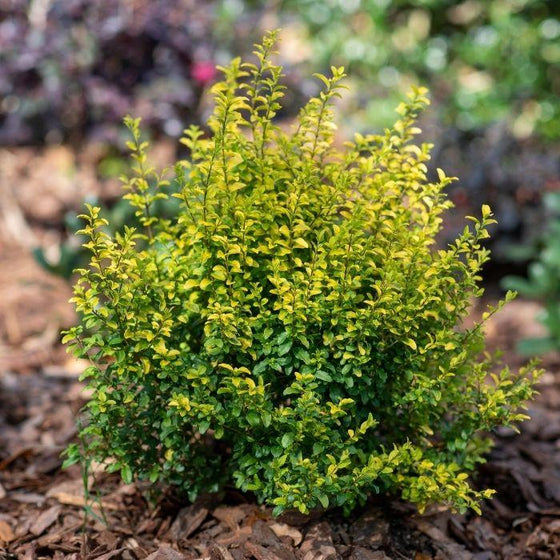
Sometimes a planting bed does not need another flower. It needs contrast. Sunshine Ligustrum provides bright golden foliage that visually lifts a landscape dominated by dark-green evergreens, at 3 to 6 feet tall and wide in Zones 6 to 10. I would not plant it everywhere. Use it strategically — near an entrance, at a turn in a walkway, among darker evergreen shrubs. Bright foliage is a little like punctuation in landscape design. Use it in the right places and everything around it becomes easier to read.
Why Sunshine Ligustrum Is the Privet You Can Actually Plant in Florida
This deserves saying plainly, because it is the kind of detail that decides whether a plant belongs in your yard.
Ligustrum sinense — Chinese Privet — is a serious invasive in the Southeast and is listed by UF/IFAS as a FISC Category 1 invasive. It also appears on Florida's official Noxious Weed List.
But read the actual rule. Rule 5B-57.007 lists "Ligustrum sinense — Chinese privet, except the cultivars 'Variegatum' and 'Sunshine'." Sunshine is named in the regulation itself as an exception, because it is a sterile selection that does not flower and therefore sets no seed for birds to spread. Southern Living Plants, which introduced it, describes it the same way.
So the plant that gives you the brightest gold foliage of anything in this article is also the one privet Florida's own rule carves out by name. That is worth knowing, and it is worth being equally clear about the flip side: if a landscaper offers you plain green Ligustrum for a hedge in Florida, that is the listed plant, and you should decline.
Gold Dust Aucuba
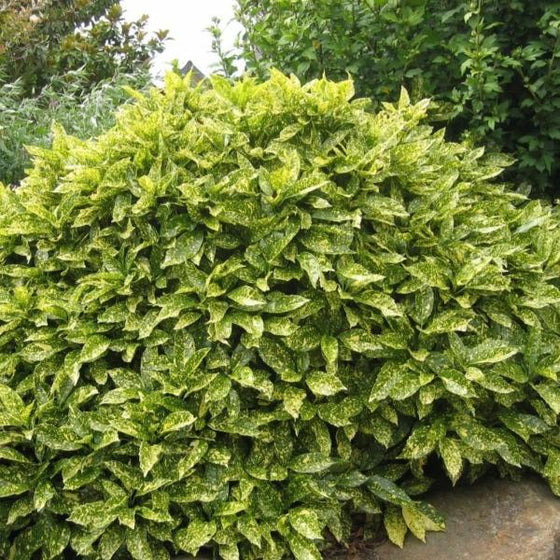
Not every Zone 10 shrub needs blazing sunshine. Aucuba japonica brings gold-speckled evergreen foliage into shaded and partially shaded planting areas where most flowering shrubs will not perform, growing 6 to 10 feet tall if left untrimmed. NC State rates it to Zone 10b, so it is genuinely a Zone 10 plant — with one hard condition attached. The same source warns that young leaves exposed to sun will blacken, and that the foliage is susceptible to windburn. This is a deep-shade plant in a Zone 10 landscape, full stop. Put it under a high canopy, along a protected north foundation, or in a woodland-inspired bed with Camellias and shade-tolerant perennials. Give it an hour of Florida afternoon sun and it will scorch. You can shop Gold Dust Aucuba here.

Nandina in Zone 10: The Cultivar Matters More Than the Zone
Nandina is genuinely useful in a warm-climate landscape. Fine texture, compact growth, changing foliage color, and year-round interest without depending on a short flowering season.
It also has a real problem, and I would rather walk you through it than pretend otherwise.
What the Nandina Problem Actually Is
UF/IFAS lists Nandina domestica as a FISC Category 1 invasive in Florida, reported mainly from the panhandle and northeastern peninsula. NC State adds a second concern: the berries contain cyanogenic compounds, and a study in Georgia linked Cedar Waxwing deaths to overconsumption of them.
Both problems come from the same place. Fruit.
The old-fashioned tall species form fruits heavily, birds move the seed into natural areas, and that is how Nandina escaped cultivation in the first place. The modern compact cultivars are a different plant in this respect, and there is now published data rather than marketing copy to show it. A 2024 study in PLOS ONE evaluated seven Nandina cultivars for female fertility and found 'Lemon-Lime' to be completely non-fruiting, with Flirt™ and Obsession™ producing 96 to 100 percent less fruit than the wildtype.
That is the difference between a shrub you should avoid and a shrub you can plant responsibly. It is a cultivar question, not a genus question — which is the same argument we make in Growing Nandinas in the Garden Responsibly.
Lemon Lime Nandina
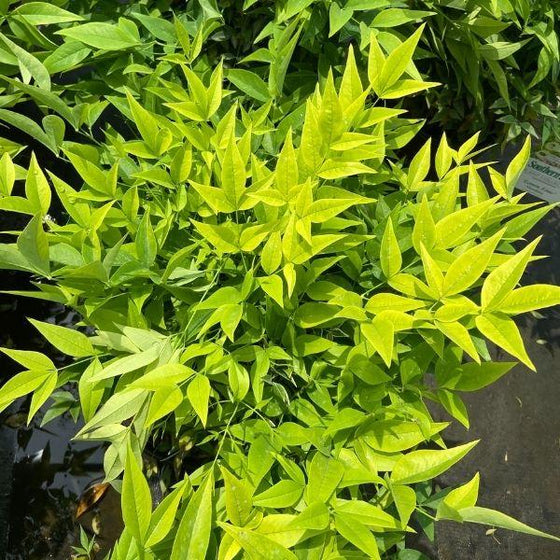
This is the Nandina I would plant in Zone 10, and the reason is the study above: 'Lemon-Lime' was one of three cultivars found to produce no fruit at all. It is also a genuinely good landscape plant on its own merits — bright lime-green to chartreuse foliage, 3 to 4 feet tall and wide, hardy in Zones 6 to 10, and the best foil I know for deep purple Loropetalum or dark glossy Gardenia foliage. Because it does not rely on red foliage for its appeal, it also opens up a fresher, brighter color palette than most Nandinas allow. If you want more options in the same fine-textured family, Flirt™ Nandina was one of the low-fruiting selections in the same study.
Blush Pink Nandina

Blush Pink Nandina is all about changing foliage color — new growth emerges pink and reddish before maturing — on a very compact plant, 1.5 to 2 feet in both directions, rated Zones 6 to 10. It works along walkways, toward the front of foundation plantings, and repeated in groups where the colorful new growth builds a stronger effect. I am linking it rather than pushing it, for one honest reason: it was not among the cultivars in the PLOS ONE fertility study, so I cannot point you to published data on its fruit set the way I can with Lemon Lime. If you plant it, shear the flowers off in spring and the question does not arise.
The Nandina I Would Skip in Florida
Gulf Stream Nandina is a widely sold, genuinely attractive compact cultivar, and it appears in our own Zone 10 shrub collection.
UF/IFAS specifically flags it. Their plant directory names 'Firepower' and 'Harbour Dwarf' as safe options while identifying 'Gulf Stream' as having high invasive potential and recommending against planting it. I am not going to recommend a plant to a Florida audience that the state's own extension service tells that audience not to plant.
'Firepower' is the UF/IFAS-approved compact Nandina, and it is a lovely thing — but its own hardiness rating tops out at Zone 9, which is why it is not one of this article's picks. If you garden in North or Central Florida rather than Zone 10, Fire Power Nandina is the one to look at. The rest of the family is in our Nandina collection.
Roses for Zone 10 Sun
Zone 10 gardeners do not have to give up Roses. They do have to pick the right ones and put them in real sun.
Red Drift® Rose
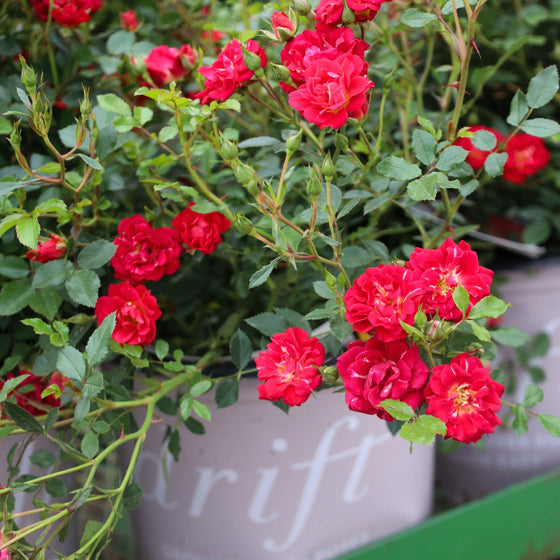
Drift Roses are useful in Zone 10 precisely because they stay low — Red Drift holds to about 1.5 to 2 feet tall and 2 to 3 feet wide, hardy across Zones 4 to 11. That lets them fit where a larger Rose would dominate: along walkways, at the front of sunny foundation beds, on slopes, around patios, or massed beneath taller shrubs. They also make an excellent transition between taller foundation shrubs and the lawn, walkway or patio. We carry Drift Roses in coral, pink, apricot, popcorn yellow, sweet pink and white as part of the wider Rose collection.
Red Knock Out® Rose

Where you want more substantial flowering impact, Knock Out Roses are the Zone 10 workhorse. Red Knock Out runs 3 to 4 feet tall and wide in Zones 5 to 11, wants full sun, and carries a long season of bloom with the disease resistance that made the series famous. That resistance matters more in Zone 10 than almost anywhere else, because heat and humidity are exactly the conditions that make black spot miserable on a traditional hybrid tea. These work in sunny foundation beds, larger mixed borders, and around outdoor living areas. The full range is in our Knock Out Rose collection.
Repetition Beats Variety
This is the single most common Rose mistake I see, and it costs nothing to fix.
A mass of one flower color creates far more landscape impact than six different colors planted randomly together. Pick a color, buy three or five, and plant them as a drift.
I also like combining Roses with evergreen foliage rather than planting them alone. Let Gardenias, Nandinas or Indian Hawthorn establish the permanent structure. Then let the Roses take the show. When the Roses are between flushes, the landscape still has a framework holding everything together.
Architectural Foliage for Hot, Dry Corners
Every Zone 10 property has a spot where the sun is brutal, the drainage is sharp, and the reflected heat off paving or a wall makes a broadleaf evergreen look tired by July.
Stop fighting it. That corner wants a different kind of plant.
Color Guard Yucca
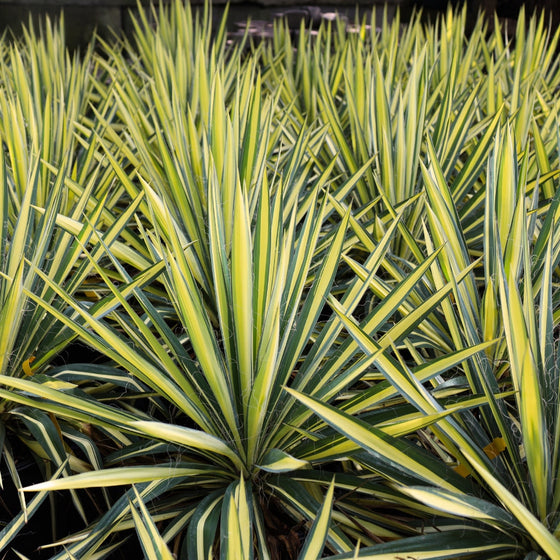
Technically, Yucca filamentosa 'Color Guard' is not the first plant most people picture when they hear the word shrub. From a landscape-design standpoint I do not care. It does the job. Sword-like foliage striped in gold and green gives strong architectural structure and an entirely different texture from rounded evergreen shrubs, at 3 to 4 feet in flower and hardy across an enormous range, Zones 4 to 10. Use it in sunny, well-drained landscapes where heat tolerance and lower water requirements matter, alongside ornamental grasses, Roses, or other plants that want the same conditions.
Red Yucca
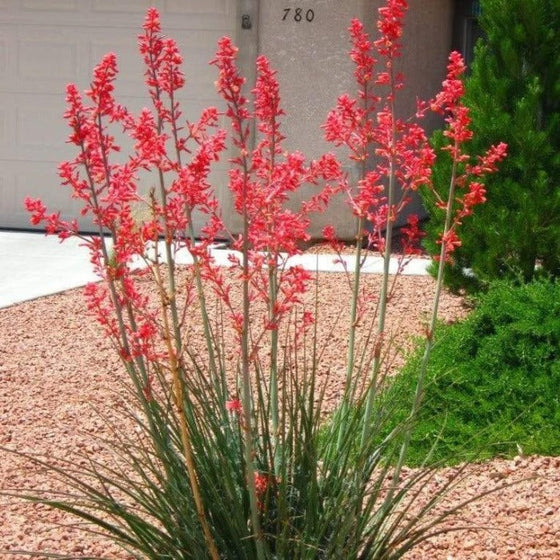
Hesperaloe parviflora is not a true Yucca at all, and it behaves differently in a good way. Narrow foliage creates a grass-like architectural mound 2 to 3 feet tall, and then coral flower spikes rise to 5 or 6 feet and stay in bloom for months, pulling in hummingbirds. It is rated Zones 5 to 10 and wants full sun. This is exactly the plant for a hot, sunny part of a Zone 10 property where traditional broadleaf shrubs feel too heavy. Combine it with stone, gravel, ornamental grasses and Roses and you get a landscape with a completely different personality from a traditional Southern garden. One or two architectural plants keep a bed full of rounded shrubs from becoming visually predictable.

Indian Hawthorn for Dependable Evergreen Mass

For a more traditional evergreen foundation plant, Eleanor Taber™ Indian Hawthorn deserves consideration. It stays compact at 3 to 4 feet tall and 2.5 to 3 feet wide, is rated Zones 7 to 10, and flowers pink in spring. This is the shrub you repeat along a foundation or through a mixed border when you need dependable evergreen mass rather than another focal point. That is an important job. Not every plant needs to scream for attention — some of the best landscape plants are the ones that quietly connect everything else.
Be Honest About Leaf Spot
Indian Hawthorn has one well-documented weakness in the humid Southeast, and it is the reason you see so many defoliated, half-dead hedges of it.
UF/IFAS describes Entomosporium leaf spot as causing leaf discoloration, leaf drop and limb dieback, and says plainly that the fungus is difficult to manage on heavily infected plants. Their advice is about placement rather than spraying: give it sun, give it well-drained soil, keep overhead irrigation off the foliage, and — this is the part people ignore — do not plant a monoculture of it.
So use Indian Hawthorn in groups of three or five inside a mixed planting, not as forty identical plants wrapping the whole house. That single change is the difference between a shrub that looks good for fifteen years and one you replace in four. It is also just a better-looking landscape.
Build the Landscape Around Evergreen Structure
One of the biggest mistakes I see is designing an entire landscape around flowers.
Flowers come and go. Structure remains.
Start with shrubs such as Gardenias, Tea Olive, Camellias, Encore Azaleas, Indian Hawthorn and other evergreen or semi-evergreen plants suited to your specific conditions. Those plants establish the bones of the garden. Then add Drift Roses, Knock Out Roses, Loropetalum, Nandina and architectural foliage plants to create the range of color and texture.
When everything is flowering, the garden looks fantastic. When nothing is at peak bloom, it still looks like a landscape. That second condition is the one that lasts most of the year, and it is the one most planting plans ignore.
Think in Layers, Not Rows
I do not want every landscape to look like three straight rows of shrubs getting progressively shorter as they approach the sidewalk.
Think in layers instead. Use taller evergreen shrubs toward the back — Tea Olive, Yuletide Camellia, larger Encore Azaleas. Bring medium flowering and foliage shrubs into the middle, where Gardenias, Sunshine Ligustrum, Knock Out Roses and Lemon Lime Nandina do their best work. Use lower plants such as Drift Roses, Purple Daydream Loropetalum and Blush Pink Nandina toward the front, where their foliage can actually be appreciated.
Then introduce something architectural — Color Guard Yucca or Red Yucca — wherever the planting needs contrast.
The goal is not perfect symmetry. It is depth.
Create Different Gardens Within the Same Property
One of the biggest lessons from The Ultimate Guide to Planting in Grow Zone 10 is that your entire yard does not have identical growing conditions. Use that to your advantage.
A protected area with morning sun and acidic soil becomes your Gardenia, Camellia and Encore Azalea garden. A shaded north foundation becomes the Gold Dust Aucuba bed. A sunny front foundation combines Lemon Lime Nandina, Knock Out Roses and Drift Roses. A bed that needs foliage contrast pairs Purple Daydream Loropetalum against Lemon Lime Nandina, letting deep purple and bright chartreuse play off one another. A hot, sharply drained corner takes Color Guard Yucca, Red Yucca and ornamental grasses.
Suddenly you are not forcing the same five plants into every corner of the property. You are letting each part of the landscape become what its conditions naturally support. If you are building the rest of the planting at the same time, our Zone 10 trees and Zone 10 perennials collections are the layers above and below these shrubs, and Best Trees for Zone 10 covers the canopy in detail.
How to Plant a Shrub in Zone 10
The planting technique matters more in a warm climate than it does further north, because a shrub here has no dormant season to recover in. Five steps.
- Match the plant to the spot before you dig. Check the sun the location actually gets in July rather than in January, note whether water stands there after a heavy rain, and find out your soil pH before planting anything acid-loving.
- Dig a hole twice as wide as the container and no deeper. Width helps roots move outward into the surrounding soil; extra depth only lets the shrub settle too low, which is the most common cause of failure in the first year.
- Set the shrub so the top of the root ball sits slightly above grade. Loosen any circling roots around the outside of the root ball with your fingers before you place it, then backfill with the native soil you removed rather than replacing it with potting mix.
- Water the shrub in thoroughly as you backfill. Water settles the soil and removes air pockets far more effectively than tamping with your foot, which compacts the soil the roots need to grow into.
- Apply 2 to 3 inches of organic mulch across the root zone, pulled back several inches from the stems. Mulch the roots, not the plant. Mounding mulch against the trunk holds moisture on the bark and invites rot.
Watering and Mulch for New Zone 10 Shrubs
Water Deeply, Then Check Before Watering Again
New shrubs need consistent moisture while they establish, especially when planted close to summer. But consistent moisture does not mean constantly saturated soil.
Water thoroughly enough to moisten the root ball and the surrounding soil, then check the soil with your finger before automatically watering again. The goal is to encourage roots to move outward into the landscape. A shrub watered lightly every day never develops a reason to.
Water in the Morning, at the Root Zone
Whenever possible, water in the morning and direct water toward the root zone rather than routinely soaking the foliage.
This is not fussiness. It is the specific thing UF/IFAS recommends to keep Entomosporium leaf spot off Indian Hawthorn, and the same logic protects Roses from black spot and Gardenias from fungal leaf problems. Overhead irrigation in a humid climate is how most shrub disease starts.
Mulch Makes a Bigger Difference in Zone 10
A 2 to 3 inch layer of organic mulch moderates soil temperature, reduces evaporation, suppresses weeds and protects developing roots. In Zone 10 the soil-temperature benefit is the one that matters most, because bare soil in full sun gets hot enough to damage shallow roots.
Just remember: mulch the roots, do not bury the plant. Keep mulch pulled slightly away from stems and crowns rather than piling it against them.
A Simple Zone 10 Shrub Palette
You do not need every Zone 10 shrub available to build a beautiful landscape. I would rather choose a smaller group and repeat it.
For an acid-soil site on the upper edge of Zone 10:
- August Beauty Gardenia for fragrance and evergreen structure
- Autumn Royalty Encore Azalea for evergreen foliage and repeat flowering
- Yuletide Camellia for cool-season flowers
- Purple Daydream Loropetalum for dark foliage and a spreading form
- Lemon Lime Nandina for bright chartreuse contrast
- Red Drift Rose for low masses of flower color
For alkaline or limestone ground in true 10b:
- Fragrant Tea Olive for fragrance, screening and pH tolerance
- Sunshine Ligustrum for gold foliage that lifts everything around it
- Eleanor Taber Indian Hawthorn for dependable evergreen mass, planted in groups
- Red Knock Out Rose for sustained flower power in full sun
- Color Guard Yucca or Red Yucca for architectural contrast
- Gold Dust Aucuba for the shaded side of the house
Then repeat. That is the important part. Repetition is what turns a collection of plants into a landscape.
Shop the Zone 10 Shrub Collection
Zone 10 Shrub Questions, Answered
What is the best all-around shrub for Zone 10?
If I had to choose one, Fragrant Tea Olive. It is hardy through Zone 11, tolerates a wide pH range rather than demanding acid soil, works as a specimen or a tall evergreen screen, and its fragrance carries across a yard. Gardenias are the more famous answer and the better one on acidic ground, but Tea Olive works in more of Zone 10 than any other shrub on this list.
Why are my Gardenia and Azalea leaves turning yellow between the veins?
That pattern is iron chlorosis, and in Zone 10 it almost always means your soil pH is too high. UF/IFAS puts the Gardenia target range at pH 5.0 to 6.5, and much of South Florida sits on limestone at pH 7.4 or above, where iron and manganese become chemically unavailable to the roots. Fertilizer will not fix it while the pH stays where it is. Either amend and acidify a defined bed, move the plant into a container of acidic mix, or switch to a shrub that does not need acid soil.
Is it safe to plant Nandina in Florida?
It depends entirely on the cultivar. UF/IFAS lists Nandina domestica as a FISC Category 1 invasive in Florida and specifically identifies Gulf Stream as having high invasive potential. The problem is fruit, and the modern compact cultivars differ enormously. A 2024 study in PLOS ONE found Lemon-Lime produced no fruit at all, with Flirt and Obsession producing 96 to 100 percent less than the wildtype. Choose a documented sterile or low-fruiting cultivar, or shear the flowers off in spring.
Can I plant Camellias in South Florida?
On the upper edge of Zone 10, in a protected part-shade spot with acidic soil, yes. In hot, bright, limestone 10b it is a genuine stretch. NC State caps Camellia sasanqua at Zone 9b, and Camellias want both acid soil and relief from afternoon sun. If you want a glossy broadleaf evergreen that flowers in the cool season and your conditions are against you, plant Fragrant Tea Olive instead.
Which shrubs handle full Zone 10 sun and reflected heat?
Color Guard Yucca, Red Yucca, Knock Out and Drift Roses, Sunshine Ligustrum and Indian Hawthorn all take open sun well. Yuccas in particular are the right answer for the hot, sharply drained corner near paving or a south-facing wall, where a broadleaf evergreen will look tired by midsummer. Gold Dust Aucuba is the opposite case and needs deep shade.
When should I plant shrubs in Zone 10?
Fall through early spring is the best window, because it gives roots months to establish before summer heat arrives. Zone 10 has no real dormant season, so container-grown shrubs can go in almost any time, but a shrub planted in June has to establish and survive at the same time. If you plant in summer, water more carefully and mulch immediately.
Woodie's Take
If I were designing a Zone 10 landscape from the ground up, I would not start by asking which shrub flowers the longest.
I would start with two questions almost nobody asks. What is my soil pH, and how much sun does this spot get in August? Answer those honestly and half the plant list writes itself. Skip them and you will spend three years wondering why a plant rated for your zone keeps failing.
Then I would start with structure. Gardenias where I could enjoy the fragrance, if my soil allowed it, and Tea Olive if it did not. Encore Azaleas where their repeat flowering could extend the season. Yuletide Camellia in the protected part-shade corner, because having a shrub in flower during the cool months is one of the real advantages Zone 10 gardeners should use.
Then I would play with foliage. Deep purple Purple Daydream Loropetalum against the bright chartreuse of Lemon Lime Nandina. Sunshine Ligustrum where a dark bed needs lifting. Gold Dust Aucuba on the shaded side. That is the kind of combination I like, because it does not depend on everything flowering at exactly the same time.
For flowers, Drift Roses toward the front of sunny beds and Knock Out Roses where I wanted more height and impact. And somewhere in the landscape, a plant that breaks the pattern — a Yucca with strong architectural foliage that keeps the whole planting from becoming a collection of round green shrubs.
Most importantly, I would not plant one of everything. I would choose the plants that fit the property and repeat them. I would use different combinations in sun and shade. I would let some shrubs provide flowers, some provide fragrance, some provide foliage color, and others simply hold the landscape together throughout the year.
Zone 10 gives you an enormous palette. The goal is not to use every plant you can grow. It is choosing the right plants, putting them in the right places, and creating a landscape that looks like it was designed to be there.