
Sycamore Trees
Fast shade and iconic bark for big landscapes and bold curb appeal.
Sycamore trees are for homeowners who want real shade quickly and don’t mind a tree with presence. They’re known for that signature camouflage bark that peels in patches, plus a broad canopy that turns a hot yard into a livable space. If you have a larger property, a wide front lawn, or a backyard where you want a true “anchor tree,” sycamore delivers the kind of scale and character you can’t fake with smaller ornamentals.
The key is planting it like the giant it becomes: full sun, room to spread, and soil that holds moisture but still drains. Sycamore is often described as tolerant of wet or compacted soils and urban conditions, which is why it can be such a practical choice for tougher sites. Establish it well in the first year, then let it grow into a long-lived shade maker under the We Grow Together Promise.

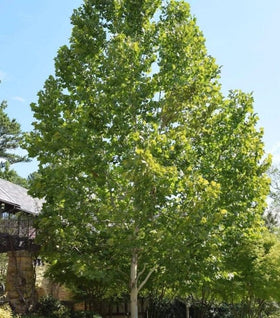
Fast shade for large yards.
Sycamore is a true shade-tree solution, with a massive canopy, a strong trunk, and a growth rate often described as moderate to rapid (commonly around 2 feet per year in good conditions). That makes it a smart pick when the goal is to cool a lawn, shade a patio area, or create a “big tree” feel on a shorter timeline than many legacy hardwoods.
This is also a functional tree for challenging sites. Sycamore is widely noted for handling moisture and even wet/compacted soils better than many trees, which makes it a practical candidate near low spots (as long as you aren’t planting into standing water). If your yard has areas that stay evenly moist after rain, sycamore can turn that condition into an advantage instead of a limitation.
Because it’s a big, long-lived tree, success is mostly about planning space. Think beyond the first five years and plant where the mature crown can spread without future conflicts with the house, driveway, or overhead lines. If you give it room and light, you get a canopy that feels intentional—rather than a tree you’re constantly cutting back to “make it fit.”
Exfoliating bark and bold canopy character.
Sycamore’s signature feature is the mottled bark, white/cream patches revealed as outer bark sheds. That trunk-and-branch pattern becomes more dramatic as the tree matures, which is why sycamore is as much a design tree as a shade tree: it looks sculptural in winter and striking up close all year.
Flowering isn’t the headline here. Sycamore produces small, wind-pollinated flowers in spring (often described as catkins/ball-like clusters), then forms the familiar fuzzy seed balls that persist and drop later. The real landscape value is structure, canopy, bark, and scale—plus the way it frames a property with a strong, classic silhouette.
Mature size is a major planning factor: sycamore is commonly listed in the 75–100 ft range, with a broad spread under good conditions, and it can become an enormous tree over time. That’s why it’s best for larger landscapes and why spacing is non-negotiable, plant it where the crown can be a crown.
Planting spots that support strong growth.
Full sun is the performance lever. Sycamore is typically recommended for full sun for best growth and canopy development, and some guidance notes that it does not tolerate shady sites well. If you want fast, dense shade and a healthy crown, give it your brightest, most open planting area.
Sycamore generally prefers moist, deep soils with good drainage, but it’s also known for broad soil adaptability (including soil pH tolerance). Translation: it can handle a lot, but it still performs best when the root zone isn’t constantly dry, and the planting site isn’t a swamp. Establishment watering plus a wide mulch ring can make a big difference early.
For spacing, plan for the mature spread, not the nursery size. A practical rule for big shade trees like sycamore is to allow on the order of 30–50+ feet of open space for canopy spread, depending on what you’re planting near and how wide you’ll allow the crown to become. If you’re lining a drive or creating a grove feel, keep trees far enough apart that crowns won’t be forced into heavy corrective pruning later.