

Best Shrubs to Plant in Fall for Color Next Spring
Published On: Aug 31, 2026
Share:
| In this Article | |||
|---|---|---|---|
There is something about that first warm stretch of spring weather that makes everyone want to start planting.
I understand it. After a long winter, we want flowers. We want color. We want to get outside and start working in the yard again.
But if you want a landscape that really comes alive next spring, one of the best times to start planting is actually this fall.
Fall planting gives shrubs an opportunity to begin establishing roots while the soil is still warm and air temperatures are cooling. Instead of asking a newly planted shrub to establish itself while also dealing with summer heat, fall gives the plant time to focus on what's happening underground.

Then spring arrives. The soil warms. The days get longer. New growth begins.
And instead of starting spring with a shrub that was just planted yesterday, you're starting with one that already has a head start.
That's why I tell gardeners: if you want more color next spring, don't wait until spring to start thinking about it. Plant this fall.
Here are some of my favorite flowering shrubs to plant in fall for a beautiful show next spring.
Forsythia: One of the First Signs That Spring Has Arrived
There aren't many shrubs that announce spring quite like Forsythia.
Those bright yellow flowers can appear while much of the rest of the landscape still looks like winter. Before the leaves fully develop, the branches become covered in yellow blooms, creating one of the earliest major flower displays in the landscape.
That's exactly why I like planting Forsythia in the fall. You're essentially planting next spring's announcement.
Garden Goods Direct carries several Forsythia selections, including the classic Lynwood Gold along with more compact varieties like Show Off Starlet, so you can choose a plant appropriate for the space you actually have.
Traditional Forsythias work beautifully along larger property lines, in informal hedges, and toward the back of mixed shrub borders. More compact selections can fit into smaller foundation beds and residential landscapes. Spring Glory Forsythia sits between the two.
Just remember to give Forsythia plenty of sunlight if you want the strongest flowering. And when pruning becomes necessary, wait until after flowering. Forsythia blooms on older wood, so pruning heavily before spring can remove the very branches that were about to flower. Our Forsythia growing guide covers the rest.
Lynwood Gold Forsythia
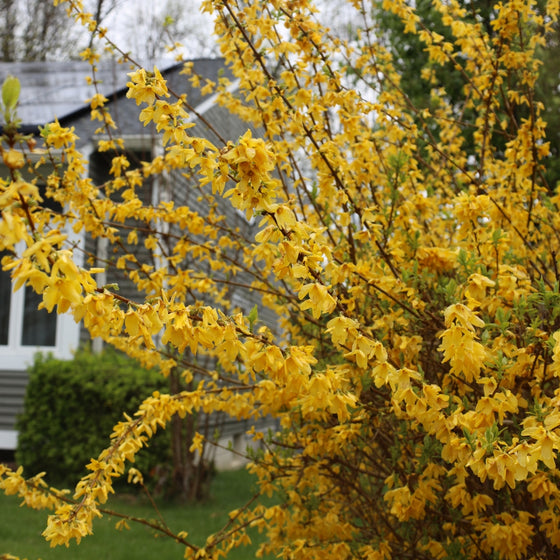
If you want that classic Forsythia look, Forsythia x intermedia 'Lynwood' is hard to beat. This is the Forsythia many gardeners picture when they think about early spring: long branches covered with brilliant yellow flowers, on a plant that reaches six to eight feet tall and wide.
I like Lynwood Gold where it has room to develop naturally. Use it along a property line, toward the back of a large landscape bed, as an informal flowering hedge, or somewhere you can see it from the house when those first flowers begin opening.
Don't try to turn every Forsythia into a perfectly round green ball. Let some of those branches develop naturally. The plant will look better, and the spring flowers will look more natural.
Azaleas: Build the Spring Landscape Around Color
If Forsythia announces spring, Azaleas celebrate it.
Few flowering shrubs can create the kind of concentrated spring color that Azaleas provide — pink, red, purple, white, coral, lavender. When Azaleas are used properly, entire sections of the landscape can change almost overnight.
They're particularly useful around foundations, beneath open-canopied trees, along woodland edges, near entrances, and throughout partially shaded gardens.
Fall is an excellent time to get them into the landscape so they can begin settling into their new location before their major spring flowering season. If you're new to them, start with our guide on how to plant Azalea bushes.
Hershey Red Azalea

Hershey Red is the kind of shrub I use when the landscape needs a strong spring focal point. The rich cherry-red flower color stands out beautifully against evergreen foliage and can be especially effective near an entrance or within a mixed foundation planting. It holds a naturally mounded three-to-four-foot form without much pruning.
Rather than planting one Hershey Red Azalea by itself, consider repeating it. Three plants create more impact than one. Five can begin defining an entire section of the landscape. Browse the rest of the red Azaleas if you want to build the whole planting around this color.
And if you have spring-flowering trees overhead, Azaleas become even more interesting. Imagine a flowering Dogwood or Redbud above a mass of Azaleas. Now you're creating layers of spring color instead of relying on a single plant to do all the work.
Gumpo White Azalea

Not every Azalea needs to become a substantial foundation shrub. Gumpo White is a dwarf Satsuki type that tops out around one to two feet tall and two to three feet wide, with a low, mounded habit and ruffled white flowers in late spring — later than most Azaleas, which is part of why I like it.
I particularly like Gumpo White toward the front of a landscape bed, along walkways, around smaller foundations, or beneath taller shrubs.
White flowers also become incredibly useful when you're trying to connect several stronger spring colors. If you already have pink, purple, or red flowers nearby, white can give the eye somewhere to rest. That's an important part of garden design. More color isn't always better. Sometimes contrast is what makes the color work. There are more options in the white Azalea collection.
Encore® Azaleas: Spring Color Is Only the Beginning

Encore Azaleas give us another approach to fall planting. You plant them now for spring flowers — but spring isn't necessarily the end of the show.
Encore Azaleas are bred to rebloom, with spring flowering followed by additional bloom cycles later in the growing season. We carry numerous varieties, including Autumn Fire, Autumn Lilac, Autumn Lily, Autumn Royalty, Autumn Starburst, Autumn Twist, Autumn Carnation, and Autumn Coral.
That's tremendous landscape value from one group of shrubs. I particularly like Encore Azaleas around foundations and entrances, wherever green foliage can provide structure year-round and flowers can return across multiple seasons. We went deeper on them in this Woodie's Picks on Encore Azaleas.
Again, don't feel like you need one of every color. Pick a color direction and repeat it. A mass of one variety generally creates much more landscape impact than a collection of unrelated colors.
Rhododendrons: Big Spring Flowers and Evergreen Structure
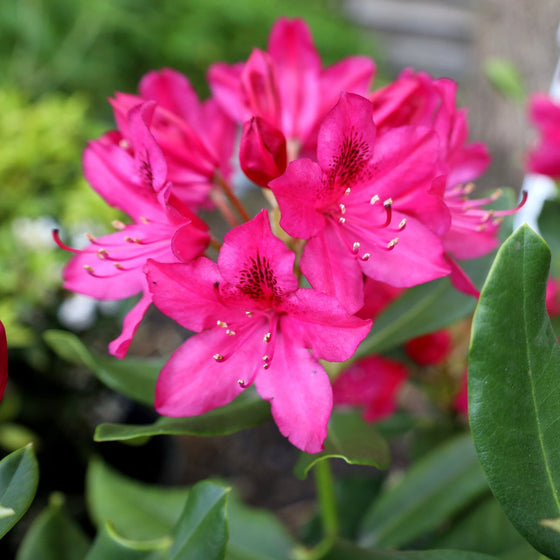
If you have the right conditions, Rhododendrons can become some of the most impressive spring-flowering shrubs in the landscape.
Their large flower clusters make a tremendous impact, while the broad evergreen foliage provides structure to the garden for the rest of the year.
That's one of the qualities I look for when choosing shrubs. I don't just want to know what the plant does during its best two weeks. What does it contribute to the other fifty weeks?
Rhododendrons answer that question with foliage.
They work especially well in woodland-inspired gardens, along partially shaded foundations, beneath high-canopied trees, and anywhere acidic, well-drained soil and appropriate moisture are available. PJM is the toughest of the group and the one I recommend first for exposed sites; Capistrano brings yellow, which is unusual in this genus; and Nova Zembla is the reliable red.
Plant them this fall, give them a good layer of mulch, and let the roots begin settling in before spring.
Pieris: Flowers, Evergreen Foliage, and Spring Growth
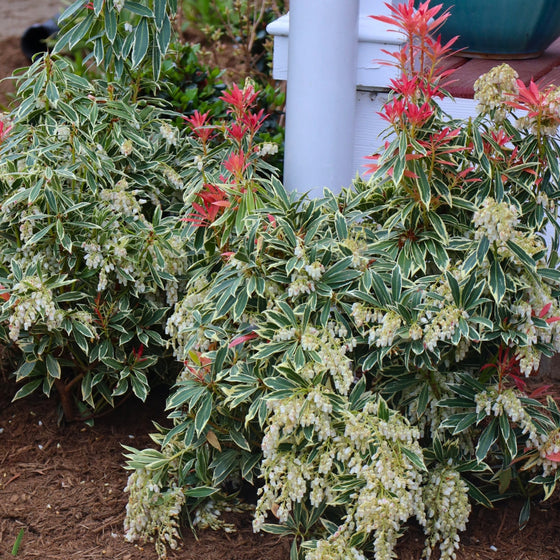
Pieris is one of those shrubs I think more gardeners should get to know.
It's a broadleaf evergreen, so you're starting with a year-round structure. Then spring arrives. Clusters of bell-shaped flowers appear, and many varieties also produce colorful new foliage that adds another layer to the display.
That's a lot happening on one shrub. Mountain Fire is the classic for that flaming red new growth, Katsura holds its wine-red color longer, and Cavatine stays compact enough for a small foundation bed.
Pieris works beautifully with Azaleas, Rhododendrons, Camellias, and other acid-loving plants. If you're creating a partially shaded foundation planting or woodland garden, this is exactly the type of shrub that can help connect everything together. We wrote more about using Pieris in the spring landscape if you want the full picture.
Mountain Laurel: Native Spring Flowers With Evergreen Foliage
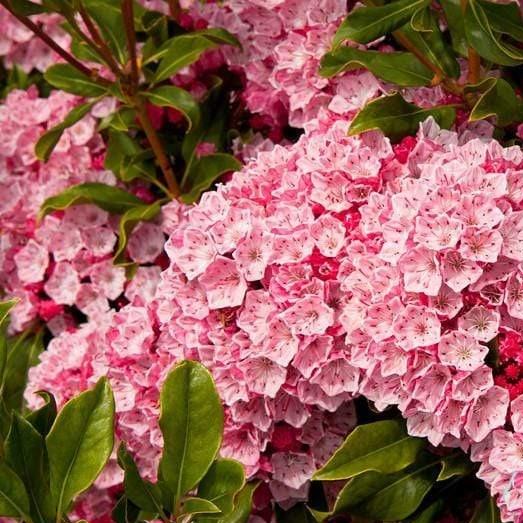
Mountain Laurel gives us another beautiful combination of spring flowers and broadleaf evergreen foliage.
Its clusters of intricately patterned flowers are unlike almost anything else in the landscape, and the evergreen leaves continue providing structure after flowering ends. Kalmia latifolia is native to the eastern United States, which is part of its appeal — you can see the rest of our native shrubs here.
I particularly like Mountain Laurel in more naturalistic and woodland-inspired gardens. Olympic Fire is the one I reach for most, and Minuet works where space is tight.
Rather than forcing it into a formal hedge, let it become part of a layered planting with Rhododendrons, Azaleas, ferns, and other shade-tolerant plants.
This is also a good example of why fall planting makes sense. You're establishing the permanent evergreen framework now, so the spring garden already has structure by the time flowering begins.
Spring-Blooming Camellias: Color Before Much of the Garden Gets Started
Depending on your growing zone, spring-blooming Camellias can be another outstanding shrub to plant in the fall. Check your zone against the USDA Plant Hardiness Zone Map before you commit — Camellias are the least cold-hardy shrubs on this list.
Camellias give you glossy evergreen foliage throughout the year and beautiful flowers when relatively few other woody plants are blooming.
That's what I call useful timing. A flower is wonderful. A flower appearing when almost nothing else is flowering is even better.
Camellias work beautifully near entrances, patios, woodland edges, and protected foundations. April Dawn is the cold-hardiest of the group we carry, Kramer's Supreme is the fragrant red, and Pink Perfection is the formal double.
Combine them with Azaleas and other acid-loving shrubs, and you can create a progression of flowers rather than one giant spring explosion followed by nothing. That's the goal. There's more on them in this Woodie's Picks on spring-blooming Camellias.
Hydrangeas: Plant in Fall for a Bigger Summer Payoff
Now we're going to stretch the idea of "next spring color" slightly.
Hydrangeas generally aren't the shrubs you're planting for an early spring flower show. But I would absolutely include them in a fall planting plan.
Why? Because spring isn't just about flowers. It's also about getting the landscape established for everything that follows.
Plant a Hydrangea in the fall, and you're giving it a head start before next year's growing season. When spring arrives, the plant can concentrate on new growth rather than simultaneously dealing with transplanting and the approach of summer.
Then comes the payoff. Summer flowers.
Limelight Hydrangea
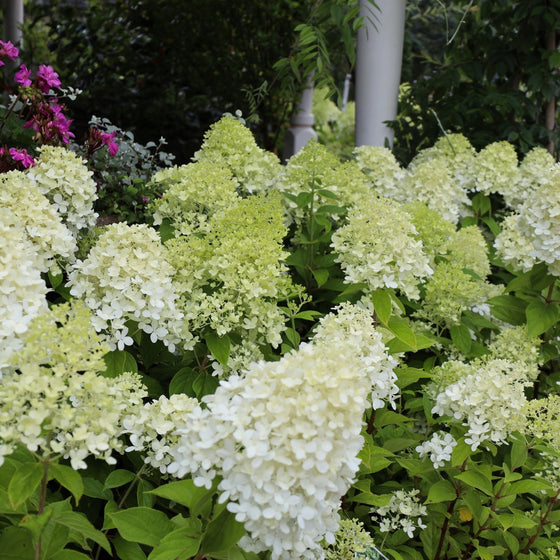
Hydrangea paniculata 'Limelight' is the panicle Hydrangea I recommend most often. It develops large flowers that transition through several colors as the season progresses — lime-green to creamy white to blush pink — and it takes considerably more sun than the bigleaf types. It reaches six to eight feet tall and wide and is hardy through Zone 3.
If you're planting for a complete next-year landscape rather than one week of spring color, Hydrangeas absolutely belong in the plan.
Don't Try to Make Everything Bloom at Once
Here's where we move from buying shrubs to actually designing a garden.
I don't want every plant flowering during the same week in April. I want a sequence.
Maybe Forsythia gets things started. Then Camellias. Then Azaleas. Rhododendrons and Mountain Laurel continue the show. Later, Roses and other flowering shrubs take over. Then, Hydrangeas carry us into summer.
That's how you create season-long color.
The goal isn't to have one spectacular Saturday. The goal is to have something interesting happening every time you walk outside.
Plant Spring Color in Layers

Another mistake I see is thinking about spring flowers only at shrub height.
Think vertically.
Imagine a spring-flowering tree, such as a Dogwood or Redbud, creating the upper layer. Below it, Azaleas or Rhododendrons create the shrub layer. At ground level, spring-flowering perennials and groundcovers complete the planting.
Now you've got flowers at three different heights. That's far more interesting than planting ten unrelated flowering shrubs in a straight line. If you want to take the idea further, we broke it down in the four layers of a woodland garden.
Caring for the Shrubs You Plant This Fall
Getting the shrub in the ground is the easy part. What you do over the next two months is what determines whether it flowers well next spring. For the planting mechanics themselves — hole width, root flare, backfill — see our full guide on planting trees and shrubs in fall and winter.
Fall Planting Gives Roots a Head Start
The biggest reason I like fall planting is simple: roots can continue developing even after the top of the plant begins to slow down.
As air temperatures cool, plants experience less heat stress. Meanwhile, soil temperatures can remain warm enough for root development well after the weather starts to feel like fall. That gives the shrub an opportunity to start establishing itself before winter. When spring arrives, the plant is already in place. There's more on the biology behind this in our article on why dormancy makes fall and winter planting work.
Of course, fall planting timing matters. You want enough time for the plant to begin settling in before the ground freezes in colder regions. In warmer climates, the fall planting window can be considerably longer. The University of Maryland Extension has good guidance on regional timing.
How to Water Fall-Planted Shrubs
Cooler weather doesn't mean newly planted shrubs no longer need water. This is one of the easiest mistakes to make.
You plant in October. The temperature drops. The lawn stops growing as quickly. And suddenly nobody thinks about watering.
But those roots are still becoming established.
Check the soil regularly and water deeply when necessary until the ground freezes in colder climates. Newly planted broadleaf evergreens such as Azaleas, Rhododendrons, Mountain Laurel, and Pieris can be particularly vulnerable if they enter winter excessively dry.
Give them moisture. Just don't keep the soil constantly saturated.
Mulch Before Winter

After planting, apply approximately 2 to 3 inches of organic mulch across the root zone.
Mulch helps moderate soil-temperature swings, conserve moisture, and protect developing roots.
But keep it away from the stems. I don't want mulch piled against the base of a shrub. Spread it outward over the root zone.
Think doughnut. Not a volcano.
Don't Push New Growth With Heavy Fall Fertilization
Fall planting is about establishing roots. It's not about forcing a bunch of tender new top growth right before winter.
I generally don't want to hit newly planted shrubs with a large dose of quick-release nitrogen fertilizer late in the season.
Plant properly. Water properly. Mulch properly. Let the plant settle in.
Then follow the appropriate spring fertilization program for the particular shrub. For the acid-lovers on this list — Azaleas, Rhododendrons, Pieris, Mountain Laurel, Camellias — that usually means Espoma Holly-tone in spring, not now.
Be Careful With Fall Pruning
If your goal is flowers next spring, this becomes especially important.
Many classic spring-flowering shrubs develop their flower buds on old wood. That means the flowers you're hoping to see next spring may already be forming on the branches this year.
If you heavily prune those shrubs during fall or winter, you may be cutting off next spring's flower display.
Forsythia and many Azaleas are good examples of plants where pruning is generally better handled after flowering, a point the University of Maryland Extension makes as well.
Don't prune simply because fall feels like cleanup season. Know what you're pruning first.
Build a Simple Fall-Planted Spring Garden
You don't need twenty different shrubs. I'd rather see you choose a few good ones and repeat them.
For example, you could use:
- Forsythia for the earliest blast of yellow.
- Spring-blooming Camellias for early flowers and evergreen foliage.
- Azaleas for concentrated spring color.
- Encore® Azaleas for spring flowers, followed by later reblooming.
- Rhododendrons for large flower clusters and evergreen structure.
- Pieris for spring flowers, colorful new growth, and evergreen foliage.
- Mountain Laurel for native character and intricate spring flowers.
- Hydrangeas to carry the flowering display into summer.
Then add spring-flowering trees and perennials around them. If you want the perennial half of this plan, we covered it separately in planting perennials in fall for spring blooms.
Now you're designing an entire season instead of buying individual plants.
Shop the Flowering Shrub Collection
Fall Shrub Planting Questions, Answered
Is fall really a good time to plant flowering shrubs?
Yes. Fall planting lets a shrub establish roots while soil temperatures stay warm and air temperatures cool, so the plant is not trying to root out and survive summer heat at the same time. Root development continues after the top of the plant slows down, which means the shrub is already settled in when spring arrives.
Will shrubs planted in fall bloom next spring?
Usually, yes. Most spring-flowering shrubs set their flower buds on old wood during the previous growing season, so a healthy Forsythia, Azalea, Rhododendron, Pieris, Mountain Laurel, or Camellia planted this fall already carries next spring's buds when it arrives. Expect a somewhat lighter first-year display than an established plant would give you, and a fuller one the following year.
How late in fall can I plant shrubs?
Plant early enough that the roots have time to begin settling in before the ground freezes. In colder regions that generally means finishing well ahead of a hard freeze; in warmer climates the fall planting window can run considerably longer. Check your USDA hardiness zone if you are unsure how much time you have.
Do I still need to water shrubs after planting them in fall?
Yes. Cooler weather does not mean a newly planted shrub is finished needing water. Check the soil regularly and water deeply when it is dry, continuing until the ground freezes in colder climates. Newly planted broadleaf evergreens such as Azaleas, Rhododendrons, Mountain Laurel, and Pieris are particularly vulnerable if they enter winter dry. Do not keep the soil constantly saturated.
Should I fertilize shrubs planted in the fall?
Skip the heavy feeding. A large dose of quick-release nitrogen late in the season pushes tender new top growth right before winter, which is the opposite of what a newly planted shrub needs. Plant properly, water, mulch, and let the shrub settle in, then follow the appropriate spring fertilization program for that plant.
Should I prune spring-flowering shrubs in the fall?
No. Many classic spring bloomers, including Forsythia and many Azaleas, form their flower buds on old wood, so heavy fall or winter pruning removes the very branches that were about to flower. Prune these shrubs after they finish flowering in spring instead.
Woodie's Take
If you want a more colorful landscape next spring, this fall is when I'd start working on it.
I'd begin with the earliest flowers. I'd find room for Forsythia somewhere I could see those yellow flowers from the house, because there are few things I enjoy more than seeing that first real sign that winter is finally losing its grip.
Then I'd build the main spring display around Azaleas. I'd use groups rather than individual plants, and I'd choose colors intentionally. If I wanted repeat flowering later in the season, I'd work some Encore Azaleas into the design.
In a partially shaded area, I'd bring in Rhododendrons, Pieris, Mountain Laurel, or Camellias. That's where you can create one of those layered gardens that feel like they've been there for years.
And I'd plant some Hydrangeas too. They aren't going to give me the first flowers of spring, but that's okay. I'm not designing for one month. I'm designing for the entire growing season.
That's really the advantage of planting in the fall. You're not waiting for next spring and then trying to create an instant landscape.
You're planting next spring's garden before spring ever gets here.
Give those shrubs the fall to begin establishing roots. Keep them watered. Mulch them properly. Resist the temptation to prune away next year's flower buds.
Then, when those first warm days arrive, and everything begins waking up, you won't be standing there wondering what you're going to plant.
You'll be watching what you planted last fall come to life.