

Best Early Fall Bloomers Perennials for Sun and Shade
Published On: Sep 10, 2024
Updated On: Sep 2, 2026
Share:
| In this Article | |||
|---|---|---|---|
Early fall is my favorite stretch of the whole gardening year. The worst of summer's heat finally loosens its grip, the light drops to a lower angle and turns gold, and the entire landscape seems to exhale.
None of that means the flower show is over. Some of the best fall-blooming perennials, flowering shrubs and ornamental grasses are only getting started in September. Asters, Sedum, Japanese Anemone, hardy Hibiscus, Bluebeard, panicle Hydrangea, perennial mums, Goldenrod and Muhly Grass will carry beds, borders and containers from late summer straight through the first hard frost.
A well-planned fall garden should feel like a second season, not the tired leftovers of summer. These are the plants I reach for to make that happen.

Why Early Fall Flowers Matter
Spring gardening gets most of the attention, and most of the budget. Fall-blooming plants quietly do some of the hardest work in the landscape.
They fill the color gap that opens when summer perennials start to look tired. They also supply nectar and pollen to bees, butterflies and other beneficial insects that are still active well into October, at a point in the season when very little else is flowering.
Fall is also the best diagnostic season you get. By early September it is obvious which parts of the garden have gone flat, where the beds have lost structure, and where you need more late-season flowers, foliage or height. Walk the yard with a notebook in the second week of September and you will build a better planting list than you ever could in May.
What Makes a Strong Fall Planting
A good fall garden is not simply a pile of late flowers. Look for a combination of:
- Long bloom periods rather than a single short burst
- Flower and foliage color that shifts as the season progresses
- Seed heads that stand through winter
- A mix of plant heights and forms
- Real late-season pollinator value
- Evergreens or dark foliage to make autumn colors read from a distance
The goal is a landscape that feels complete, not crowded.
Woodie's Picks: Six Early Fall Bloomers
If you only add six plants to the garden this fall, make it these. Every one of them is in stock, every one of them earns its space, and together they cover sun, shade, shrub and perennial.
Raydon's Favorite Aster

Raydon's Favorite is a selection of the native aromatic aster, Symphyotrichum oblongifolium, and it is the aster I recommend more than any other. It carries masses of lavender-blue, daisy-like flowers with golden centers from September until frost. NC State Extension describes the species as one of the last flowers blooming before a heavy frost, which is exactly why it belongs in a fall border. It forms a rounded clump roughly 2 to 3 feet tall and wide, wants full sun and average, well-drained soil, and tolerates dry spells once established. What it will not tolerate is ground that stays wet through winter.
Woodie's Take: One aster is pleasant. Three or five planted together change the entire fall garden. Give Raydon's Favorite room to build its natural mound and let the flowers run as a broad sweep of color.
Autumn Joy Sedum
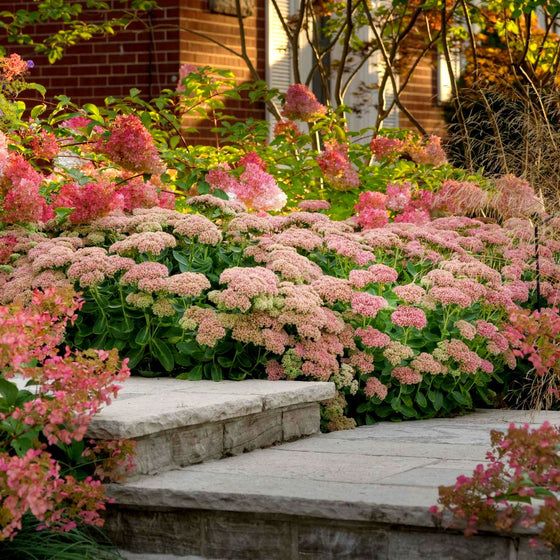
Autumn Joy is the most dependable fall-blooming perennial you can plant, and it asks for almost nothing. The broad flower heads open as pale green buds, turn pink, then deepen through rose and copper to rusty red as the season runs down. The dried heads stand all winter. Give it full sun and lean, well-drained soil. Too much water, too much fertilizer or too much shade produces floppy stems that split open in the middle, which is the single most common complaint about this plant and is almost always a care problem rather than a plant problem. For a deeper look at the genus, see our guide to planting sedums in the garden.
Woodie's Take: Autumn Joy makes you look like a better gardener than you probably are. Sun, drainage, and restraint with the fertilizer. That is the whole recipe.
Honorine Jobert Anemone
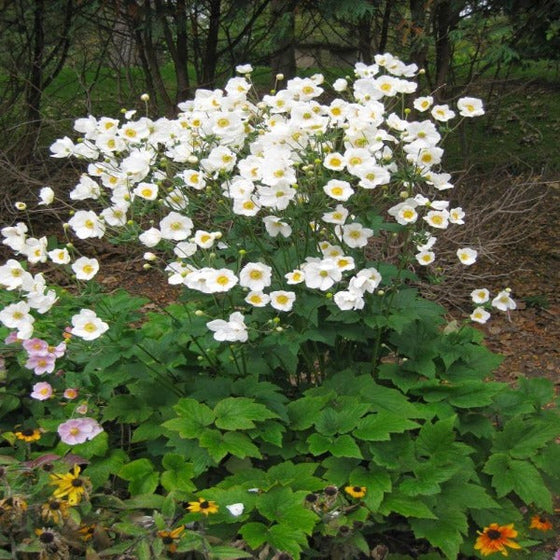
If there is one plant missing from most American fall gardens, it is the Japanese Anemone. Honorine Jobert, an Anemone x hybrida selection that has been in gardens since the 1850s, floats pure white, yellow-centered flowers on tall wiry stems well above its foliage from late summer into October. It handles part shade better than almost anything else that blooms this late, which makes it the answer to the hardest question in fall gardening: what flowers on the shady side of the house. Give it moist, well-drained soil rich in organic matter. It is slow to settle in and then spreads steadily by underground runners, so site it where that is a feature rather than a problem.
Woodie's Take: Anemones take a year to look like anything and then look like everything. Plant them where you will see them backlit in the late afternoon and be patient through the first season.
Dark Knight Caryopteris

There are not many compact shrubs that produce genuinely blue flowers in late summer and early fall, which is what makes Bluebeard so useful. Dark Knight, a Caryopteris x clandonensis selection, carries deep blue-purple flower clusters against gray-green foliage from August into September, and the bees find it within hours of opening. It runs roughly 3 feet tall and wide, so it fits a foundation bed, a mixed border or a pollinator planting without taking over. Full sun and sharp drainage are non-negotiable. Heavy or consistently wet soil kills more Bluebeard than cold ever will. Because it flowers on new growth, prune it in late winter or early spring, before growth begins.
Woodie's Take: The blue flowers get the attention, but the compact habit is what makes this plant genuinely useful. I put Bluebeard near the front of a sunny border where you can watch the pollinator traffic up close.
Midnight Marvel Hardy Hibiscus

Midnight Marvel brings tropical-looking flowers to gardens that get real winters. The scarlet flowers reach 8 to 9 inches across and sit against foliage so dark it reads nearly black. It starts in summer and keeps producing into early fall, building to 3 or 4 feet tall and wide, with the presence of a small shrub. Full sun gives the darkest leaves and the heaviest flowering. Hardy Hibiscus descends from swamp species, so unlike most sun perennials it appreciates consistent moisture and handles wet ground. Do not panic in spring when it is the last thing in the bed to show growth; that is normal for the genus. If you want the full range, our guide to perennial hibiscus covers the rest of the family.
Woodie's Take: Midnight Marvel is not a quiet plant and should not be treated like one. Give it room, steady water, and time to wake up in spring.
Sheffield Pink Chrysanthemum

Sheffield Pink is a true perennial garden mum, and it looks nothing like the tight florist globes sold for porch displays. Its single, daisy-like flowers open in soft pink to apricot with warm yellow centers, and the open form makes them far easier for late pollinators to work than a densely double mum. It blooms in October, when most of the garden has finished. Full sun and well-drained soil.
Woodie's Take: Sheffield Pink does not look like a temporary ball of flowers dropped into the landscape. It looks like it belongs there. That is the whole point.
Best Fall-Blooming Asters
Asters are the backbone of the fall perennial garden, and the differences between varieties are almost entirely about size and placement rather than culture. All of them want full sun, average well-drained soil, and air moving through the planting. Browse the full aster collection if you want to compare side by side.
Wood's Blue Aster
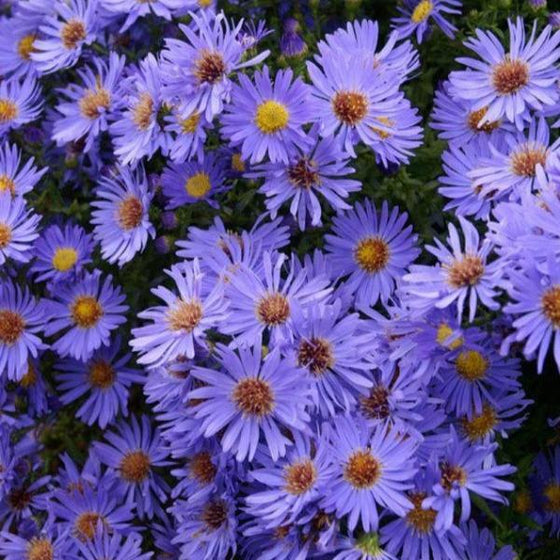
Wood's Blue is the compact option, holding at 12 to 18 inches and forming a neat mound smothered in blue daisies. That size makes it the right choice for the front of a border, along a walkway, or in a fall container, and it is the aster to try if you have written the genus off as too tall and too floppy. Water it regularly while it establishes and during dry spells, particularly while it is in flower. It looks best next to Sedum, Heuchera, compact grasses, or the warm yellow of Black-Eyed Susan.
Wood's Pink Aster
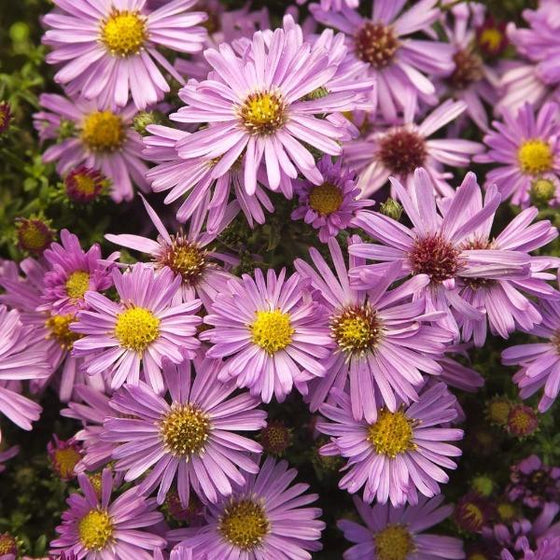
Wood's Pink is the same compact habit in rose-pink, and it is the aster that plays best with copper and bronze foliage. Paired with Autumn Joy Sedum as its flower heads deepen to rust, it is one of the most reliable color combinations in the early fall garden. Mildew resistance in the Wood's series is noticeably better than in older garden asters, which matters in a humid Mid-Atlantic September.
October Skies Aster

October Skies is the other great aromatic aster selection, a little lower and wider than Raydon's Favorite at roughly 18 inches tall by 3 feet across, with violet-blue flowers that arrive slightly later. Use it where you want the aster to spill over a wall or path edge rather than stand upright. If you are planting a drift, mixing Raydon's Favorite and October Skies extends the bloom window by a couple of weeks at no extra effort.
Two more worth knowing: Purple Dome Aster is the deep purple New England aster in a tidy 18-inch mound, and White Wood Aster is the one true shade aster, covered further down.
Japanese Anemones for Early Fall
Anemones are the most underused fall perennial in the country, and the one plant on this list most likely to make a visitor stop and ask what it is. They flower from late August into October on tall stems that move in the slightest breeze, they tolerate part shade, and deer generally leave them alone. Give them moist, well-drained soil with organic matter worked in, and expect a slow first year. Our full Anemone collection runs from 15-inch dwarfs to 4-foot border plants.
Pretty Lady Emily Anemone

Pretty Lady Emily is the compact, better-behaved anemone. It carries semi-double pink flowers on a plant roughly half the height of the old border types, and it does not run the way older Japanese Anemones do. If you have avoided anemones because you heard they spread, this is the series that solves that objection. It is also the best of the group for a large container.
September Charm Anemone

September Charm is the classic single pink, with silvery rose flowers whose backs are a deeper shade than their faces. It reaches 2 to 3 feet in flower and is the one I plant when I want the flowers floating above a mass of Hosta or fern. It is vigorous in good soil, so give it a defined bed rather than dropping it into a mixed border and hoping.
Also worth a look: Pamina for deep rose double flowers on a shorter plant, Fantasy Red Riding Hood for the most compact habit in the group, and Pretty Lady Diana for clear rose-pink singles.
Fall-Blooming Perennials for Full Sun
Beyond asters and anemones, these are the sun perennials that carry a border through September and October.
Goldsturm Black-Eyed Susan
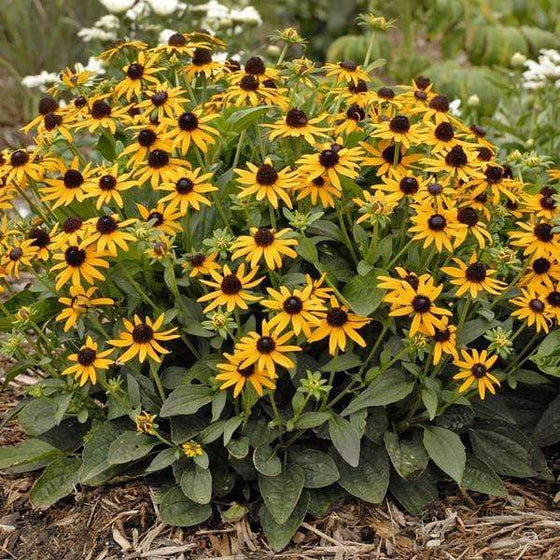
Goldsturm, a selection of Rudbeckia fulgida, is the bridge between summer and fall. Golden flowers with dark brown centers open in midsummer and frequently run into September on a healthy plant. It grows in full sun, tolerates light shade, adapts to average garden soil and becomes drought tolerant once established. Give it airflow, because crowding is what produces leaf spot in humid weather. Leave some of the seed heads standing in fall for winter texture and for the goldfinches.
Fireworks Goldenrod
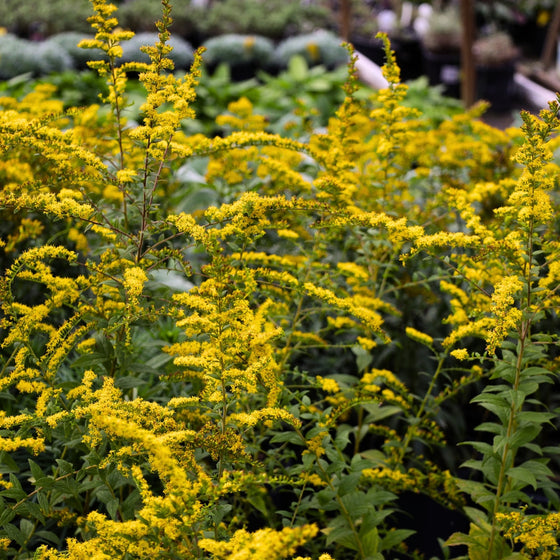
Goldenrod carries an entirely undeserved reputation. It does not cause hay fever; ragweed, which blooms at the same time and has wind-borne pollen, does. Goldenrod pollen is heavy and insect-carried, and the plant is one of the most valuable late-season nectar sources in the eastern United States. Fireworks is the garden-worthy selection of Solidago rugosa, throwing arching sprays of tiny gold flowers outward in every direction rather than forming the coarse upright clump of the roadside species. It reaches 3 to 4 feet, needs full sun, and is best in average to lean soil. Rich ground makes it flop. See also Solar Cascade Goldenrod for a more upright habit.
Helenium

Helenium, or sneezeweed, is the hot-color counterpart to all the blue and pink in a fall border. The Mariachi series stays compact at roughly 18 to 24 inches, which solves the flopping problem the taller old varieties are known for, and the flowers carry red, orange and mahogany around a prominent brown cone. Unlike most of this list, Helenium wants consistent moisture and will not forgive a dry summer. Plant it in full sun in soil that holds water. We have written about it before in our piece on Helenium as an early fall garden essential.
Autumn Fire Sedum
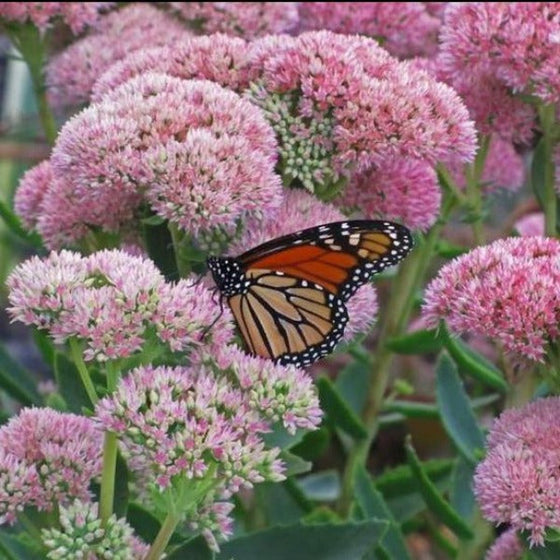
Autumn Fire is the improvement on Autumn Joy that most gardeners have never heard of. It holds its stems more upright, the flower heads are denser and the color runs a deeper rose-red, and it stays presentable later into the season. Culture is identical: full sun, lean soil, sharp drainage, and no fertilizer. If you have had Autumn Joy split open on you more than once, plant this instead.
Rounding out the sun list, Russian Sage keeps producing hazy blue-purple spikes into September and is close to indestructible in hot, dry, well-drained ground.

Fall-Blooming Plants for Shade
Almost every list of fall flowers assumes full sun, which leaves the shady side of the house looking finished by Labor Day. It does not have to. Three plants do most of the work here.

Toad Lily
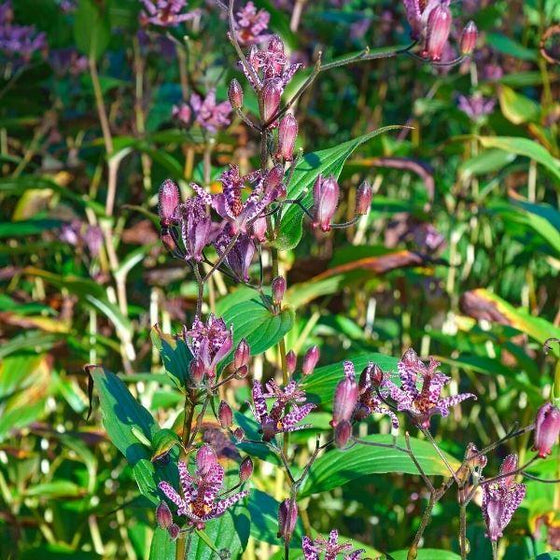
Toad Lily, Tricyrtis, is the strangest and best shade plant of the fall. The flowers are small, orchid-like, and speckled in purple on white, and they open along arching stems in September and October, right when a shade garden is otherwise nothing but foliage. Because the flowers are small, placement matters more than with anything else on this list: put it at the edge of a path or beside a bench where people will actually look at it, not at the back of a bed. It wants shade to part shade and soil that never dries out completely.
White Wood Aster

White Wood Aster, Eurybia divaricata, is a native woodland species and the only aster I would plant in real shade. It carries loose sprays of small white flowers on dark, almost black wiry stems from late August into October, and it will colonize dry shade under mature trees, which is the hardest site in most yards. It is not a tidy plant. It is a plant that solves a problem nothing else solves.
The Japanese Anemones covered above are the third piece. They will take more shade than most sources give them credit for, though flowering thins out below about four hours of light. Morning sun with afternoon shade is the sweet spot, and in the Mid-Atlantic that combination also spares the foliage from scorching in a hot September.
Add Heuchera for foliage color underneath and a shade bed will hold up until frost.
Shrubs That Bloom in Early Fall
Perennials get the credit for fall bloom, but a few shrubs do the same job with more structure and less maintenance.
Little Lime Hydrangea

Little Lime starts flowering in summer, but its most interesting color arrives as fall approaches. The panicles open lime green, soften to creamy white, then pick up blush pink, rose and burgundy as nights cool. Instead of one static flower color you get a plant that changes with the season. It holds at roughly 3 to 5 feet tall and wide, which delivers most of the impact of a full-size panicle hydrangea in a fraction of the space. Full sun to part shade and moist, well-drained soil; more sun means stronger stems and heavier flowering in cooler zones, while afternoon shade helps in the South. It flowers on new wood, so prune in late winter or early spring.
One honest caveat: panicle hydrangeas are grown for display rather than for pollinators. The showy florets are sterile. Pair Little Lime with asters, Sedum and Bluebeard if late-season nectar is part of the plan.
Bluebeard is covered in the picks above, but it belongs in this list too, because it is the only genuinely blue-flowered shrub most gardens can grow in September. Dark Knight Caryopteris is the one to plant, and it belongs at the front of a sunny border where the pollinator traffic becomes part of the show.
Fall Camellias

Camellias take over where this article leaves off. Camellia sasanqua selections begin flowering in October and carry into December in Zone 7 and warmer, which makes them the natural next layer after the asters and anemones finish. Browse the fall-blooming camellia collection, or read our piece on camellias that carry through fall and winter.
Ornamental Grasses That Flower in Fall
Grasses are a full subject of their own, and we cover them properly in our guide to the best ornamental grasses for any season. Two of them flower dramatically enough in early fall to belong in a bloom article.
Pink Muhly Grass
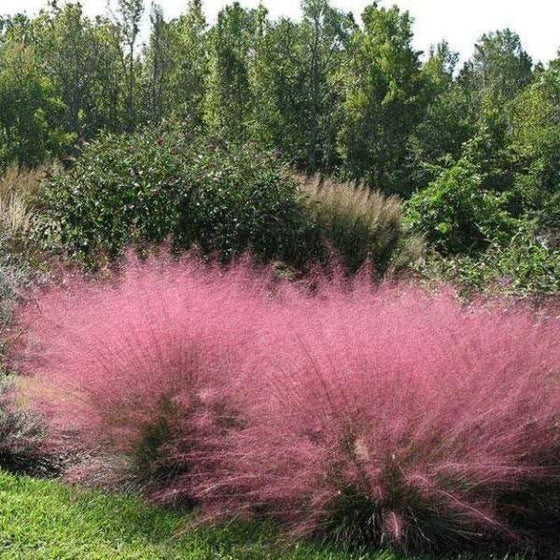
Muhlenbergia capillaris spends spring and summer as a tidy green mound and then, in early fall, throws up clouds of rose-pink flowers that catch the light and move with the slightest breeze. It is most effective in groups; a single plant is attractive but a drift of five is unforgettable. Full sun and sharp drainage, especially over winter. Leave the foliage and dried flowers standing and cut back in late winter.
White Cloud Muhly Grass

White Cloud Muhly Grass is the same plant in white, and it is the better choice against a dark evergreen background or in a planting where the pink would fight with nearby flowers. It also tends to run slightly taller. If you are already using pink asters and rose-toned Sedum, White Cloud is the version that will not compete.
Two more that flower and then hold their seed heads all winter: Standing Ovation Little Bluestem and Shenandoah Switchgrass, both of which turn red and burgundy in fall.
How to Design an Early Fall Garden
A good fall garden does not need dozens of different plants. It needs a handful of dependable performers arranged so their colors, heights and forms work together.
Layer Plants by Height
Put the tall things at the back: Midnight Marvel Hardy Hibiscus, Fireworks Goldenrod, September Charm Anemone, the larger asters. Fill the middle with Little Lime Hydrangea, Bluebeard and Pink Muhly Grass. Finish the front with Autumn Joy Sedum, Wood's Blue Aster and Helenium.
Mix Flower Shapes
Asters, mums, Helenium and Black-Eyed Susans all produce daisies. Break the repetition with the broad flat heads of Sedum, the cone-shaped panicles of Little Lime Hydrangea, the outsized blooms of hardy Hibiscus, and the haze of Muhly Grass. A garden gets interesting when everything is not the same shape.
Use Repetition
Repeating one plant in several places is what makes a border read as designed rather than collected. Three groups of Autumn Joy Sedum will always look better than three unrelated plants scattered through a bed. In larger spaces plant in drifts, not dots, and use odd numbers.
Add a Dark Background
Dark evergreen foliage makes pale, blue, pink and white flowers read from across the yard. Little Lime Hydrangea in front of an evergreen hedge is the classic example, because its changing flower color stays visible at a distance. Dark-leaved plants do the same job at a smaller scale, which is part of why Midnight Marvel works so hard: it supplies its own background.
Plan for the Low Sun

This is the design move most people miss. From late September the sun sits low enough to shine through plants rather than down onto them. Anything translucent, meaning Muhly Grass, Little Bluestem, anemone stems and the seed heads of Black-Eyed Susan, should be placed on the west or south side of a viewing point so it lights up in the last two hours of the day. It costs nothing and it is the single biggest visual upgrade available to a fall garden.
When to Plant Fall Bloomers
Early fall is a good planting season in most regions. Air temperatures drop, soil stays warm, plants experience less heat stress, and roots keep developing after top growth slows.
There is a real caveat, and it is worth knowing before you buy. University of Maryland Extension notes that perennials which flower in late summer or autumn may transplant with less interruption in growth if planted in spring, and that spring-flowering perennials are the ones that acclimate more smoothly when planted in late summer or early fall. Clemson Cooperative Extension says the same thing about garden mums specifically: spring-planted mums produce a more robust plant for the fall landscape.
That does not mean do not plant now. It means plant early in the fall window rather than late, water more attentively than you would in spring, and be realistic about which plants are the safe bets. Asters, Sedum, Goldenrod, Black-Eyed Susan and Bluebeard planted in early September in Zone 6 or warmer establish reliably. Perennial mums, Helenium and Japanese Anemone are the three on this list I would most want in the ground by mid-September, or would otherwise hold until spring in a colder zone.
How to Plant a Fall Bloomer
- Match the plant to the site first. Check sun hours honestly and check that the spot drains. Winter wet kills more asters, Sedum and Bluebeard than winter cold does.
- Dig the hole wide, not deep. Make it two to three times the width of the container and no deeper than the root ball. Loosening a wide, shallow area is what lets roots run before the ground cools.
- Set the plant level with the surrounding soil. The top of the root ball should sit flush with grade. Planting the crown below grade is the most common cause of rot in fall-planted perennials.
- Backfill with native soil and water it in. Skip the amendments in the planting hole; they encourage roots to circle rather than move out into the surrounding ground. Water deeply enough to settle the soil around the roots.
- Space for mature width. A 2 to 3 foot aster needs 2 to 3 feet. Crowding a fall planting is how you get mildew the following September.
- Mulch, keeping it off the crown. Two to three inches over the root zone moderates soil temperature and holds moisture. Pull it back an inch or two from stems and crowns.
- Keep watering until the ground freezes. Sunny, windy fall weather dries new plantings faster than most people expect. Cool air does not mean the plant is done needing water.
Skip heavy fertilizer entirely. Feeding in fall pushes tender growth that will not harden off before the first freeze.
Caring for Fall-Blooming Plants
A few simple practices decide whether these plants flower well or merely survive.
Keep Watering During Dry Weather
A plant that runs dry while it is setting buds produces fewer flowers or finishes early. This is the single most common reason a fall garden underperforms, and it happens in August, weeks before anyone notices. Water deeply at the base rather than sprinkling the surface.
Avoid Late Heavy Pruning
Do not prune fall-blooming perennials or shrubs while they are preparing to flower; you will remove the buds. Plants that bloom on new wood, including Bluebeard and Little Lime Hydrangea, get their main pruning in late winter or early spring instead.
Pinch Selected Perennials Before Midsummer
Asters and perennial mums can be pinched earlier in the season to encourage branching and a fuller habit. Clemson recommends starting when the plant reaches 6 inches, removing the top half inch to inch of new growth about every four weeks, and stopping in early July in cooler areas or early August closer to the coast. Stop on schedule; pinch too late and you remove the flower buds you were trying to multiply. Pinching only part of a clump will stagger the bloom period.
Leave Healthy Stems Standing
There is no need to cut every perennial to the ground after the first frost. University of Maryland Extension notes that perennials and grasses left standing provide shelter and seed for birds and other wildlife through winter, and specifically names Black-Eyed Susan seed heads as both attractive and a good food source. Remove diseased foliage, but leave healthy stems from asters, Sedum, Rudbeckia and grasses until late winter.
Divide on the Right Schedule
Asters, Sedum and mums all decline in the center after three or four years. Divide them in spring rather than fall, when the plant has a full season to rebuild before it has to flower. Dividing a fall bloomer in September is asking it to establish and perform at the same time.
Shop the Fall Interest Plant Collection
Woodie's Take
A fall garden should not feel like the end of something. It should feel like the landscape changed gears.
The colors deepen, the light softens, and flowers that looked ordinary in July suddenly stand out. A blue aster next to a copper Sedum, or a drift of Muhly Grass lit from behind at six in the evening, is every bit as good as the first tulip of spring, and it lasts longer.
You do not need to replant the yard. Start with the part of the garden that goes flat first, usually whatever bed you were proudest of in June. Put in a group of asters, one dependable Autumn Joy Sedum, and one compact flowering shrub. If that bed gets afternoon shade, make the anemone the first purchase instead. Build from there next year.
Plant for spring, enjoy summer, but always save a little room for fall.
Fall-Blooming Plant FAQs
What flowers bloom in early fall?
Asters, Autumn Joy Sedum, Japanese Anemone, Black-Eyed Susan, Goldenrod, Helenium, hardy Hibiscus, perennial Chrysanthemum, Bluebeard, Toad Lily and Pink Muhly Grass all provide color from late summer into early fall. Exact bloom timing depends on your climate and the variety.
What are the best fall-blooming perennials for full sun?
Raydon's Favorite Aster, Wood's Blue Aster, Autumn Joy Sedum, Fireworks Goldenrod, Midnight Marvel Hardy Hibiscus, Sheffield Pink Chrysanthemum and Goldsturm Black-Eyed Susan all perform best with six or more hours of direct sun.
What blooms in fall in the shade?
Three plants do most of the work: Japanese Anemone, which takes part shade and flowers from late August into October; Toad Lily, which flowers in real shade in September and October; and White Wood Aster, a native species that will colonize dry shade under mature trees. Adding Heuchera for foliage color keeps a shade bed reading well until frost.
Which fall-blooming plants attract pollinators?
Asters, Goldenrod, Sedum, Bluebeard, Helenium, single-flowered perennial mums and Black-Eyed Susan all provide nectar or pollen for late-season pollinators. Planting several species extends the food supply across the season. Note that panicle hydrangeas are grown for display and their showy florets are sterile, so they do not contribute nectar.
Does goldenrod cause hay fever?
No. Goldenrod pollen is heavy and carried by insects rather than wind, so it does not travel far enough to trigger seasonal allergies. Ragweed blooms at the same time, produces light wind-borne pollen, and is the actual cause. Goldenrod simply happens to be the showy plant standing next to it.
Can I plant fall-blooming perennials while they are flowering?
Yes, provided you handle them carefully and water consistently. Plant as early in fall as you can so roots have time to establish before the ground freezes. Be aware that University of Maryland Extension notes late-summer and autumn-flowering perennials often transplant with less interruption when planted in spring, so in a colder zone late-season purchases are the ones most worth holding until spring.
Should fall-blooming plants be cut back after frost?
Not necessarily. Healthy stems and seed heads provide winter interest, food for birds and overwintering habitat for beneficial insects. Remove anything with serious pest or disease damage, but leave healthy growth standing until late winter or early spring.
What can I plant with asters for fall color?
Asters pair well with Autumn Joy Sedum, Black-Eyed Susan, Fireworks Goldenrod, Pink Muhly Grass, Little Bluestem, Switchgrass, Heuchera and compact flowering shrubs such as Bluebeard. The reliable formula is blue or purple daisies against warm copper, gold and rust.
Are panicle hydrangeas fall bloomers?
Panicle hydrangeas usually begin flowering in summer, but the flowers stay attractive into fall and shift from white or green to pink, rose and burgundy as nights cool. That makes them valuable transitional plants for the early fall landscape rather than true fall bloomers.
Why is my Sedum flopping open in the middle?
Almost always too much of something: too much water, too much fertilizer, or too much shade. Upright Sedum wants full sun, lean soil and sharp drainage. If the site is right and the plant is more than three or four years old, divide it in spring. Autumn Fire holds its stems more upright than Autumn Joy if you want to replace rather than manage.