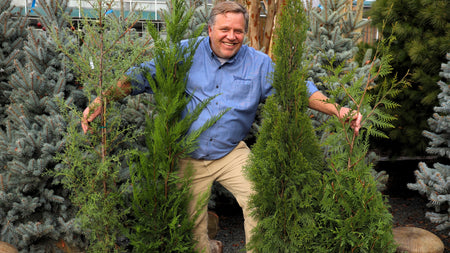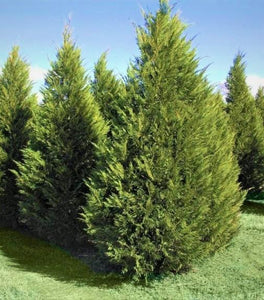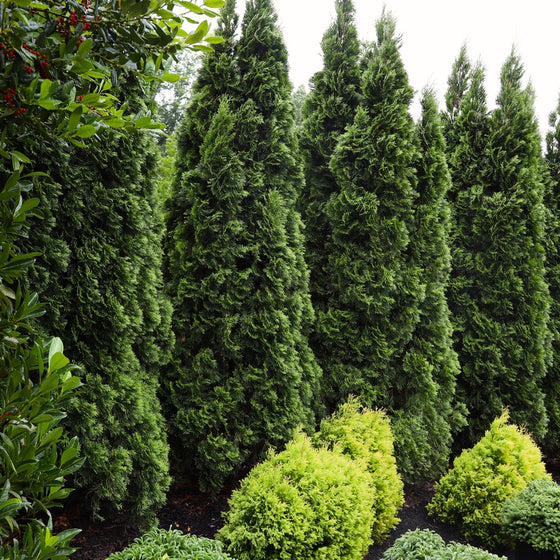


Images Depict Mature Plants
Emerald Green Arborvitae
Thuja occidentalis 'Emerald Green'
Emerald Green Arborvitae is one of the best choices when a customer wants privacy but does not have room for a giant evergreen. It gives you that clean, formal, year-round screen in a narrow footprint that fits along fences, driveways, patios, and property lines. I like it because it looks polished without needing constant pruning. The two things I always stress are watering during establishment and protecting it from deer where browsing is heavy.

EXTENDED MEMORIAL DAY SALE 20% OFF
Use Code EXTENDED20 at Checkout!
📦 Free shipping on orders over $99.
Delay shipping by leaving us a message at Checkout.
Share:

Narrow Evergreen Privacy Trees for Clean Year-Round Screening
A Classic Privacy Tree for Tight Spaces.
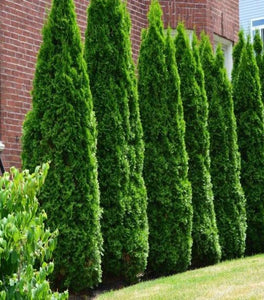
Emerald Green Arborvitae is one of the most trusted evergreen privacy trees for homeowners who want year-round screening in a narrow footprint. Its dense, upright, pyramidal shape makes it ideal along fences, property lines, driveways, patios, pool areas, and side yards where wider evergreens would take up too much room. The rich emerald-green foliage creates a clean living wall that stays attractive through winter.
Dense Green Foliage in Every Season.
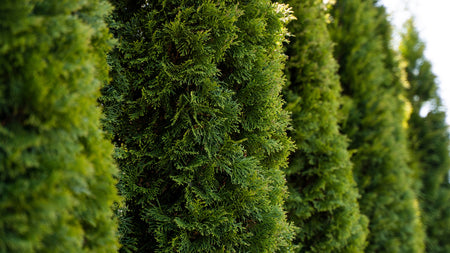
This arborvitae is prized for its glossy, bright green foliage and tidy conical form. The scale-like sprays of foliage stay dense from top to bottom when planted in good light and given proper spacing. Unlike some evergreens that bronze heavily in winter, Emerald Green Arborvitae is valued for maintaining a strong green color through cold weather, providing the landscape with dependable four-season structure.
Perfect for Privacy Hedges and Property Lines.
Plant Emerald Green Arborvitae in rows to create a natural evergreen fence, or use single trees as vertical accents near entrances, corners, and mixed borders. For a faster solid hedge, space plants about 2 to 3 feet apart on center. For a looser, more defined row, space them about 3 to 4 feet apart. This makes Emerald Green especially useful when customers want privacy without planting a massive tree.
Cold Hardy, Adaptable, and Low Maintenance.
Emerald Green Arborvitae grows best in full sun to part shade and average, medium-moisture, well-drained soil. It is cold-hardy in northern climates and adaptable to many residential landscape settings as long as the soil does not become extremely dry or waterlogged. Regular watering during the first 1 to 2 years is the key to strong establishment, dense foliage, and long-term performance.
An Honest Choice for Deer-Aware Landscapes.
Emerald Green Arborvitae is a beautiful and practical evergreen, but it is not deer-proof. In areas with heavy deer pressure, especially during winter, deer may browse the foliage and damage young hedges. Use repellents, fencing, or protective placement where deer are common. When deer pressure is low to moderate, Emerald Green remains one of the best narrow evergreens for clean, formal privacy.
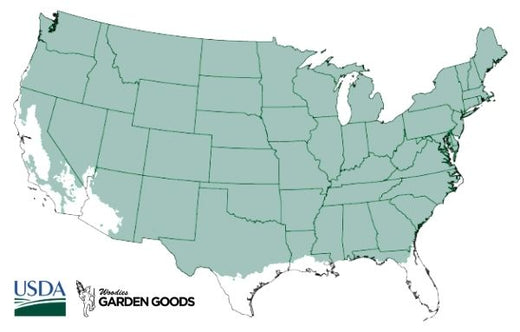
| Hardiness Zone: | 3-8 |
|---|---|
| Mature Height: | 12 to 15 feet |
| Mature Width: | 3 to 4 feet |
| Sunlight: | Full sun to Part Shade |
| Soil | Average, medium-moisture, well-drained soil; avoid extremely dry or soggy sites |
| Water | Regular watering for the first 1 to 2 years; moderate drought tolerance once established |
| Bloom Time / Color | Grown for evergreen foliage, not flowers |
| Foliage: | Evergreen; Glossy bright green, scale-like foliage in dense fan-shaped sprays |
| Ornamental Features | Narrow pyramidal form, bright green foliage, year-round privacy, formal evergreen structure |
| Wildlife Value | Dense evergreen branching can provide shelter for birds and small wildlife |
| Resistance | Cold hardy; generally pest and disease resistant; not reliably deer-proof |
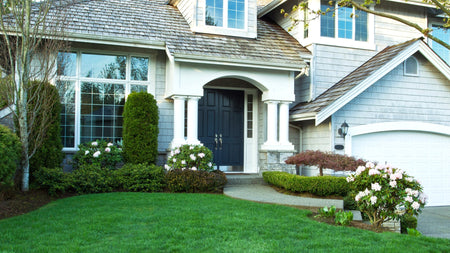
| Landscape Uses | Privacy hedges, evergreen screens, property lines, driveway borders, pool screens, foundation plantings, accent specimens, large containers, narrow side yards |
How to Care for Emerald Green Arborvitae
Once you buy an Emerald Green Arborvitae, make sure to read about the care instructions that are required and recommended to keep this plant healthy and thriving.

How should I plant Emerald Green Arborvitae?
Plant Emerald Green Arborvitae in full sun to part shade where the soil is well drained and the tree has enough room to reach its mature height and width. For a privacy hedge, mark the planting line first so the row stays straight and spacing is consistent. Space trees about 2 to 3 feet apart for a faster solid screen or 3 to 4 feet apart for a looser, more defined row. Dig a hole about twice as wide as the root ball and no deeper than the root mass. Set the top of the root ball level with or slightly above the surrounding soil, backfill with native soil, and water thoroughly to settle the roots. Add a 2- to 3-inch mulch layer over the root zone, keeping mulch pulled back from the trunk to prevent rot.

How often should I water Emerald Green Arborvitae after planting?
Water Emerald Green Arborvitae deeply after planting and keep the root ball consistently moist during the first growing season. In most conditions, deep watering 1 to 2 times per week is a good starting point, adjusting for rainfall, heat, wind, soil type, and planting size. The goal is to soak the root ball and surrounding soil rather than sprinkle the surface. After the first full year, water during extended dry periods, especially in summer and early fall. Established Emerald Green Arborvitae has moderate drought tolerance, but it will look fuller and healthier with occasional deep watering. Avoid letting young plants become extremely dry, and avoid soggy soil that holds water around the roots.

When should I fertilize Emerald Green Arborvitae?
Fertilize Emerald Green Arborvitae in early spring as new growth begins. Use a balanced slow-release fertilizer formulated for trees and shrubs, or apply a light topdressing of compost around the root zone. Avoid overfertilizing, especially late in the season. Too much fertilizer can push soft growth that is more vulnerable to stress. Good soil moisture, mulch, sunlight, and proper spacing are more important than heavy feeding.

When and how should I prune Emerald Green Arborvitae?
Prune Emerald Green Arborvitae lightly in late spring to early summer after the first flush of growth begins to firm up. Use clean pruners or hedge shears to shape only the outer green growth and maintain the natural narrow pyramid form. Avoid cutting into old bare wood where no green foliage remains, because arborvitae do not reliably regrow from deep cuts. Keep the top slightly narrower than the base so sunlight reaches the lower branches. Remove broken, dead, or snow-damaged branches as needed.