

Planting Groundcovers in Fall: What to Plant & Where
Published On: Aug 26, 2026
Share:
| In this Article | |||
|---|---|---|---|
When fall arrives, most gardeners start thinking about planting trees, shrubs, spring bulbs, and maybe a few last-minute perennials. Those are all good choices, but there is another group of plants I think deserves a lot more attention this time of year: groundcover plants.
Fall is a wonderful time to look down.
Look underneath your trees. Look between your shrubs. Look along the edges of your walkways and retaining walls. Look at that slope you hate mowing, or the shady corner where grass has given up. Look at all those places where you spread mulch every spring, only to wonder where half of it went by August.
Those empty spaces aren't really empty. They're opportunities.

Planting perennial groundcovers in fall can transform bare soil into a living layer of foliage, flowers, texture, and roots. Instead of continually fighting weeds, erosion, patchy turf, exposed soil, and disappearing mulch, you can put plants to work solving those problems for you.
And fall gives many hardy groundcovers exactly what they need to get started: cooler air, warm soil, less heat stress, and time to begin establishing roots before winter.
Why Fall Is a Great Time to Plant Groundcovers
We tend to associate planting with spring because that's when everything looks like it's growing. But what we see above the soil is only half the story.
As fall air temperatures cool, the ground can remain relatively warm for weeks. Hardy perennials can use this period to begin establishing roots without simultaneously dealing with the heat and moisture stress of summer.
That's particularly useful with groundcovers because we're usually planting more than one plant. We're creating a colony that eventually needs to spread, meet its neighbors, and knit together.
Get that process started in the fall, and your groundcover planting can be ready to resume growth when spring conditions return. It's the same logic behind fall planting generally, and groundcovers may benefit from it more than almost anything else we sell.
There is another practical reason I like fall planting for groundcovers: fall shows you where your landscape needs them.
After living with the garden all summer, you know where the weeds kept coming back. You know which slope washed out during thunderstorms. You know where the grass struggled beneath a shade tree. You know where mulch disappeared and which planting beds looked unfinished.
Instead of forgetting those problems over winter and rediscovering them next May, fix them now.
What a Groundcover Plant Actually Does
A groundcover is simply a plant used to cover and visually connect an area of soil.
Some groundcovers stay only a few inches tall and spread into tight carpets. Others form slightly taller clumps or colonies. Some are evergreen or semi-evergreen, while others disappear during winter and return each spring. Some produce spectacular flowers, while others are valued almost entirely for their foliage.
That's important because there isn't one "best groundcover."
There is the best groundcover for a particular place and purpose.
A sunny, dry slope might call for Creeping Phlox, low-growing Sedum, Ice Plant, or Creeping Thyme. A shaded bed underneath mature trees may be better suited to Pachysandra, Mondo Grass, Liriope, Ajuga, or Woodland Phlox. If you want the longer background on the whole category, our guide to what ground covers are and how to use them covers the types and spacing math in more detail.
Start with the problem you're trying to solve, then select the plant.
That's much better gardening than falling in love with a plant first and trying to convince your yard to accommodate it later.
Why Use Groundcovers in the Landscape?
Groundcovers are sometimes treated as filler plants. I think that dramatically undersells what they can do.
Trees establish the ceiling of a landscape. Shrubs create the walls and major masses. Perennials provide layers of flowers, foliage, and seasonal change. But the lowest layer — the layer running along the ground — is what visually ties everything together.
That's where groundcover plants shine.
A good groundcover planting can:
- Cover bare soil
- Reduce weed competition once established
- Reduce the amount of mulch needed over time
- Help stabilize slopes and reduce erosion
- Replace struggling turf in difficult locations
- Add flowers and foliage to otherwise empty spaces
- Soften retaining walls, walkways, rocks, and bed edges
- Provide habitat and, with flowering varieties, forage for pollinators
- Reduce mowing in hard-to-reach areas
- Create a finished, layered landscape appearance
I particularly like using groundcovers underneath shrubs. Too many landscapes have beautiful hydrangeas, azaleas, hollies, or other shrubs floating individually in seas of mulch. Bring a compatible groundcover through that lower layer, and suddenly the whole planting starts looking like a garden rather than a collection of individual plants.
Think of Groundcovers as Living Mulch
This may be my favorite way to think about them.
Mulch is useful. It protects soil, conserves moisture, reduces weeds, and gives planting beds a finished appearance. But mulch is temporary. It decomposes, fades, washes away, blows around, and eventually needs to be replaced.

A healthy groundcover does something mulch cannot do.
It grows.
Plant a groundcover properly, and it becomes more useful as it matures. Individual plants expand. Gaps get smaller. Roots occupy more of the soil. Leaves shade the surface. The planting begins functioning as its own living layer.
You may still want mulch between new plants during establishment, but as the groundcovers fill in, your dependence on mulch can decrease.
That's a pretty good trade: replace something you repeatedly buy with something that repeatedly grows.
Groundcovers Can Help Suppress Weeds
Let's be careful with the wording here. No plant magically eliminates weeds.
But a dense, established groundcover can make life much harder for them.
When groundcover foliage shades the soil and its roots occupy available growing space, many weed seedlings have a tougher time getting started. That's one reason I like planting groundcovers at a spacing that creates reasonably fast coverage, rather than scattering individual plants several feet apart and waiting years for them to meet.
You still need to weed while the planting is establishing. In fact, the first season may require the most attention because open soil remains between young plants.
Think of it as an investment.
Do the work early. Help the groundcover close the gaps. Once it forms a continuous planting, maintenance often becomes much easier.
Groundcovers for Slopes and Erosion Control
If you have a steep slope that is difficult to mow, constantly loses mulch, or experiences soil erosion during heavy rain, groundcovers for slopes are worth considering.

The goal isn't merely to hide the soil. You want roots throughout that upper soil profile and foliage intercepting rainfall before it pounds directly against bare ground.
The right plant depends heavily on sunlight, drainage, climate, and how steep the slope is.
For sunny, well-drained slopes, options can include Creeping Phlox, Creeping Thyme, low-growing Sedum, Ice Plant, and certain spreading Junipers. In locations with more shade, plants such as Pachysandra, Ajuga, Liriope, or Mondo Grass may make more sense depending on conditions.
Plant slopes in staggered patterns rather than perfectly straight rows. As the plants expand, their growth overlaps more naturally, creating a continuous mass rather than visible stripes across the hill.
And remember that plants aren't an instant engineering solution for severely unstable slopes. Groundcovers can help manage ordinary landscape erosion, but serious erosion, drainage, or structural slope problems need to be corrected first.
Best Groundcovers for Shade
One of the most common places homeowners need groundcovers is also one of the hardest places to grow grass: underneath mature trees.
There is a reason turf struggles there. You're dealing with shade, competition for water, tree roots near the surface, and sometimes dry soil despite the lack of direct sun.
Trying harder to grow grass doesn't necessarily solve the problem.
Sometimes the answer is to stop growing grass. Our full range of perennials for the shade garden goes well beyond the five plants below, but these are the ones I reach for first.
Pachysandra
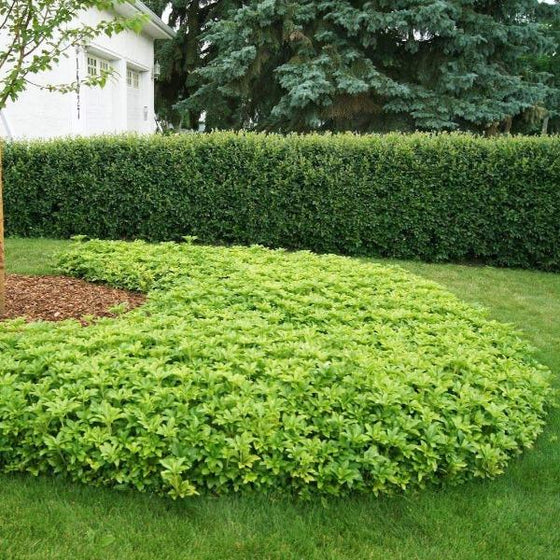
Pachysandra remains one of the classic evergreen groundcovers for shaded landscapes. Its dense green foliage creates an attractive carpet beneath trees and shrubs and provides interest throughout much of the year.
I especially like Pachysandra in larger naturalized or woodland-style beds where a simple sweep of foliage can visually connect trees, shrubs, and pathways. If you want the full rundown on establishing it, we have a dedicated planting and care guide for Japanese Pachysandra.
Ajuga
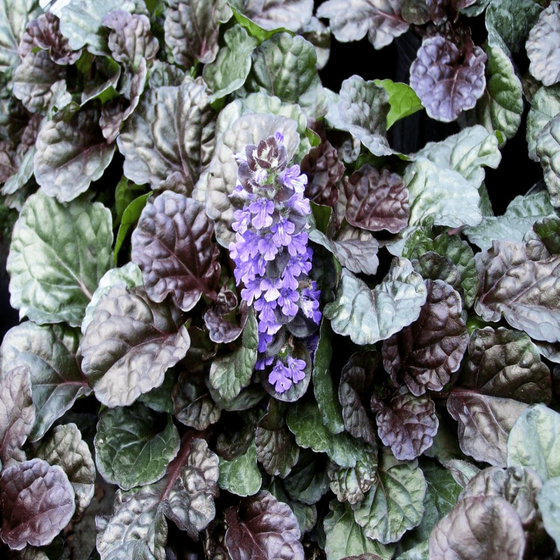
Ajuga offers another option for shade and partial shade, with considerably more foliage and flower color.
Black Scallop Ajuga features glossy, nearly black foliage and blue flowers, while Chocolate Chip Ajuga remains particularly compact, with small chocolate-burgundy leaves.
This is where groundcover design gets interesting. Groundcover doesn't have to mean green.
Using darker foliage underneath green shrubs creates contrast and makes both plants look better.
Mondo Grass
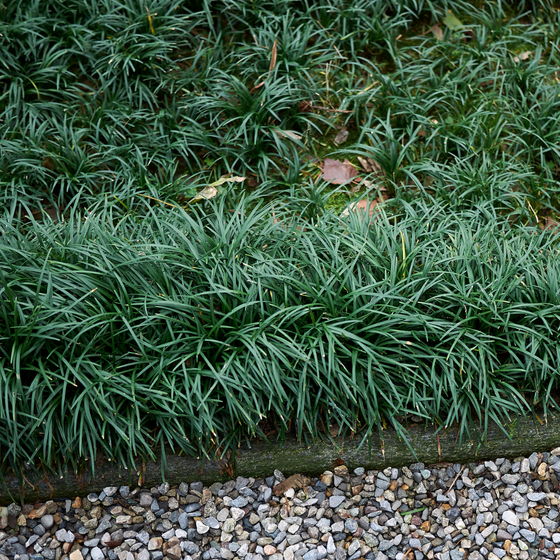
Mondo Grass offers narrow, grass-like evergreen foliage that works beautifully where you want something more architectural than a broad-leaved groundcover.
It's especially effective along pathways, beneath shrubs, and in Asian-inspired or more formal landscapes. Dwarf Mondo Grass stays lower still for tight spaces, and Black Mondo Grass brings almost-black foliage where you want real contrast. There's more on the whole group in our Mondo Grass guide.
Liriope
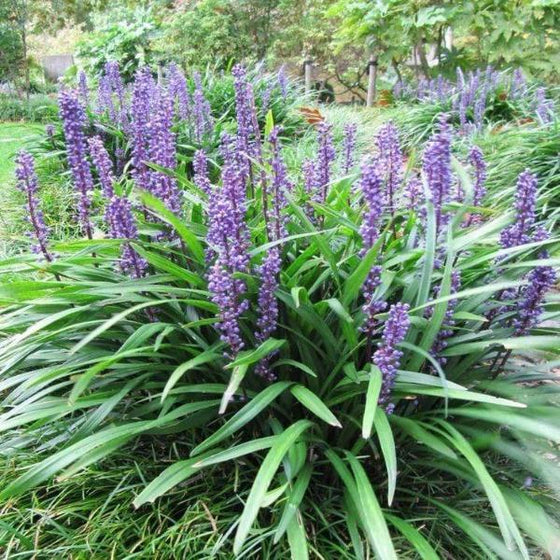
Big Blue Liriope and Variegated Liriope are tough, versatile landscape plants that can create substantial ground-level coverage.
I particularly like Liriope where you want a little more height than a carpet-forming groundcover. It can provide the visual transition between low-growing plants and larger shrubs.
Clumping Liriope varieties are also useful when you want a more controlled planting rather than an aggressive spreading groundcover.
Sherwood Purple Woodland Phlox

For something that feels a little more like a woodland garden, consider Sherwood Purple Woodland Phlox.
Its spring flowers provide a completely different appearance from Pachysandra or Liriope and give shaded and partially shaded landscapes a more naturalistic character.
This is a plant I would use when the goal isn't simply to cover the soil, but to make the garden's lowest layer part of the seasonal show.
Best Groundcovers for Full Sun
Move into full sun, and your choices change dramatically.
Sunny groundcovers often give us brighter flowers, drought tolerance once established, succulent foliage, and plants particularly well adapted to rock gardens and slopes.
Creeping Phlox

Creeping Phlox is one of the first plants I'd consider when someone wants a flowering groundcover for a sunny landscape.
Its low-growing evergreen or semi-evergreen foliage spreads outward and becomes covered with flowers in spring.
The current collection provides enough colors that Creeping Phlox doesn't have to be treated as a generic groundcover. Varieties such as Purple Beauty, Emerald Pink, Emerald Blue, Scarlet Flame, Amazing Grace, Drummond's Pink, and Candy Stripe allow you to coordinate groundcover color with the rest of the landscape.
Plant several varieties together to create ribbons of spring color across a bank or rock garden. Our guide to growing Creeping Phlox walks through spacing and after-bloom shearing.
That's groundcover doing a lot more than hiding dirt.
Elfin Thyme
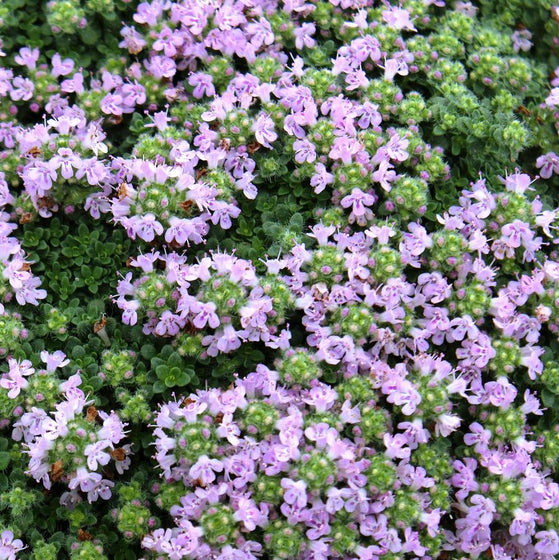
For hot, sunny locations where low growth is important, Elfin Thyme is another intriguing choice.
Its tiny evergreen foliage stays close to the ground, produces lilac-colored flowers, and tolerates drought once established. It can even handle occasional light foot traffic, making it useful around stepping stones and between hardscape areas. If you want more flower color from the same habit, Red Creeping Thyme works the same way.
Low-Growing Sedum
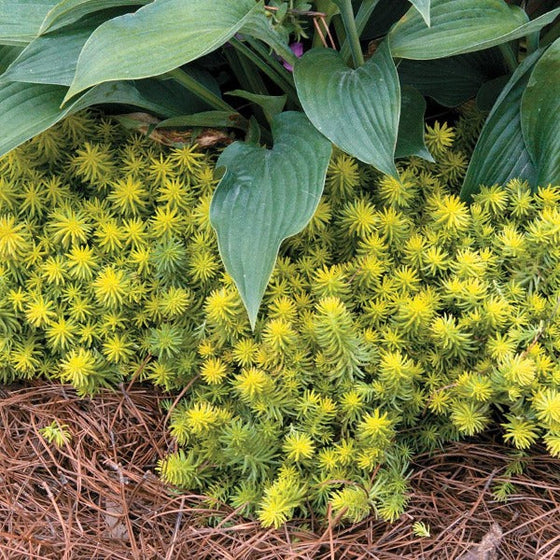
Low-growing Sedum plants, sometimes called stonecrop, are excellent candidates for hot, sunny, well-drained locations.
Selections such as Dragon's Blood Sedum, Angelina Sedum, and Fuldaglut Sedum can bring foliage color and texture to rock gardens, slopes, bed edges, and other places where traditional perennials may struggle with heat.
Sedum has one major rule: drainage.
Give it sun and well-drained soil, and it can be remarkably tough. Put it somewhere that stays wet, and you're asking for trouble.
Ice Plant
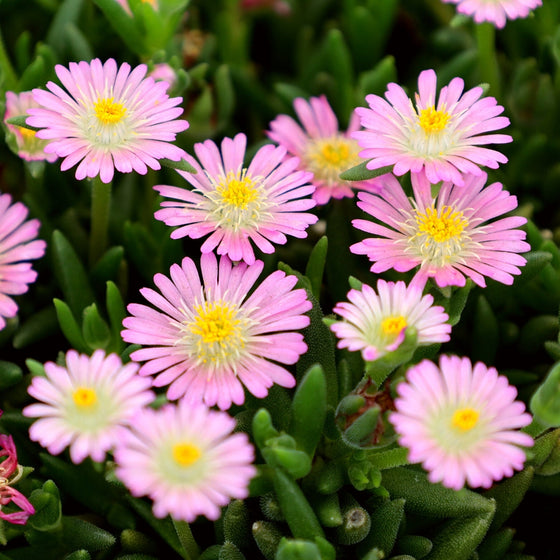
Delosperma cooperi, commonly called Ice Plant, brings vivid flowers and succulent foliage to sunny, dry areas.
It is a particularly good example of why choosing a groundcover should start with site conditions. Ice Plant isn't a substitute for Pachysandra under a maple tree, and Pachysandra isn't a substitute for Ice Plant on a hot, sunny rock garden. There are several colors in the hardy Ice Plant collection if you want more than the classic magenta.
Right plant. Right place.
It really is that simple.
Groundcovers for Walkways, Rock Gardens and Small Spaces
Not every groundcover needs to cover hundreds of square feet.
Some of the most interesting uses are intimate spaces around paths, patios, stones, and garden edges.
Irish Moss creates a fine, moss-like green carpet that looks beautiful around stones and in smaller garden spaces. Blue Star Creeper gives a soft, low-growing appearance with tiny flowers and can work beautifully between and alongside hardscape, where conditions are suitable. Elfin Thyme is another natural fit around stepping stones where occasional light traffic occurs.
Use these plants almost like grout between the larger landscape pieces.
A walkway stops looking like concrete dropped into a garden and starts to feel like it belongs there.
Start with the Site, Not the Plant
There's one principle worth underlining above all the others: the best groundcover is the one matched to its location.
Don't start with color.
Start with conditions.
Before choosing a plant, answer five questions:
- How much direct sunlight does the area actually receive?
- Is the soil generally dry, moist, or periodically wet?
- Does water drain freely after heavy rain?
- Is the site flat, sloped, or subject to erosion?
- How quickly do I want the groundcover to spread?
Then consider your USDA Hardiness Zone and the plant's mature size and growth habit.
Only after those questions are answered should you start choosing between dark foliage, variegated leaves, spring flowers, evergreen texture, or other ornamental features.
That's how you end up with a plant that is both useful and beautiful.
Don't Forget About How Fast the Plant Spreads
"Fast-growing groundcover" sounds wonderful until the plant arrives somewhere you didn't want it.
Every groundcover exists somewhere on a spectrum between a neat clumper and an enthusiastic traveler.
Neither is automatically better.
If you're trying to cover a large slope quickly, a spreading plant may be exactly what you want. Along the edge of a precisely maintained perennial garden, that same growth habit could create unnecessary work.
Before planting, ask yourself where you're willing to let the plant go.
Hardscape, walkways, edging, walls, and lawn areas can provide natural boundaries. More vigorous groundcovers are often best used where their spreading habit is an asset rather than a maintenance problem.
How Far Apart Should Groundcover Plants Be?
This is where budget, patience, and design meet.
You can generally space groundcovers farther apart and wait longer for them to fill in, or plant them closer together and create a continuous planting more quickly.
Neither strategy is inherently wrong.
For large landscape projects, I often prefer reasonably close spacing because getting the soil covered sooner gives you the effect you're actually after. It can also reduce the amount of time weeds have to establish in open ground between plants.
But don't simply choose one spacing for every groundcover. Creeping Phlox, Pachysandra, Mondo Grass, Liriope, Ajuga, and Sedum don't all grow at the same speed or to the same mature width.
Use the expected mature spread of the individual plant as your starting point.
And when planting large areas, stagger the plants rather than installing them in straight rows. Imagine a triangular pattern, with each new plant sitting between the two plants in the row ahead of it.
When the plants eventually meet, the result looks much more natural.
Preparing the Soil Before Planting Groundcovers
One lesson I've learned over the years is that it is much easier to prepare a groundcover bed before planting than afterward.
Remove perennial weeds first. Don't assume your new groundcover will simply overpower established weeds.
Check the soil and drainage. If you're unsure about fertility or pH, a soil test gives you far better information than guessing and adding amendments you may not need.
When planting underneath established trees, be particularly careful. Avoid deep tilling or major excavation that damages tree roots. Work around significant roots rather than cutting through them just to fit another plant.
Your groundcover is supposed to improve the garden, not injure the tree creating the garden's shade.
How to Plant Groundcovers in Fall
Fall groundcover planting is straightforward.
Plant at the same general depth the plant was growing in its container, loosen circling roots when necessary, backfill around the root system, and water thoroughly.
Apply a light layer of mulch between plants during establishment. This helps retain moisture and suppress weeds while the individual groundcovers are still growing toward one another.
But remember what we're trying to accomplish.
Eventually, the plants become the mulch.
Water consistently while new roots establish, particularly if autumn is dry. Cooler temperatures can fool gardeners into assuming plants don't need water. They do.
Keep checking the soil until cold weather halts active growth and the ground begins to freeze in colder climates.
Don't Fertilize Groundcovers Just Because It's Fall
You'll often see specific fertilizer ratios recommended for fall groundcover planting. I wouldn't make that recommendation across the board.
Different plants and soils have different needs, and applying fertilizer without knowing whether it's necessary can create more problems than it solves.
For newly planted groundcovers, I'd focus on good soil preparation, proper planting depth, correct spacing, drainage, mulch, and watering.
Those fundamentals matter more than trying to force extra growth before winter.
If a soil test tells you something is missing, that's different. Then you have information to work with.
Gardening gets much easier when we stop trying to feed our way out of problems caused by the wrong plant, wrong location, or wrong amount of water.
Mix Groundcovers Instead of Planting Just One
Here's where I think modern landscapes can improve on the traditional approach to groundcover planting.
You don't necessarily need 500 square feet of one plant.
Try thinking in communities.
Under a large tree, one area might transition from Pachysandra into Mondo Grass and then into Woodland Phlox as light conditions change. In a sunny rock garden, Creeping Phlox could flow between stones while Sedum and Ice Plant take over the hottest, driest pockets.
That variation creates a more natural landscape and allows you to respond to subtle differences in soil, moisture, and sunlight.
It also gives the lowest layer of the landscape something it rarely gets:
Personality.
Groundcovers Are the Missing Layer in Many Landscapes
When I look at a landscape, and something doesn't quite feel finished, I often find the problem isn't what's missing at eye level.
It's what's missing at ground level.
You've got the tree. You've got the shrubs. You've got the perennials.
And then you've got mulch.
There's nothing wrong with mulch, but imagine that same bed with Creeping Phlox spilling over the edge in spring, Ajuga weaving between shrubs, Mondo Grass providing dark green texture beneath a tree, or Liriope running along the walkway.
Suddenly, every layer is doing something.
That's the difference between planting plants and building a landscape.
Woodie's Take: This Fall, Look Down
Fall has always been one of my favorite planting seasons because it gives us a chance to think beyond what's blooming today.
And groundcovers might be one of the best examples of that kind of gardening.
That troublesome slope, bare patch under the maple, awkward strip beside the walkway, or mulch bed you're tired of refreshing every year isn't necessarily a problem. It may simply be waiting for the right plant. If the trouble spot is turf you're tired of mowing altogether, that's a bigger conversation — and we covered it in no-mow lawns and grass alternatives.
Choose according to the conditions. Think about how quickly you want the plants to spread. Give them enough water to establish. Then give them time to do what good groundcovers do best — spread, connect, soften, and make the rest of the landscape look better.
Trees get the attention. Flowers get the photographs. Shrubs give the garden structure.
But sometimes the plant that pulls everything together is the one growing six inches off the ground.
So this fall, before you put away the shovel, take one more walk around the yard.
And this time, look down.