

Green Giant vs. Emerald Green Arborvitae: How to Choose
Published On: Sep 1, 2026
Updated On: Sep 2, 2026
Share:
| In this Article | |||
|---|---|---|---|
When homeowners start researching Arborvitae for privacy, two names come up again and again: Thuja Green Giant and Emerald Green Arborvitae.
They're two of the most popular evergreen screening trees we grow, and there's a good reason for that. Both provide year-round color. Both can create excellent privacy. Both are relatively easy to maintain once established. And both can become long-term structural plants in the landscape.
But here's where homeowners sometimes get into trouble:
Green Giant and Emerald Green Arborvitae aren't really competing for the same job.
One isn't necessarily better than the other.
Green Giant is a large, fast-growing privacy tree designed to cover substantial space. Emerald Green is a smaller, narrower Arborvitae that creates a more refined screen where space is limited.
Put either one in the right location, and it can be an outstanding landscape plant.
Put it in the wrong location, and you may spend the next twenty years trying to keep a tree from becoming something it was naturally designed to be.
So instead of asking, "Which Arborvitae is better?"
Let's ask the more useful question:
Which Arborvitae is better for what you're trying to accomplish?
Green Giant vs. Emerald Green Arborvitae at a Glance
| Feature | Thuja Green Giant | Emerald Green Arborvitae |
|---|---|---|
| Best Use | Large, fast privacy screens | Narrow, formal privacy screens |
| Growth Rate | Fast | Moderate |
| Mature Height | Approximately 40–60 ft. | Approximately 12–15 ft. |
| Mature Width | Approximately 12–18 ft. | Approximately 3–4 ft. |
| Privacy Speed | Faster | Slower |
| Landscape Style | Large, natural screen | Formal, refined hedge |
| Best Property Size | Medium to large | Small to medium |
| Space Required | Considerable | Relatively narrow |
| Pruning | Usually minimal with enough room | Light shaping if desired |
| Year-Round Color | Evergreen | Evergreen |
| Best Reason to Choose | Fast coverage and substantial screening | Privacy where width is limited |
Those differences tell most of the story.
But let's look at what they actually mean in a landscape.
Choose Green Giant When You Need Privacy Fast

If someone tells me they have a large backyard, can see directly into the neighbor's house, and wants privacy as quickly as reasonably possible, Thuja Green Giant is usually one of the first trees I consider.
Green Giant is built for scale.
Its rapid growth allows it to create a substantial evergreen screen much faster than Emerald Green Arborvitae. Once established under good growing conditions, it can put on several feet of growth in a year.
That makes a tremendous difference when you're starting with an open property line.
Green Giant is particularly useful for:
- Large backyard privacy screens
- Long property boundaries
- Screening neighboring homes
- Creating separation between larger properties
- Windbreaks
- Screening roads or commercial properties
- Creating evergreen backdrops for large landscapes
The tradeoff is space.
Green Giant eventually becomes a big tree.
That's exactly why it's so effective for privacy, but it's also why I don't automatically recommend it for every property. If you want the full rundown on this one tree, we cover it in depth in our Green Giant Arborvitae care, spacing and privacy guide.
Choose Emerald Green When Space Is Limited
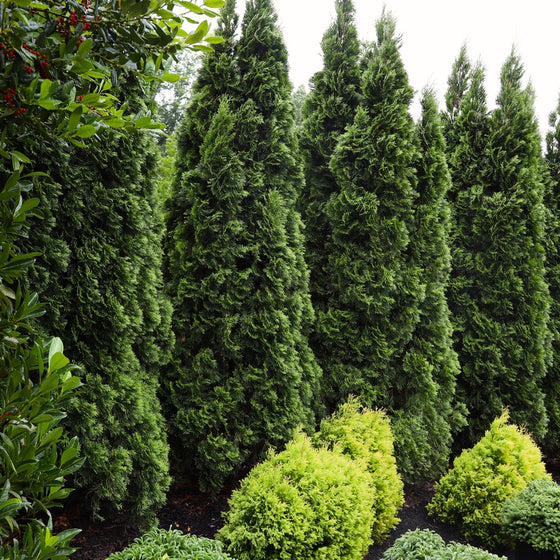
Now imagine a completely different situation.
You've got a suburban side yard with only six or eight feet between the house and the property line.
You still want privacy.
But you don't have room for an evergreen that eventually wants to become 15 feet wide.
That's where Emerald Green Arborvitae starts making much more sense.
Its naturally narrow growth habit allows it to create a substantial evergreen screen without consuming nearly as much horizontal space.
That's incredibly valuable in modern residential landscapes.
Emerald Green is particularly useful for:
- Narrow side yards
- Smaller suburban properties
- Fence-line screening
- Pool equipment screening
- Creating privacy around patios
- Formal evergreen hedges
- Framing entrances
- Smaller foundation landscapes
You're giving up some growth speed.
But you're gaining space.
That's not a disadvantage.
That's choosing the right plant for the job. We go deeper on where this variety fits in our guide to the versatility of Emerald Green Arborvitae.
If Speed Matters Most: Green Giant
This is probably the easiest comparison.
If your number-one priority is fast-growing privacy, Green Giant wins the speed category.
Its naturally vigorous growth allows homeowners to establish significant screening relatively quickly.
Emerald Green grows at a much more moderate pace.
That doesn't make Emerald Green inferior.
It simply means that if you're standing in an open backyard thinking, "I need to block that view as quickly as possible," Green Giant is usually better suited to the assignment.
Just remember:
Fast-growing trees eventually become large trees.
Make sure you have room for what you're planting.
If Width Matters Most: Emerald Green
This is where Emerald Green becomes the better choice.
A mature Green Giant needs considerable room.
Emerald Green remains dramatically narrower.
That difference becomes critical along fences, beside driveways, between neighboring properties, and around patios.
I would much rather plant an Emerald Green in a narrow location and let it develop naturally than plant a Green Giant there and spend years trying to keep it artificially small.
One of the easiest ways to create a low-maintenance landscape is to choose plants whose natural mature size already fits the available space.
For Large Properties: Green Giant
Large properties give Green Giant the room it deserves.
If you're screening a long property boundary, creating separation from a road, or trying to establish a major evergreen backdrop, Green Giant's size becomes an advantage rather than a problem.
Its height and width allow relatively fewer trees to create a substantial visual barrier.
You can also use Green Giants as the backbone of a mixed privacy screen.
Rather than planting a perfectly straight wall of one species, combine them with other large evergreens and flowering trees to create a more natural landscape.
That's one of my favorite ways to use them.
For Smaller Properties: Emerald Green
Smaller landscapes require more discipline.
Every foot matters.
That's where Emerald Green's narrow footprint becomes incredibly valuable.
You can create a tall evergreen presence without surrendering a huge portion of the backyard.
Emerald Greens also have a naturally neat, upright appearance that works beautifully with more formal architecture and smaller foundation beds.
Think of Green Giant as a large landscape tree.
Think of Emerald Green as a vertical landscape element.
That distinction makes choosing between them much easier.
For a Formal Hedge: Emerald Green
If you want a clean, uniform row of evergreens to define a property line or frame an outdoor space, Emerald Green Arborvitae is hard to beat.
Its naturally narrow, pyramidal habit gives it a much more formal appearance.
Repeated at consistent spacing, Emerald Greens can create an evergreen hedge that looks intentional without requiring constant shearing.
This works especially well around:
- Patios
- Pools
- Courtyards
- Formal gardens
- Entrances
- Property boundaries
The result feels architectural.
For a Natural Privacy Screen: Green Giant
Green Giant feels different.
Its larger scale and broader form make it especially useful for creating a more natural evergreen backdrop.
Give the trees enough room and allow them to develop their natural shape.
Then layer flowering shrubs, ornamental grasses, and perennials in front.
Now the Green Giants aren't simply blocking the neighbors.
They're becoming the background of an entire landscape.
That's a much better use of a privacy tree.
For a Windbreak: Green Giant
If you're dealing with an open property exposed to prevailing winds, Green Giant generally makes more sense.
Its larger mature size and substantial evergreen mass allow it to function as both a privacy screen and a windbreak.
For larger properties, consider staggered plantings rather than one perfectly straight row.
That creates greater depth and often results in a more natural-looking landscape.
Emerald Green can certainly provide some wind protection, but that's not really where I'd choose it first.
Its strength is fitting into narrower spaces.
Around a Patio: It Depends on the Space
This is where the comparison gets interesting.
Both trees can work.
If you have a large patio with ample surrounding landscape space and want a tall evergreen backdrop, Green Giant may be a good fit.
But if the patio sits close to the property line or you're trying to create privacy without losing valuable outdoor space, Emerald Green is probably the better fit.
Before planting, imagine the tree at maturity.
Not next year.
Not five years from now.
At maturity.
That's the tree you're really buying.
Around a Pool: Think About Scale
The same principle applies around pools.
A large property with a substantial pool and generous planting areas may easily accommodate Green Giants.
A smaller suburban pool, with limited planting space, may be much better suited to Emerald Greens.
You can also combine them.
Use larger Green Giants farther from the pool to screen distant views and narrower Emerald Greens where the planting area becomes tighter.
There's no rule saying you have to choose only one Arborvitae for the entire property.
For Screening a Two-Story Neighbor: Green Giant
Sometimes the problem isn't what's happening at ground level.
It's the second-story window looking directly into your backyard.
That's where mature height matters.
Green Giant has the potential to create a substantially taller screen than Emerald Green, making it more useful where vertical screening is the priority. If you're weighing other tall evergreens for the same job, it's worth comparing options across our privacy tree collection.
Again, make sure you have enough width.
You're solving a tall problem with a large tree.
For Screening a Fence: Emerald Green
If you already have a six-foot privacy fence but want to soften its appearance or add a little extra height, Emerald Green may be all you need.
There's often no reason to plant a 50-foot tree to solve a 10- or 12-foot screening problem.
Emerald Greens can soften the fence, provide evergreen color, and add vertical structure without overwhelming the space.
That's efficient landscape design.
What About Deer?
This deserves special attention because Arborvitae and deer have a complicated relationship.
Emerald Green Arborvitae can be susceptible to deer browsing, particularly during winter when other food sources become limited.
Green Giant is generally considered more deer-resistant — the NC State Extension Gardener Plant Toolbox lists deer among the challenges it resists — although no Arborvitae should be considered completely deer-proof.
If you live in an area with heavy deer pressure, that difference may influence your decision.
For Emerald Greens, young plants may require protection until they become established and grow above the primary browsing zone.
Always remember:
A hungry deer can change the rules.
Sunlight and Soil
Both Green Giant and Emerald Green perform best when given plenty of sunlight and well-drained soil.
Neither wants to spend its life sitting in standing water.
Proper drainage becomes especially important in heavy clay soils or low areas where water collects after storms.
Both also benefit from consistent moisture during establishment.
A newly planted Arborvitae doesn't yet have the root system of a mature tree.
Give it time.
Watering During Establishment
The first couple of growing seasons matter tremendously.
Water deeply enough to moisten the root ball and surrounding soil rather than lightly sprinkling the surface every day.
Then check the soil before watering again.
You want consistent moisture.
You don't want constantly saturated soil.
A good layer of mulch can help conserve moisture and moderate soil temperatures, but keep mulch away from the trunk.
Think doughnut.
Not a volcano.
How Close Should You Plant Them?

Spacing should be based on the mature width of the tree and the type of screen you're trying to create.
This is where many privacy projects go wrong.
Homeowners want instant privacy, so they plant everything extremely close together.
It looks great for a few years.
Then the trees begin competing for space, sunlight, airflow, and moisture.
For Green Giants, allow enough room for their substantially broader mature habit.
Emerald Greens can be planted closer because they're naturally narrower.
The exact spacing should depend on how quickly you want the screen to fill, how formal you want it to appear, and how much long-term maintenance you're willing to accept. Our guide to planting Arborvitae trees includes a spacing chart by variety if you want specific numbers before you dig.
Don't design only for year three.
Design for year twenty.
Can Green Giant and Emerald Green Be Trimmed?
Yes.
But pruning should refine the plant — not fight its genetics.
Both can be lightly trimmed to maintain shape.
Emerald Green naturally stays compact and narrow, so it generally requires little pruning when properly placed.
Green Giant can also be maintained at a somewhat smaller size with regular pruning, but I wouldn't plant one in a tiny space with the expectation of permanently turning it into an Emerald Green.
If you need a narrow tree, plant an Emerald Green.
That's easier for you and healthier for the plant.
Can You Use Both in the Same Landscape?

Absolutely.
In fact, this may be the best answer for some properties.
Use Green Giants along the back or outer boundary where you need substantial height and fast privacy.
Then use Emerald Greens closer to the house, patio, pool, or tighter side yards where width becomes more important.
Add flowering shrubs and ornamental grasses between those evergreen elements, and you've created something far more interesting than a single row of Arborvitae.
You've created layers.
Green Giant vs. Emerald Green: Which Should You Choose?
Here's the easiest way I know to make the decision.
Choose Thuja Green Giant if:
- You need privacy quickly.
- You have plenty of room.
- You need substantial height.
- You're screening a large property.
- You need a windbreak.
- You want a natural-looking evergreen backdrop.
- Deer pressure is an important consideration.
Choose Emerald Green Arborvitae if:
- Your planting area is narrow.
- You have a smaller suburban property.
- You want a more formal appearance.
- You're screening a fence or patio.
- You want a narrow evergreen hedge.
- You don't need 40 or 50 feet of eventual height.
- Preserving usable yard space is important.
And sometimes the correct answer is:
Use both.
Woodie's Take
I don't think Green Giant vs. Emerald Green Arborvitae should ever be a conversation about which tree is better.
They're both excellent trees.
They're just excellent at different things.
If I had a large property and wanted privacy quickly, I'd probably choose Thuja Green Giant. I'd give the trees plenty of room, let them develop naturally, and use them as the evergreen backbone of the landscape.
If I had a narrow suburban backyard and every foot of space mattered, I'd choose Emerald Green Arborvitae without hesitation. Why plant a tree that naturally wants to become fifteen feet wide when I really need one that stays around four feet wide?
And if I had a property with both situations?
I'd use both.
Green Giants along the distant property line.
Emerald Greens closer to the patio or house.
That's really what good landscape design comes down to.
Don't ask which plant is better. Ask which plant is better for the job.
Choose the right Arborvitae for the space you actually have, give it room to become the tree it was meant to be, and you'll spend a lot less time pruning — and a lot more time enjoying the privacy you planted it for.