
Shasta Daisy Plants for Sale
Classic white summer flowers for sunny borders, cottage gardens, and cutting beds.
Shasta Daisies are one of those perennials that make a garden feel familiar in the best possible way. The bright white petals and yellow centers are instantly recognizable, and they work with almost any color you already have in the landscape. Plant them with salvia, coneflowers, catmint, yarrow, ornamental grasses, or roses, and the white flowers help tie everything together. The current assortment is centered around Becky Shasta Daisy, one of the taller, sturdier selections in the group. Becky gives you strong stems, substantial flowers, and enough height to hold its own in a mixed perennial border while still working beautifully as a cut flower.
What makes Shasta Daisies especially useful is how straightforward they are when the site is right. They want plenty of sun, sharp drainage, and enough room for air to move through the clump. Once established, they tolerate some dryness and are generally passed over by deer and rabbits. Deadheading keeps the planting cleaner and can encourage additional bloom, while dividing mature clumps every few years helps maintain vigor. The one thing I would not compromise on is drainage—wet winter soil is much harder on Shasta Daisies than summer heat. Give them a sunny, well-drained home, and they can deliver weeks of classic white flowers with very little complication. The We Grow Together Promise adds another layer of confidence when choosing the right perennial for your garden.


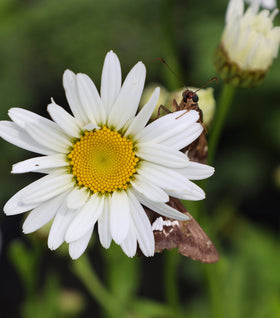
Becky Shasta Daisy
As Low As $18.95
Bring classic summer color into sunny beds.
Shasta Daisies are built around one of the simplest and most effective flower combinations in the garden: white petals around a golden-yellow center. That clean color works especially well in mixed perennial borders because it brightens the planting without competing with nearby purple, blue, pink, orange, or red flowers.
Bloom timing generally falls in early to midsummer and can continue through late summer depending on cultivar, climate, and deadheading. Some selections begin flowering earlier, while others carry the strongest display through July and August. Removing spent blooms helps prevent the planting from looking tired and may encourage additional flower production.
The current active assortment is centered around Becky Shasta Daisy. Becky grows larger than many compact Leucanthemum selections and gives gardeners a more substantial perennial for the middle or back of a border. Its sturdy stems also make it particularly valuable in cutting gardens where you want flowers with enough length and strength for arrangements.
Shasta Daisies also work beyond traditional cottage gardens. Use them in pollinator beds, sunny foundation plantings, mixed borders, cutting gardens, and larger containers. Their upright flower stems rise above the basal foliage, so the plants provide height without creating the heavy mass of a shrub.
Choose a compact daisy or a taller border plant.
Shasta Daisy size varies considerably by cultivar. Compact selections may stay around 9 to 18 inches tall, making them useful along walkways, at the front of borders, and in containers. Mid-sized cultivars often reach 18 to 30 inches, while larger forms can grow 3 to 4 feet tall.
Becky sits toward the taller end of the range. It typically reaches around 3 to 4 feet tall and roughly 2 to 3 feet wide under good garden conditions. That size gives it enough presence to anchor a mixed perennial planting and enough stem length to perform well as a cut flower.
The flowers themselves also vary in form. Traditional Shasta Daisies have a single row of clean white petals surrounding a yellow center, while other cultivars may have semi-double, double, fringed, or frilly petals. Flower size typically ranges from 2 to 4 inches across, depending on the selection.
The foliage forms a clump of dark green, toothed leaves at the base, with flowering stems rising above it. The plants are herbaceous perennials, so top growth dies back after frost and returns from the crown the following spring.
Growth is generally moderate. Individual clumps become larger and fuller over several seasons, but Shasta Daisies are not typically aggressive spreaders. Mature clumps can become crowded with age, which is why periodic division is useful.
Give Shasta Daisies sun and excellent drainage.
Full sun is the best location for Shasta Daisies. Six or more hours of direct light supports stronger stems, heavier flowering, and a more compact plant. Some light afternoon shade can be useful in very hot summer climates, but too much shade usually results in fewer flowers and weaker growth.
Drainage is just as important as sunlight. Shasta Daisies prefer average to moderately rich soil that drains freely. Sandy loam, loam, and other well-drained soils are generally suitable. What they do not tolerate well is heavy winter soil that remains saturated around the crown.
That winter drainage issue deserves special attention. A Shasta Daisy may handle summer drought better than prolonged winter wetness. If you garden in heavy clay, improve the planting area, plant slightly high, or use a raised bed where excess water can move away from the crown.
Spacing depends on cultivar size. Compact selections may need only 12 to 18 inches between plants, while larger cultivars such as Becky should be given around 24 to 30 inches or more. Good spacing keeps air moving through the foliage, gives the clump room to mature, and makes deadheading easier.
Use Shasta Daisies in full-sun borders, cottage gardens, cutting gardens, pollinator plantings, perennial beds, and large containers. They pair especially well with plants that flower in blue, violet, pink, or red because the white blooms provide a clean visual break between stronger colors.
Deadhead for more flowers and divide for stronger plants.
Regular deadheading is one of the easiest ways to keep Shasta Daisies looking their best. Remove faded flowers by cutting the stem back to a healthy leaf or side shoot rather than simply snapping off the flower head. This keeps the plant cleaner and may encourage additional buds.
Once the main flowering season is finished, stems can be cut back toward the basal foliage. This tidies the plant and helps redirect energy toward the crown rather than seed production. Leave healthy lower foliage in place until it naturally declines later in the season.
Shasta Daisies benefit from division every two to three years, especially when flowering begins to decline or the center of the clump becomes thin. Spring or early fall is a good time to divide mature plants. Lift the clump, separate healthy outer sections, and replant them at the original soil level.
Water regularly during the first growing season. Established plants become reasonably drought tolerant, but they still flower better when they are not allowed to remain severely dry for long periods. Avoid frequent shallow watering; deeper watering encourages a stronger root system.
Feeding should stay modest. Compost or a light application of balanced fertilizer in spring is generally enough. Overly rich soil or excessive nitrogen can encourage tall, soft stems that are more likely to lean rather than produce a sturdy, balanced plant.
Pest problems are usually limited, but aphids, leaf miners, and spider mites can occasionally appear. Shasta Daisies can also develop leaf spot, powdery mildew, stem rot, or verticillium wilt. Full sun, good spacing, and well-drained soil help reduce the likelihood of many of these problems.
Deer and rabbits generally avoid Shasta Daisies, especially once plants are established, although hungry animals can browse almost any plant. The flowers attract bees, butterflies, and other pollinating insects, making Shasta Daisies useful in gardens designed to support summer pollinator activity.