
Hydrangea Arborescens for Large Blooms & Dependable Garden Color
Native summer-blooming hydrangeas with big flowers and easy pruning.
Smooth hydrangeas are some of the easiest hydrangeas to understand and one of the most dependable choices for gardeners who want big summer flowers without complicated pruning rules. Hydrangea arborescens is native to the eastern United States, and today’s cultivars have taken that naturally adaptable shrub and added larger flowers, stronger stems, more compact habits, and colors beyond the familiar white of old-fashioned Annabelle. The current collection includes classic white-flowering Incrediball®, pink and blush selections, compact mauve varieties, lime-green flowers, and newer introductions bred to withstand summer rain better. Most stay in the useful 3- to 5-foot range, although individual cultivars can be smaller or larger, making this group easy to work into foundations, mixed shrub borders, cottage gardens, native-inspired landscapes, and flowering hedges.
The biggest advantage is simple: smooth hydrangeas bloom on new wood. Their flower buds develop on the growth they produce each spring, so winter cold does not have to preserve last year’s buds for you to get flowers. That also means you can prune in late winter or early spring without accidentally removing the coming summer’s bloom. Give them moist, well-drained soil, part shade, or enough moisture to support them in brighter sun, and they are remarkably forgiving shrubs. Modern varieties with sturdier stems also help solve the flopping problem associated with some older smooth hydrangeas after heavy rain. The We Grow Together Promise adds another layer of confidence when you are choosing a hydrangea for a prominent spot in your landscape.
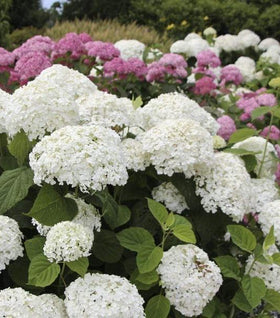

Incrediball® Blush Hydrangea
$109.95

Invincibelle Mini Mauvette® Hydrangea
$109.95


Incrediball® Storm Proof™ Hydrangea
$109.95
Bring home dependable summer hydrangea color.
Smooth hydrangeas are excellent for gardeners who want the classic rounded hydrangea look but would rather not worry about whether winter damaged last season’s flower buds. These shrubs begin pushing fresh stems from the existing framework or crown in spring, then form their flowers on that new growth. Depending on the cultivar and climate, blooming generally begins in early to midsummer and can continue well into late summer or fall as individual flower heads mature.
The current collection offers much more than basic white flowers. Incrediball® delivers oversized white flower heads that often open green, mature to bright white, and age back toward green. Incrediball® Blush and Invincibelle® Spirit II bring pink into the group, while Invincibelle Mini Mauvette® offers a deeper pink-mauve color on a compact plant. Invincibelle Limetta® provides fresh lime-green tones, and newer selections such as Incrediball® Storm Proof™ focus on stronger stems and better flower coverage.
Unlike many blue and pink bigleaf hydrangeas, the smooth hydrangea flower color is not controlled by changing the soil pH. A pink cultivar stays genetically pink, a white cultivar stays white, and a lime-green selection follows the color progression bred into that plant. That makes choosing flower color straightforward: select the cultivar that already produces the look you want rather than trying to alter it with soil amendments.
The flowers are also useful beyond the garden. Large, rounded clusters make excellent fresh-cut flowers, and mature blooms can be dried for arrangements later in the season. Leave a few aging flower heads on the plants into fall and winter, and they add texture after the green foliage has dropped.
Find the size, color, and stem strength that fit.
Smooth hydrangeas naturally develop into rounded, multi-stemmed deciduous shrubs. The straight species commonly grows around 3 to 5 feet tall and wide, but modern cultivars have expanded the size range considerably. Compact selections such as Invincibelle Mini Mauvette® stay around 2½ to 3 feet, making them easier to place near walkways, at the front of a foundation bed, or in a large container.
Many of the current varieties settle comfortably around 3 to 4 feet. Invincibelle® Spirit II and Invincibelle Limetta® fit this middle range and are especially useful when you want enough size to make an impact without filling the entire bed. Incrediball® Storm Proof™ also remains relatively compact, at roughly 3½ to 4 feet, while offering improved stem strength.
Larger selections can become substantial flowering shrubs. Incrediball® typically reaches about 4 to 5 feet tall and wide, while Incrediball® Blush may reach roughly 5 to 6 feet tall and 4 to 5 feet wide. Those dimensions make them better suited to the middle or back of a border, larger foundation beds, mass plantings, or low flowering screens where you want the shrubs to have real presence.
Growth is generally moderate to fairly fast once plants establish. Stem strength varies by cultivar, which matters with smooth hydrangeas because large flower heads can become heavy with rain. Older types may bend or flop when flowers become saturated, while many modern selections have been bred specifically for stronger, more upright stems. If a clean, upright presentation is important near a front entry or walkway, pay as much attention to stem strength as you do to flower color.
Give them moisture, light, and enough room.
Part shade is a natural fit for smooth hydrangeas, especially in hot summer climates. Morning sun followed by afternoon shade provides enough light for strong flowering while protecting the foliage from the harshest part of the day. The species is naturally associated with woodland slopes, ravines, streambanks, and other sites where soil moisture is available without roots remaining submerged.
Smooth hydrangeas can also grow in full sun when moisture is consistent. In cooler climates, brighter light can help build stronger stems and heavier flower production. In hotter locations, full afternoon sun may increase wilting and water demand, so morning sun and afternoon protection are often the safer combination. Deep shade is tolerated by the species, but flowering is generally stronger with more light.
Space plants according to the cultivar’s mature width rather than the nursery pot. Compact varieties may need about 3 feet between plants, while larger Incrediball-type shrubs are better spaced 4 to 5 feet or more apart. For a flowering hedge, plants can be positioned toward the closer end of their recommended spacing so the canopies eventually meet. For individual specimens and better airflow, give them their full mature width.
Smooth hydrangeas work beautifully in foundation beds, woodland edges, mixed shrub borders, cottage gardens, native-inspired plantings, shade gardens, rain gardens, and mass plantings. Compact cultivars also adapt to substantial patio containers when drainage and watering are carefully managed. Because the species is native to eastern North America, it is particularly useful for gardeners who want to incorporate more native woody plants without giving up the large hydrangea flowers they enjoy.
Prune in spring and enjoy reliable flowers.
Pruning smooth hydrangeas is refreshingly straightforward. They flower on new wood, so pruning in late winter or early spring does not remove the coming season’s flower buds. Start by removing dead, damaged, thin, or weak stems. Established shrubs can then be shortened to control size and encourage vigorous new flowering growth.
You do not have to cut every smooth hydrangea to the ground each spring. Hard pruning can encourage vigorous stems and very large flower heads, but those oversized blooms may become heavy enough to pull stems downward. Allowing some established woody framework to remain can produce more stems, slightly smaller flowers, and a sturdier-looking plant. Young shrubs are often better allowed to grow for a season or two before they receive aggressive pruning.
Consistent moisture is one of the biggest keys to success. Water newly planted shrubs deeply while their roots establish, then continue watering during extended dry periods. Full-sun plants generally need more supplemental water than those receiving afternoon shade. Keep the soil moist but well-drained; hydrangeas appreciate moisture, but they do not want their roots sitting in saturated ground.
A 2- to 3-inch layer of organic mulch can help keep the root zone cooler and reduce soil moisture fluctuations. Keep mulch pulled away from the stems rather than piling it against the crown. Smooth hydrangeas generally need only modest feeding. A spring compost application or balanced slow-release fertilizer is usually enough in average garden soil; excessive nitrogen can push leafy growth without improving the overall flower display.
Pest and disease issues are usually manageable. Aphids, mites, scale, and nematodes can occasionally occur, while bud blight, bacterial wilt, leaf spots, rust, mold, and powdery mildew are among the potential disease concerns. Proper spacing, good airflow, and watering at the root zone rather than repeatedly wetting the leaves help reduce disease pressure. Smooth hydrangeas should also not be considered deer resistant; tender stems and leaves may be browsed where deer pressure is high.
There is an important distinction among pollinators within this group. The native species provides wildlife value and serves as a host plant for the hydrangea sphinx moth, but many ornamental mophead cultivars contain a high percentage of showy sterile flowers. Their value to bees and other flower-visiting insects can therefore vary by cultivar. Newer selections that retain more fertile flowers can offer greater pollinator benefit, while gardeners seeking maximum habitat value can pair showy smooth hydrangeas with nectar-rich native perennials and other flowering shrubs.