
Mondo Grass
Evergreen, grass-like groundcover for shade, borders, pathways, and small spaces.
Mondo grass is one of my favorite plants for those difficult spaces where you want the clean look of grass but traditional lawn grass does not make much sense. Despite the name, mondo grass is not actually a true grass. It belongs to the asparagus family and grows as a low, grass-like perennial groundcover with narrow evergreen leaves. That distinction matters because it explains why mondo grass performs so well beneath trees, along shaded walkways, between larger shrubs, and in other areas where turf can become thin and frustrating. The current assortment also gives you three very different looks to work with: traditional green mondo grass, very low-growing dwarf mondo grass, and dramatic black mondo grass with nearly black-purple foliage.
What I like most about this group is how useful it is in the landscape. Standard mondo grass can gradually knit together into a soft evergreen carpet, dwarf selections stay low enough for tighter edging and stepping-stone plantings, and black mondo grass is outstanding when you want contrast rather than a traditional green groundcover. These plants are generally low maintenance, deer resistant, and adaptable to partial shade, with established green mondo grass also showing useful tolerance of foot traffic and salt. They are not instant groundcovers, especially the slower black forms, so a little patience pays off. Give them moist, well-drained soil while they establish and enough room to spread naturally, and they can become a very polished part of the garden. The We Grow Together Promise adds another layer of confidence when choosing the right type for your space.


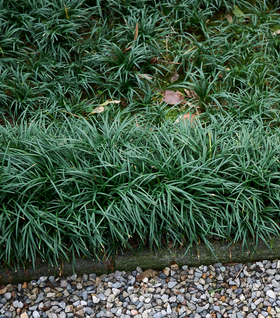
Cover difficult ground with evergreen texture.
Mondo grass is especially useful where regular lawn grass struggles. Beneath high tree canopies, along the shaded side of a house, beside patios, and around established shrubs, it creates a fine-textured green layer without needing the same mowing and maintenance routine as turf. Standard mondo grass gradually expands by short underground or surface-running stems, allowing individual plants to develop into a connected mat over time.
That spreading habit makes it useful for groundcover, but it is also an excellent edging plant. A row of mondo grass along a walkway or planting bed creates a clean transition without the rigid look of a clipped hedge. Its narrow, arching leaves soften stone, concrete, brick, and other hardscape materials while staying low enough to keep the path visually open.
Dwarf mondo grass takes that idea even further. Its especially low habit makes it useful between stepping stones, along the front edge of a shade garden, beneath small ornamental shrubs, and anywhere you want a carpet-like effect without much height. When planted closely, dwarf forms can create a dense, miniature lawn appearance in spaces where conventional turf would be difficult to maintain.
Black mondo grass serves a different design role. Its dark purple-black foliage is more dramatic and generally spreads more slowly, making it especially effective as an accent, edging plant, or contrasting groundcover mixed with chartreuse, silver, gold, or bright green foliage. Instead of disappearing into the planting, it becomes part of the design.
Choose the height and color that fit the space.
Standard mondo grass, Ophiopogon japonicus, generally matures around 6 to 12 inches tall and roughly as wide before gradually spreading outward to form colonies. Its foliage is narrow, arching, and deep green, creating the appearance of a miniature ornamental grass even though botanically it is not a grass. Growth is moderate once plants become established.
Dwarf mondo grass stays considerably shorter. Depending on the selection and growing conditions, dwarf forms may remain only a few inches tall. This makes them particularly useful where visibility matters—between stones, at pathway edges, beneath low windows, or at the front of a mixed planting. The lower the plant, the more convincing it can look as a miniature evergreen lawn.
Black mondo grass, Ophiopogon planiscapus, typically reaches about 8 to 12 inches tall and wide. Its narrow leaves mature to deep purple-black, creating one of the darkest foliage colors available in a hardy groundcover. It grows more slowly than standard green mondo grass, so it is better suited to deliberate accents and smaller mass plantings than situations where you need rapid coverage.
The foliage is the main attraction, but mondo grass also produces flowers. Small white, lavender, or pinkish flowers appear in summer, often partly hidden among the leaves on standard green forms. Black mondo grass may hold its pale lilac-tinted flowers more visibly above the dark foliage. Blue to dark purple berries can follow in fall, adding a subtle seasonal detail.
Because these plants are evergreen or semi-evergreen across much of their range, their real value lies in foliage that remains useful long after many herbaceous perennials have gone dormant. In colder parts of their hardiness range, winter foliage can look tired or suffer some damage, but fresh growth normally replaces it in spring.
Use mondo grass where lawn grass gives up.
Shade and partial shade are ideal conditions for traditional mondo grass. It performs particularly well under open tree canopies and in bright shaded gardens where direct sun is limited. Standard Ophiopogon japonicus can tolerate considerable sun when it receives enough moisture, but in hotter climates it generally looks better with some afternoon protection.
Black mondo grass is especially attractive in part sun to part shade. A little sunlight helps intensify its dark foliage, but harsh afternoon exposure in hot climates can cause stress. Consistently moist, well-drained soil provides black mondo grass with the best balance of growth and leaf quality.
For standard mondo grass, space plants roughly 6 to 12 inches apart when the goal is eventual groundcover. Closer spacing creates a solid mat sooner, while wider spacing lowers the initial plant count but requires more time for the plants to meet. Dwarf types can also be planted relatively closely when creating a carpet between stones or along a border. Black mondo grass is generally allowed around 8 to 12 inches of room between plants because of its slower, clumping habit.
Mondo grass works well beneath trees, along sidewalks, at the edge of patios, between stepping stones, around fountains, in Asian-inspired gardens, beneath foundation shrubs, and as a small-scale lawn alternative. It can also be used in containers as a fine-textured evergreen filler. Black mondo grass is particularly effective beside gold Japanese forest grass, chartreuse heuchera, silver foliage, light-colored stone, or other plants that make its dark leaves stand out.
Standard green mondo grass tolerates some foot traffic, but think of it as a groundcover you can occasionally step across rather than a replacement for a heavily used recreational lawn. In pathways, stepping stones are still useful for directing regular traffic while allowing the plants to fill the gaps around them.
Keep maintenance simple as the groundcover fills in.
Mondo grass prefers soil that drains well but does not dry excessively while plants are becoming established. Water new plantings regularly during their first growing season, especially where tree roots or nearby shrubs compete for moisture. Once established, standard mondo grass becomes more tolerant of short dry periods, but consistent moisture generally produces fuller, healthier foliage.
Heavy fertilizer is unnecessary. A light application of compost or a balanced slow-release fertilizer in spring is usually enough when soil fertility is poor. Excessive feeding can create soft, overly lush growth without meaningfully improving the groundcover. The goal is steady root and runner development rather than rapid top growth.
Established plantings may benefit from a yearly cleanup in late winter or very early spring. Old, weather-damaged foliage can be cut or mowed back before fresh growth emerges. Do not cut so low that you damage the crowns. Dwarf and black forms may be easier to clean up by hand or with light trimming rather than mowing.
Mondo grass spreads by runners and can gradually create dense mats. That is desirable when you are using it as groundcover, but keep an eye on the edges if you want it confined to a precise area. Remove wandering clumps or divide plants when necessary. Standard mondo grass can spread assertively under favorable conditions, although it is not classified as a problem invasive species in every region. Check local invasive-plant guidance if you are planting near natural areas.
The plants are generally trouble-free. Slugs can occasionally chew the foliage, particularly in damp shaded gardens, but serious insect and disease issues are uncommon. Good drainage remains important because continuously saturated soil can weaken the roots and crowns.
Mondo grass is also notably resistant to deer browsing, making it useful in landscapes where deer pressure makes many other low groundcovers difficult to maintain. Standard mondo grass also has good salt tolerance, which can be useful in coastal landscapes or areas exposed to moderate salt exposure.