
Japanese Forest Grass
Cascading golden foliage that brings movement and light to the shade garden.
Japanese Forest Grass is one of the first ornamental grasses I think of when a gardener tells me they have shade. Most of the grasses we use in landscapes want plenty of sun, but Hakonechloa macra is different. It naturally grows as a low, arching mound and performs beautifully in partial shade, bright shade, and woodland-style settings. Instead of producing a stiff, upright clump, the leaves sweep in the same general direction, creating a soft, flowing look that reminds me of water moving over the edge of a rock. The current assortment gives you two especially useful choices: Golden Japanese Forest Grass ‘Aureola’, with green-and-gold striped leaves, and All-Gold Japanese Forest Grass, with brighter solid-gold foliage. Both are excellent for bringing light into darker planting areas where green foliage alone can start to feel flat.
This is not a grass you plant when you need instant height or rapid coverage. Japanese Forest Grass grows slowly, and I actually consider that one of its strengths. It stays manageable, gradually develops into wider cascading mounds, and does not charge through neighboring plants the way some spreading grasses can. Use it along a shaded walkway, beneath Japanese maples, at the front of a woodland border, around rocks, or in a container where the foliage can spill over the edge. Give it rich, moist, well-drained soil and protection from the hot afternoon sun, then cut back the old foliage before new growth starts in spring. It is also generally deer-resistant and remarkably trouble-free once established. The We Grow Together Promise adds another layer of confidence when choosing the right variety for your shade garden.
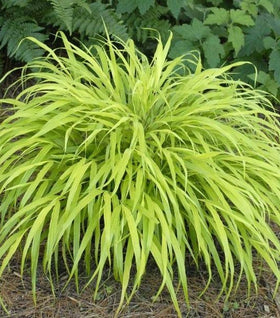
All-Gold Japanese Forest Grass
As Low As $56.95
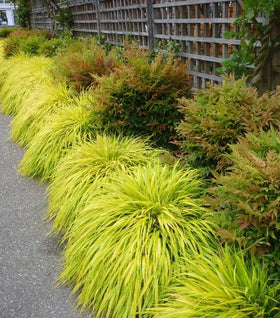
Brighten the shade with flowing golden foliage.
Japanese Forest Grass is grown primarily for its foliage, and that is exactly what makes it so useful. In a shade garden, flowers can come and go quickly, but a mound of gold, chartreuse, and green foliage can carry the planting for months. The long, narrow leaves arch outward and downward as the clump matures, creating movement even when there is very little wind. That soft texture is especially valuable around broad-leaved plants such as hostas, hellebores, heucheras, brunnera, and ferns.
Golden Japanese Forest Grass, or Hakonechloa macra ‘Aureola’, has narrow green stripes running through golden foliage. The variegation gives the plant depth and keeps the color from reading as one solid block of yellow. In bright shade or gentle morning light, the gold can become especially noticeable, while deeper shade tends to produce a greener overall appearance.
All-Gold Japanese Forest Grass gives you a brighter and somewhat cleaner look. Rather than the pronounced green striping of ‘Aureola’, the foliage is predominantly golden yellow. It makes a strong contrast against dark green ferns, burgundy heuchera, black mondo grass, evergreen shrubs, and shaded stonework. Where ‘Aureola’ feels softer and more variegated, All-Gold creates a more concentrated splash of chartreuse-gold.
Neither plant needs showy flowers to earn its place, but Japanese Forest Grass does bloom. Fine greenish-yellow flower panicles appear in midsummer to late summer, generally around July and August. They are subtle and can be partly hidden by the foliage, so think of them as an added detail rather than the main event. The foliage remains the real reason to grow these grasses.
Choose between striped gold and solid gold.
Japanese Forest Grass stays relatively small compared with most ornamental grasses. The species generally grows about 12 to 18 inches tall and eventually 12 to 24 inches wide, creating a low mound rather than a tall vertical clump. That smaller scale makes it particularly useful near paths, patios, steps, rock gardens, and the front of shaded borders.
Golden Japanese Forest Grass ‘Aureola’ typically reaches 12 to 18 inches tall and 18 to 24 inches wide. Its long leaves arch over one another as the plant fills out, producing the classic cascading appearance that has made this one of the best-known Hakonechloa cultivars. The gold-and-green striping may also pick up pink, red, orange, or copper tones as autumn progresses.
All-Gold is generally a little more upright in appearance and is known for its brighter yellow-gold foliage. It usually stays in roughly the same low range, around 12 to 18 inches tall, while gradually expanding to around 2 feet wide or somewhat wider with age. Because it is slow-growing, it takes time for a small planting to become a broad drift.
That slow growth should be part of your design plan. Japanese Forest Grass spreads by short rhizomes and stolons, but it expands gradually rather than aggressively. A single plant becomes more substantial every year, and several plants eventually blend into a flowing mass. If you want a finished effect sooner, plant several together rather than expecting one plant to cover a large space quickly.
The plants are deciduous rather than evergreen. The foliage develops from spring through fall, often coloring attractively as temperatures cool, then dies back for winter. The crown remains dormant below ground and sends up fresh shoots again the following spring.
Put it where shade needs color and movement.
Partial shade is the sweet spot for most Japanese Forest Grass. Morning sun, filtered sunlight, dappled woodland light, and bright shade all work well. Variegated and golden forms often develop their best color in gentle light, but harsh afternoon sun can scorch the leaves, especially where the soil is allowed to dry out.
Deep shade is also tolerated, although the foliage may become greener and less intensely gold. That makes Japanese Forest Grass unusually useful because you can use it in places where many traditional ornamental grasses lose vigor or simply fail to perform. Under high tree canopies, on the shaded side of a home, and along woodland paths are all natural locations.
The soil should stay consistently moist but drain well. Japanese Forest Grass comes from moist woodland and mountain environments in Japan, so it appreciates soil with plenty of organic matter. What it does not appreciate is the combination of dry soil and summer heat or heavy ground that remains waterlogged. Improving poor soil with organic matter before planting can make establishment much easier.
Space plants roughly 18 to 24 inches apart when you want them to develop into a continuous drift. You can plant somewhat closer for a quicker massed effect or farther apart when using individual plants as accents. Remember that growth is slow, so wider spacing will remain visually open for several seasons.
Use Japanese Forest Grass along shaded walkways, beneath Japanese maples, around large rocks, on slopes, at woodland edges, in courtyard gardens, beside patios, and at the front of shade borders. It is also excellent in containers because the foliage naturally cascades over the rim. Planting several in a repeated line creates a beautiful flowing edge without the rigid appearance of a formal hedge.
Give it moisture and let it grow at its own pace.
Japanese Forest Grass usually needs more patience than maintenance. Water regularly during the first growing season so the roots can establish in the surrounding soil. Mature plants appreciate consistent moisture as well, particularly during summer heat. Do not allow the soil to remain saturated, but do not treat Hakonechloa like a dry-site ornamental grass either.
A layer of organic mulch helps keep the root zone cool and evenly moist. This is particularly useful during hot summers and can also help protect the crown from repeated freezing and thawing in colder climates. Keep mulch loose rather than packing it heavily over the center of the plant.
Fertilizing should be modest. Rich garden soil or a light spring application of compost is often enough. Japanese Forest Grass is naturally slow-growing, and adding large amounts of fertilizer will not make it fast-growing. Steady, healthy growth is better than pushing weak foliage with excessive nitrogen.
Leave the foliage standing through fall if you enjoy the changing bronze, copper, pink, or reddish tones. Once the plant has gone dormant, the old leaves can remain through winter and then be cut close to the ground in late winter or very early spring. Finish the cleanup before fresh shoots begin emerging so you do not accidentally cut the new foliage.
Division is rarely an annual concern. Because the clumps expand slowly, several years may pass before a plant becomes large enough to divide. When division is necessary, spring is an excellent time to lift and separate established clumps before vigorous new growth gets underway.
Japanese Forest Grass is considered deer resistant and generally has very few serious insect or disease problems. The bigger concerns are environmental. Leaves can scorch when plants receive too much hot sun without enough moisture, poorly drained soil can weaken the crown and roots, and winter freeze-thaw cycles can occasionally cause crown heaving. Good placement prevents most of these problems.
Although Japanese Forest Grass spreads through rhizomes and stolons, it is not generally considered invasive. Its slow growth is one of the reasons it remains such a useful choice around other shade perennials. It expands enough to create a mature clump or drift without typically overwhelming neighboring plants.