
Ginkgo Trees
Legendary durability, unmistakable foliage, and some of the brightest gold color of fall.
Ginkgo trees are unlike almost anything else you can plant. Ginkgo biloba is the sole surviving species of an ancient group of trees that existed long before most of the flowering trees we grow today, yet it fits remarkably well into modern landscapes. The fan-shaped leaves give the canopy a texture you immediately recognize, and in fall the entire tree can turn an almost electric golden yellow before the leaves drop. What makes the current collection especially useful is the range of forms. Autumn Gold gives you the classic broad shade-tree look, Princeton Sentry and Brooks Road provide narrower upright options for tighter spaces, and Spring Grove Dwarf brings Ginkgo character into patios, courtyards, small gardens, and even large containers.
I also like Ginkgo because it becomes easier, not harder, as it matures. Once established, these trees handle heat, drought, pollution, compact urban settings, and deer pressure remarkably well, and serious pest and disease problems are uncommon. The cultivars in the current assortment are male selections, which is important because male Ginkgos do not produce the messy, foul-smelling seeds associated with female trees. Give them full sun, well-drained soil, enough space for the mature cultivar, and patience while young plants establish. These are not trees you plant for a quick seasonal effect—they are trees you plant because they can become memorable long-term pieces of the landscape. The We Grow Together Promise adds another layer of confidence when choosing the right form for your property.


Plant a tree that gets better with age.
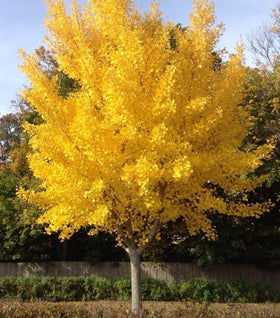
Ginkgo has a presence that is difficult to match with any other tree. The leaves are broad but divided into a distinctive fan shape, with veins that repeatedly fork as they move toward the outer edge. They emerge fresh green in spring, hold a clean appearance through summer, and then shift dramatically to golden yellow in fall.
The autumn display is one of the main reasons to plant Ginkgo. Instead of gradually changing through several colors, the foliage often turns a remarkably uniform yellow. Once leaf drop begins, much of the canopy may fall over a relatively short period, creating a bright golden carpet beneath the tree.
These are not flowering trees in the usual sense. Ginkgo is a gymnosperm, so it does not produce showy flowers. Male trees produce small pollen structures in spring, while female trees form ovules that can eventually develop into fleshy-coated seeds. The foliage, structure, longevity, and fall color are the real ornamental features.
Ginkgo trees are also unusually durable once established. They tolerate urban pollution, heat, occasional drought, moderate salt exposure, and difficult city conditions better than many large landscape trees. That durability makes them useful not just as specimens in residential landscapes but also along streets, driveways, walkways, and other developed areas.
Choose full-size, columnar, or dwarf Ginkgo.
Autumn Gold is the traditional shade-tree choice in the current assortment. This male cultivar develops a broadly pyramidal to rounded canopy and typically matures around 40 to 50 feet tall with a spread of roughly 25 feet. It is an excellent choice for lawns, larger front yards, specimen plantings, and areas where the mature canopy has enough room to develop.
Princeton Sentry gives you similar Ginkgo character in a much narrower form. It generally reaches around 40 to 50 feet tall while remaining approximately 15 to 25 feet wide. Its upright habit makes it useful along streets, driveways, narrow lawns, and property lines where a broad spreading canopy would take up too much horizontal space.
Brooks Road takes the narrow-tree idea even further. It typically matures around 30 to 40 feet tall but only about 5 to 10 feet wide. That tight columnar shape gives gardeners a way to add height, golden fall color, and Ginkgo foliage to spaces that could never accommodate a conventional shade tree.
Spring Grove Dwarf is on an entirely different scale. It commonly reaches only about 6 to 8 feet tall and 4 to 5 feet wide and grows slowly. Instead of functioning as a traditional shade tree, it works as a specimen near an entry, in a courtyard, beside a patio, in a rock garden, or even in a substantial container.
This size range is one of the strongest reasons to shop Ginkgo by cultivar rather than species name alone. A Spring Grove Dwarf and a full-sized Autumn Gold may share the same distinctive leaves and golden fall color, but they solve completely different landscape problems.
Give Ginkgo sun and the right amount of room.
Full sun is the best location for Ginkgo trees. Six or more hours of direct sunlight helps produce stronger growth, a well-developed canopy, and the best fall color. Young trees can tolerate some light shade, but a sunny site is the better long-term choice.
Ginkgo adapts to a surprisingly wide range of soils and pH levels. Clay, loam, sand, acidic soil, neutral soil, and alkaline conditions can all work when drainage is good. The important thing is to avoid sites where water remains standing around the roots for long periods.
Water regularly through the first growing seasons while the root system becomes established. Young Ginkgos appreciate consistent moisture, but mature trees become considerably more drought tolerant. Deep watering during extended dry weather is more useful than frequent shallow irrigation.
Spacing depends entirely on cultivar. Spring Grove Dwarf only needs room for a canopy around 4 to 5 feet wide. Brooks Road can fit into spaces roughly 5 to 10 feet wide. Princeton Sentry needs significantly more width, while Autumn Gold should be treated as a true shade tree requiring roughly 25 feet of mature canopy space.
Keep large cultivars well away from buildings, overhead utilities, narrow planting strips, and other locations that cannot accommodate mature height and root growth. Narrow cultivars solve many width problems, but Brooks Road and Princeton Sentry are still tall trees and need appropriate vertical clearance.
Use full-sized Ginkgos as shade trees, lawn specimens, street trees, and long-term landscape anchors. Narrow cultivars work well beside driveways, in urban yards, along property lines, and wherever vertical structure matters more than a broad canopy. Dwarf forms fit patios, courtyard gardens, entry beds, and small landscapes.
Keep care simple and avoid the messy seed problem.
Ginkgo trees are naturally slow to moderate growers, especially when young. Do not mistake steady establishment for poor performance. Once the root system becomes established and the tree settles into the site, growth generally becomes more consistent. These are trees designed for longevity rather than instant size.
Pruning needs are fairly light. Young trees benefit from structural pruning that encourages one strong central leader and removes crossing, damaged, or poorly positioned branches. Late winter or very early spring is a good time to make corrective cuts while the tree is dormant and its branching structure is easy to see.
Mature Ginkgos generally need little pruning beyond removing dead or damaged branches and maintaining necessary clearance. Avoid unnecessary topping or heavy shaping. The natural form of the cultivar—broad, columnar, or dwarf—is one of the main reasons to select it in the first place.
Fertilizer should also be modest. Newly planted trees should be allowed to focus on root establishment. In later years, a balanced slow-release fertilizer can be used in early spring if growth or soil conditions indicate a need, but healthy Ginkgos growing in reasonable soil rarely require aggressive feeding.
One of the most important things shoppers should understand about Ginkgo is the difference between male and female trees. Female Ginkgos produce fleshy-coated seeds that become yellow-orange in fall. When those seeds drop and the outer coating breaks down, they can produce a strong, unpleasant odor and become messy on sidewalks, patios, and driveways.
That is why named male cultivars are preferred for most residential and urban landscapes. Autumn Gold and Princeton Sentry are male selections, and Brooks Road and Spring Grove Dwarf are also sold as fruitless male cultivars. That allows you to enjoy the foliage, fall color, durability, and longevity of Ginkgo without having to plan around the seed problem associated with female trees.
Female seed pulp can also irritate sensitive skin, and ingestion of significant amounts of the fleshy material can cause gastrointestinal symptoms. Because the current assortment consists of male cultivars, seed production is not expected under normal conditions, but the species-level caution is still useful for gardeners who encounter older or unnamed female Ginkgo trees elsewhere.
Ginkgo has remarkably few serious pest and disease concerns. It is resistant to deer browsing and is known for its ability to withstand heat, drought, air pollution, and harsh urban conditions. That combination helps explain why mature Ginkgos are so often found thriving along streets and in older developed landscapes where less durable trees struggle.
These trees are not native to North America, but Ginkgo is not generally treated as an invasive landscape tree. Male cultivars eliminate seed production, and even the species is better known for longevity and durability than aggressive natural spread.
Choose the cultivar based on the space you actually have. Autumn Gold works when you want a substantial shade tree, Princeton Sentry and Brooks Road bring that character into narrower landscapes, and Spring Grove Dwarf allows you to enjoy one of the world's most distinctive trees on an entirely smaller scale.