
Creeping Phlox
Blanket sunny beds, slopes, and stonework with brilliant spring color.
Creeping phlox is one of the easiest ways to make a spring garden look finished. Phlox subulata stays only a few inches tall but spreads outward into a dense mat, then covers itself with so many flowers in spring that you can barely see the foliage underneath. The current collection gives you a great range of colors to work with: Amazing Grace brings white flowers with a magenta eye, Candy Stripe adds crisp pink-and-white striping, Drummond’s Pink and Emerald Pink deliver strong pink color, Purple Beauty adds softer purple tones, Emerald Blue brings blue-lavender color, and Scarlet Flame gives you one of the brightest reddish-pink displays in the group. That range makes it easy to build anything from a quiet single-color sweep to a mixed spring carpet.
I especially like creeping phlox on slopes, around boulders, along walkways, and spilling over retaining walls because the plant’s natural habit does most of the design work for you. It stays low, tolerates dry conditions once established, attracts bees, butterflies, and hummingbirds, and generally gives deer very little reason to bother with it. The needle-like foliage remains green to semi-evergreen throughout much of the year, depending on climate, so the planting continues to cover the soil long after the spring flower show is finished. Give it plenty of sun, sharp drainage, and a light trim after flowering, and it is one of the simplest perennial groundcovers to keep looking good. The We Grow Together Promise adds another layer of confidence when choosing the right color for your garden.
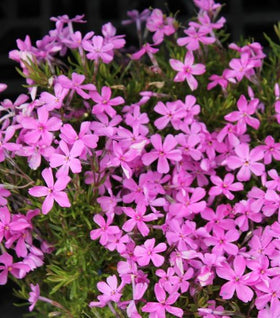
Emerald Pink Creeping Phlox
As Low As $18.95

Candy Stripe Creeping Phlox
As Low As $18.95

Purple Beauty Creeping Phlox
As Low As $18.95


Emerald Blue Creeping Phlox
As Low As $18.95
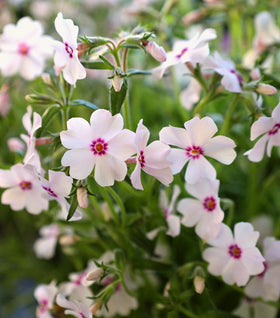
Amazing Grace Creeping Phlox
As Low As $18.95
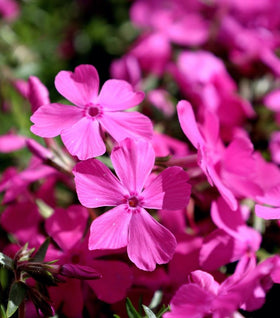
Drummond’s Pink Creeping Phlox
As Low As $18.95
Turn bare sunny ground into spring color.
Creeping phlox is built to cover ground. Individual plants stay low, usually around 4 to 6 inches tall, while the stems spread outward and root as they grow. Over time, neighboring plants knit together into a continuous mat that softens the edges of soil, stone, mulch, and other hard landscape elements.
That growth habit makes creeping phlox particularly useful on sunny slopes and banks. Instead of leaving bare ground between larger plants, you can use low mats of phlox to create a living layer of cover while adding one of the strongest early-spring flower displays. Its spreading stems also make it useful where erosion and exposed soil are concerns.
Rock gardens and retaining walls are another natural fit. Creeping phlox looks especially good when stems are allowed to spill over stone, brick, or timber edges. The flowers follow the shape of the ground rather than standing upright, so the planting can appear almost as if color is flowing down the wall.
It also works beautifully as a living border along sidewalks, driveways, and the front of perennial beds. Because it stays so low, it gives you color without hiding tulips, daffodils, coneflowers, shrubs, or other plants growing behind it. After the flowers fade, the foliage keeps the edge of the bed looking defined.
Pick the spring color that fits your garden.
Amazing Grace is one of the brightest choices in the collection. Its clean white flowers carry a vivid magenta-pink eye in the center, creating a crisp two-tone effect. It works especially well beside dark stone, evergreens, spring bulbs, and other plants where the white flowers can brighten the planting.
Candy Stripe has one of the most distinctive flower patterns. Each bloom combines bright white with a strong pink stripe, giving the plant a candy-cane effect when viewed up close. In a larger drift, those individual markings blend into a lively pink-and-white carpet.
Drummond’s Pink provides deeper, more saturated pink flowers. It is a strong choice when you want a groundcover that is clearly visible from the street or across a large bed. Emerald Pink gives you a somewhat softer bright-pink look with the same dense mat-forming habit.
Purple Beauty adds mauve-to-purple flowers, while Emerald Blue produces blue-lavender tones that are especially useful for gardeners trying to build cooler spring color combinations. Pair them with yellow daffodils or chartreuse foliage for strong contrast, or use them with white flowers for a softer palette.
Scarlet Flame brings the warmest color to the collection. Despite the name, the flowers often read as intense reddish pink or magenta rather than a true fire-engine red. It is an excellent choice when you want the strongest possible color impact from a low groundcover.
Most of these varieties mature around 4 to 6 inches tall and approximately 18 to 24 inches wide, although established Phlox subulata can eventually spread 2 to 3 feet across. Growth is moderate rather than aggressive, and plants gradually become broader and denser as stems root along the ground.
Give creeping phlox sun and excellent drainage.
Full sun is the best location for creeping phlox. Six or more hours of direct sunlight encourages the heaviest flower coverage and keeps the mat dense. In hot, humid climates, some light or dappled afternoon shade can be helpful, but too much shade usually means fewer flowers and looser growth.
Drainage matters just as much as sunlight. Creeping phlox naturally grows in rocky, sandy, gravelly, and relatively lean soils, so it is much happier in a site that drains quickly than in heavy soil that stays wet. Raised beds, slopes, rock gardens, and areas amended for better drainage are excellent locations.
The plant handles average garden soil, sandy soil, shallow rocky ground, and leaner conditions once established. It can tolerate occasional drought considerably better than many other phlox species. During the first growing season, however, water consistently enough to help the stems and roots establish before expecting the plant to handle extended dry periods.
For a continuous groundcover, space plants about 12 to 18 inches apart. Closer spacing creates a finished carpet more quickly, while plants placed farther apart will take longer to meet. If you are using individual plants to spill over stones or walls, give each plant enough room for roughly 18 to 24 inches of lateral growth.
Use creeping phlox in rock gardens, sunny woodland edges, slopes, banks, front borders, foundation beds, pollinator gardens, containers, naturalized areas, and along walkways. It also works particularly well at the top of retaining walls, where the stems can cascade naturally over the edge.
Trim once after bloom to keep the mat dense.
Creeping phlox is a low-maintenance perennial, but one well-timed trim can make a noticeable difference. After the main spring flower display finishes, shear the stems back lightly—roughly by one-third to one-half if needed. This encourages branching and helps the plant remain thick instead of becoming woody and open in the center.
Do not treat that trim like a hard seasonal cutback. Creeping phlox maintains living foliage throughout much of the year and should not routinely be cut to the ground like an ornamental grass. The goal is simply to remove spent flowers, shorten long stems, and encourage fresh growth.
Older plantings can occasionally thin in the center as new stems continue spreading outward. When that happens, trim back older woody sections after bloom, divide healthy portions, or allow fresh stems to root back into the open area. Plants are also easily propagated through division or stem cuttings if you want to expand an established planting.
Feeding should stay light. Creeping phlox performs well in relatively lean soil, so a thin layer of compost or modest application of balanced slow-release fertilizer in early spring is usually plenty. Heavy nitrogen feeding can encourage foliage at the expense of the dense flower display you are planting it for.
Powdery mildew, which can be frustrating on tall garden phlox, is generally less troublesome on Phlox subulata. Spider mites can appear during hot, dry weather, while nematodes may cause problems under wet, humid conditions. Phytophthora and southern blight can also occur in susceptible plants when drainage and growing conditions favor disease.
Good spacing and drainage are the easiest defenses. Avoid placing creeping phlox where water routinely collects, and give the mats enough airflow instead of forcing them beneath dense, overhanging foliage. Water the soil rather than repeatedly soaking the leaves whenever practical.
Deer generally leave creeping phlox alone, although no landscape plant is completely deer-proof. Rabbits are more likely to browse the foliage, particularly on young or tender growth. Established plants usually recover well from light damage.
The flowers provide useful spring nectar for bees, butterflies, skippers, and hummingbirds. Because Phlox subulata is native to large portions of central and eastern North America, it is also a strong choice for gardeners seeking a native flowering groundcover rather than relying solely on introduced spreading plants.
Creeping phlox is not considered invasive. It spreads horizontally and can reseed, but its growth is generally manageable in a garden setting. Edge the mat when it moves beyond the space you want it to occupy, or simply allow it to drape naturally through rock gardens and along slopes.
Moss phlox is also listed as non-toxic to dogs, cats, and horses. As with any ornamental plant, pets should still be discouraged from eating large amounts of foliage, but Phlox subulata is a useful option for gardeners who are specifically concerned about known toxic landscape plants.