
Beautyberry Shrubs
Brilliant fall berries that bring color and wildlife into the late-season garden.
Beautyberry is one of those shrubs that can be fairly quiet through spring and early summer, then suddenly become one of the most interesting plants in the landscape. Small flowers form along the stems during summer, but the real show arrives when clusters of berries begin wrapping around the branches in late summer and fall. The current assortment offers several versions of that effect. American Beautyberry brings the classic bright purple fruit to a native shrub; Early Amethyst produces heavy crops of glossy amethyst-purple berries on graceful, arching stems; Profusion develops rich violet-purple fruit on a larger shrub; and Plump & Plentiful™ Snow Star changes the whole look with pearl-white berries. Together, they give gardeners much more choice than the common name might suggest.
What I like most about Beautyberry is how useful that late-season timing is. Just as many flowering shrubs are settling down, these plants are beginning their best display. Birds and other wildlife notice the fruit too, while summer flowers support bees, butterflies, and other pollinators. Most Beautyberries bloom and fruit on new growth, which makes pruning straightforward: shape or rejuvenate them in late winter or early spring, then let the fresh stems carry that year's flowers and berries. Give them sun for the heaviest berry set, good drainage, and enough room for their naturally arching shape. The We Grow Together Promise adds another layer of confidence when choosing the right Beautyberry for your landscape.

Make fall the most colorful part of the season.
Beautyberry earns its name from the fruit. Instead of producing berries at the tips of branches, many Callicarpa form dense clusters around the stems where the leaves meet the branches. When a mature shrub is carrying a heavy crop, the berries can appear to wrap around the stems in bright rings of purple, violet, amethyst, or white.
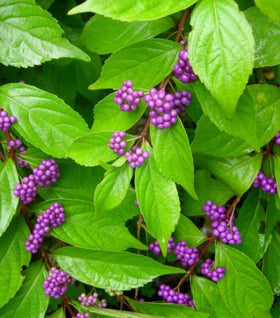
American Beautyberry gives you the classic native look. Its small pink-to-lavender flowers appear from late spring into summer, followed by vivid purple berries beginning in late summer. Those fruit clusters can remain into fall and sometimes early winter until birds and other wildlife begin removing them.
Early Amethyst lives up to its name by developing its purple fruit earlier in the season. Its arching branches and roughly 3- to 4-foot height make it easier to fit into a residential border than some larger Beautyberries. The glossy berries develop along the stems, creating a strong late-summer-to-fall display.
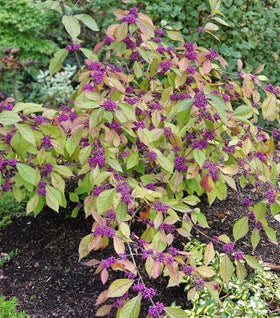
Profusion is a larger-growing Beautyberry with an upright-to-rounded habit and a heavy crop of violet-purple berries. New foliage can show bronze tones, the small flowers are pale pink to lilac, and the mature fruit becomes the dominant ornamental feature in fall.
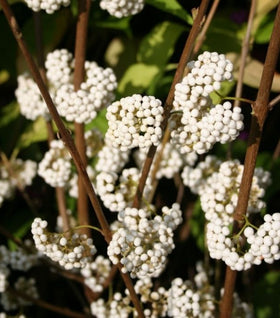
Snow Star offers something completely different. Instead of purple, its branches develop dense clusters of pearl-white berries. Once the yellowing foliage begins to fall away, those pale fruits become even more visible against the bare stems. It is an excellent choice when you want Beautyberry's unusual fruiting habit without adding another purple accent to the landscape.
Choose native purple, early amethyst, or pearl white.
American Beautyberry typically reaches 3 to 6 feet tall and wide in garden settings, though it can grow larger under ideal conditions. It develops an open, arching form rather than a stiff formal outline, which makes it especially well suited to native borders, naturalized plantings, woodland edges, and informal shrub groups.
Early Amethyst stays somewhat more compact at roughly 3 to 4 feet tall and 4 to 5 feet wide. Its long stems arch outward as they mature, giving the shrub a graceful fountain-like appearance. That smaller size makes it easier to use near foundations, in mixed borders, or as a loose low hedge.
Profusion generally reaches around 4 to 6 feet tall and wide in the current assortment, although its parent species can grow larger. It develops enough size to stand alone as a specimen, but also works well when grouped with other shrubs, where the fall berries can become part of a larger seasonal display.
Snow Star usually reaches approximately 4 to 6 feet tall and 4 to 5 feet wide. Its branching is more upright and densely rounded, giving it a somewhat tidier appearance than the looser arching habit of some Beautyberries. That shape works particularly well in foundation beds and more designed mixed borders.
Beautyberries are deciduous shrubs, so they lose their leaves in fall. That is actually an advantage when fruit is the main feature. As foliage drops, the berries become increasingly visible along the exposed stems, extending the display after many other shrubs have finished their season.
Growth is generally moderate to fast once established. Because flowers and berries form on new growth, even shrubs cut back substantially during late winter can rebuild quickly enough to flower and fruit during the same growing season.
Give Beautyberry sun for the biggest berry display.
Most Beautyberries perform in full sun to part shade, but stronger sunlight generally means denser growth, more flowers, and a heavier berry crop. Plants grown in too much shade may become looser or leggier and usually produce fewer fruits.
American Beautyberry is particularly adaptable. It handles clay, loam, sand, acidic or alkaline conditions, and both moderately moist and occasionally dry soil when drainage is adequate. That adaptability makes it useful in naturalized areas and difficult mixed borders where conditions are not perfectly uniform.
Early Amethyst also performs best in full sun to light shade with average, well-drained soil. It appreciates regular watering while establishing and develops useful drought tolerance later. In colder parts of its range, stems may die back during winter, but because flowering and fruiting occur on new growth, plants can still produce berries the following season.
Profusion prefers full sun for maximum berry production but tolerates partial shade. Give it well-drained soil and enough room for its broader mature frame. Planting Beautyberries in small groups can improve pollination and fruit set on some species and cultivars, particularly where you want the heaviest possible fall display.
Snow Star is listed as capable of producing berries without a separate pollinator, making it easier to use as a single specimen. It still benefits from strong light, appropriate moisture during establishment, and a site where its white berries are clearly visible in autumn.
Spacing should reflect the mature variety. Early Amethyst generally needs about 4 to 5 feet of width, Snow Star approximately 4 to 5 feet, and American Beautyberry roughly 3 to 6 feet or more depending on how naturally you want it to grow. Profusion should also be given about 4 to 6 feet in residential landscapes. Wider spacing lets the arching stems develop naturally and improves airflow.
Use Beautyberry in mixed shrub borders, native gardens, wildlife gardens, woodland edges, foundation beds, informal hedges, naturalized areas, pollinator gardens, and fall-interest plantings. It is especially effective when people can see the berry-laden stems up close rather than when the shrub is hidden deep in the back of a planting.
Prune in late winter and let the new growth carry the show.
Beautyberry is one of the easier berry-producing shrubs to prune because the flowers and fruit form on new wood. Late winter to early spring is the best time for major pruning, before fresh growth becomes active. This lets you reshape the shrub without removing the coming season's berry display.
How hard you prune depends on the look you want. If you prefer a compact, bushier plant, established Beautyberries can be cut back substantially in late winter. American Beautyberry and Early Amethyst respond particularly well to rejuvenation pruning. Fresh shoots grow quickly, then flower and fruit later in the same year.
If you prefer the shrub's natural arching shape, prune more selectively. Remove dead, weak, crossing, or older stems near the base and allow the strongest branches to remain. Avoid shearing Beautyberry repeatedly during spring and summer because trimming off new flowering growth can reduce the fall berry crop.
Water consistently during establishment. Once rooted in, many Beautyberries tolerate periodic dry weather, but occasional deep watering during extended drought helps maintain healthy foliage and supports flowering and fruit development. Keep the root zone mulched to conserve moisture while leaving the base of the stems uncovered.
Fertilizer requirements are modest. Compost or a light application of balanced slow-release shrub fertilizer in early spring is generally sufficient where soil needs additional fertility. Heavy nitrogen feeding can create excessive leafy growth without giving you a better berry display.
Beautyberries usually have few serious pest or disease problems. American Beautyberry is considered especially trouble-free, though caterpillars may occasionally chew foliage. Other Callicarpa species can experience leaf spots, stem diseases, or black mold under some conditions. Good airflow and sensible watering help reduce disease pressure.
Deer resistance varies more than simple plant lists sometimes suggest. Some Beautyberries are described as rarely damaged, but deer are also known to browse American Beautyberry foliage and fruit. I would treat the group as moderately browse resistant rather than deer-proof, especially where deer pressure is heavy.
Birds are one of the biggest reasons to plant Beautyberry. American Beautyberry fruit is eaten by robins, thrashers, finches, towhees, and other songbirds, along with several small mammals. The summer flowers also attract bees and butterflies. Planting Beautyberry with other native and wildlife-friendly shrubs can extend food and habitat value deeper into the season.
Not every Beautyberry in this collection is native to North America. American Beautyberry is native to the central and southeastern United States, while Early Amethyst is from the Asian species Callicarpa dichotoma, and Profusion is from Callicarpa bodinieri. This distinction matters if your primary goal is creating a strictly native landscape.