
Amsonia Plants for Blue Spring Flowers & Golden Fall Color
Soft spring blue, airy texture, and glowing fall color in one easy perennial.
Amsonia (bluestar) is one of those plants that doesn’t scream for attention, then suddenly your border looks calmer, more intentional, and more “designed.” In late spring to early summer, it blooms with clusters of pale blue, starry flowers that feel fresh and natural instead of fussy, and the plant settles into a shrub-like clump that holds the middle of a bed beautifully. What really wins people over, though, is the long game: many amsonias turn a rich golden yellow in fall, giving you a second season of interest without replanting a thing. It’s the kind of perennial that makes landscapes look mature, especially when you repeat it in drifts and let the fine foliage create that soft, airy movement around bolder blooms and evergreens.
For performance, think “sun + average soil + patience,” and you’re 90% of the way there. Most amsonias do best in full sun but tolerate partial shade; too much shade can lead to flopping, which is easy to prevent by cutting plants back after flowering to encourage a tighter, bushier habit. The care is refreshingly straightforward: steady water while establishing, then a lighter hand once roots are in, and a simple late-winter/early-spring cleanup before new growth. One practical caution: when you cut or break stems, some types exude a milky sap that can irritate skin, so gloves are a smart move. With the We Grow Together Promise behind you, this is a “plant it once, enjoy it for years” perennial that earns trust season after season.

Hubricht’s Bluestar (Amsonia hubrichtii)
As Low As $29.95
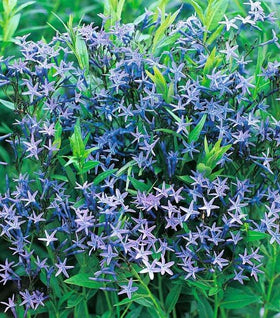
Calm blue blooms, legendary fall color.
Amsonia is a rare “two-season star” that earns its keep in spring and again in fall. In late spring to early summer, you’ll get those soft blue flowers that read as natural and upscale, perfect for homeowners who want color that feels timeless, not trendy. Then, as the season turns, many amsonias shift to bright golden fall foliage, giving your beds a warm glow as summer bloomers start to fade. If you’re building a landscape that feels complete across seasons, this plant makes it easier without adding maintenance.
This collection can include different Bluestar species and selections, which matters because it lets you match the look to the job. Some forms have finer, threadlike foliage for a feathery, almost ornamental-grass effect, while others have broader leaves and a more classic, clumping perennial silhouette. Either way, the habit is typically upright and shrub-like, which is ideal for creating a “middle layer” in borders—tall enough to be seen, but not so tall that it blocks windows or sightlines.
Design-wise, Amsonia is a connector plant. Use it to soften the transition between bolder shapes (such as hydrangea mounds or evergreen forms) and finer textures (such as grasses and airy bloomers). It also looks fantastic in repetition, three, five, seven plants, because the foliage reads like a single, intentional brushstroke through the bed. The result is a border that feels cohesive, even when you mix lots of different plants.
Feathery texture and shrub-like form.
Most amsonias form a sturdy clump that gradually gets fuller over time rather than racing around the garden. Many popular landscape forms land in a planning-friendly size range, often about 2–3 feet tall and 2–3 feet wide, so you can use them in foundation beds, mixed borders, and island plantings without worrying they’ll outgrow the space in a hurry. That steady, predictable growth is exactly what makes amsonia a favorite for “set it and forget it” planting plans.
Bloom timing is another reason this plant is so easy to design with. You can expect spring bloom, often April into May for some types, and late spring into early summer more broadly, so it pairs naturally with early-season companions and bridges the gap between bulbs and summer perennials. The flowers aren’t oversized or heavy; they’re refined and plentiful enough to create a gentle haze of color that looks great up close and from the street.
After bloom, the foliage becomes the main event. Fine-leaved types create a soft, airy mass that moves in the breeze and makes nearby colors look richer, while broader-leaved types stay clean and architectural through summer. And then fall arrives: many amsonias turn a strong golden yellow, adding a dependable autumn moment that doesn’t rely on flowers at all, just great foliage performance.
Best spots for bluestar success.
For the strongest flowering and best fall color, plant amsonia in full sun when you can, while knowing that partial shade can work, especially if you’re aiming for a slightly looser, woodland-edge feel. The tradeoff is form: too much shade can make plants open up and flop. The easy fix is placement (more sun) and a post-bloom cutback that encourages bushier regrowth.
Soil-wise, Amsonia is pleasantly adaptable. Many types prefer moist, well-drained soils but can tolerate average garden soil and adapt to clay and sandy conditions when drainage is reasonable. That adaptability makes it useful in “real yards,” not just perfect beds, especially when you’re building mixed borders, meadow-style plantings, or naturalistic designs that don’t get pampered.
For spacing, think in terms of the mature clump. A practical range is about 24–36 inches between plants for many common forms, which gives each clump room to fill out while still creating a cohesive drift over time. That spacing also improves airflow—helpful in humid climates, and makes it easier to access plants for a quick post-bloom trim if you want the tightest, cleanest habit.
Low-fuss care, year after year.
Amsonia doesn’t ask for much, but it loves smart timing. Water consistently during the first growing season to establish a strong root system, then shift to occasional deep watering during extended dry spells (site dependent). Avoid over-fertilizing; overly rich soil can encourage softer, floppier growth, especially in partial shade, while average fertility supports sturdier stems and a more natural, self-supporting shape.
Pruning is where you get to choose your “look.” If you want the tidiest, most compact clump, many guides recommend cutting back after flowering, often by about one-third (or more, depending on goals), to reduce flop and promote bushier regrowth. Then, in late winter or early spring, cut dormant stems back to the ground to make way for clean new growth. That simple routine keeps amsonia looking sharp with very little annual effort.
Pests and diseases are typically low-pressure for amsonia, which is a big part of its “trust factor.” When problems do show up, they’re often tied to site conditions, too much shade, too-rich soil, or not enough airflow, rather than constant pest battles. One important caution: some types have a milky sap that can irritate skin, so wear gloves when cutting back or dividing. If clumps ever get crowded or you want more plants, division in spring (or fall in some climates) can refresh vigor and expand your planting.